
Assigning Party members to be in charge of household groups in Con Cuong: Difficulties
(Baonghean)Con Cuong is the first unit in the province to implement the model of assigning Party members to be responsible for groups of households. This is considered one of the important solutions to strengthen the role of Party branches and link the responsibility of Party members with the community at the grassroots level. Initially, this model has yielded positive results; however, there are still many concerns and challenges in practice.
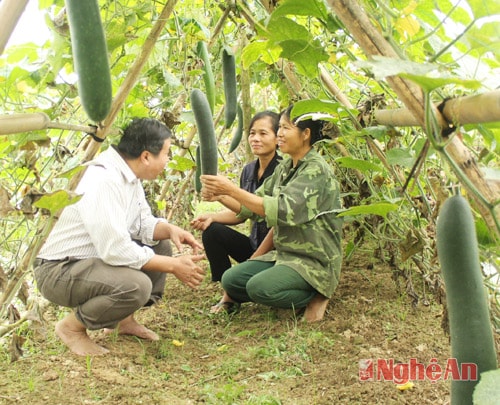 |
| This is the model of growing green squash commercially by the family of Ms. Vi Thi Nguyet in Thai Son 2 village (Mon Son, Con Cuong). |
Following the directives of the Con Cuong District Party Committee, all 132 rural Party branches (out of a total of 241 branches in the district) in 13 communes and towns within Con Cuong have assigned Party members to be responsible for households and groups of households. Accordingly, these assigned Party members actively coordinate with organizations and associations to mobilize the people to effectively implement the Party's policies and resolutions, and the laws of the State; focusing on developing production, ensuring social security and order, and building a prosperous and happy life.
Over the years, the Party Committee of Mon Son commune has been recognized by the Con Cuong District Party Committee as a grassroots party organization that has achieved many results in assigning party members to oversee groups of households. The commune has 21 party branches with 320 party members, including 14 village/hamlet party branches with 201 members. Implementing this policy, the commune Party Committee assigned members of the Standing Committee to directly visit the party branches to guide and suggest solutions to issues directly related to each village/hamlet. During the implementation process, the party branches developed action plans tailored to their specific circumstances. To effectively carry out the task of overseeing groups of households, the Thai Son 2 village party branch reviewed and assessed the qualifications, capabilities, and specific conditions of 24 party members and assigned them to support 157 families in 12 residential groups. Over the past two years, party members have diligently monitored the situation in their respective residential groups, maintained and developed economic models, and contributed to ensuring security and order in the area.
Thanks to these efforts, concentrated vegetable and fruit farming models, mushroom cultivation, and commercial livestock farming have been established, contributing to increased income for the villagers. A special feature of this Party branch is the weekly Monday morning flag-raising ceremony at the community center; quarterly meetings are held with the participation of all family members. As a result, all policies and guidelines are communicated to everyone, and all initiated movements are actively supported. Currently, two out of twelve residential groups in the village, groups 6 and 12, do not have Party members, but the Party branch has assigned four Party members from groups 1 and 11 to take charge and serve as deputy group leaders. Therefore, all residential groups now have Party members in charge, gradually contributing to positive results and building a more prosperous village.
However, successful models of Party members taking charge of household groups, such as the one in Thai Son 2 village in Con Cuong district, are still rare. The main problem is that most rural Party branches in mountainous areas have a small number of members, while the number of households is large and scattered; in many branches, Party members are elderly and in poor health, while the younger members often work far away. Even in Mon Son commune, which is considered to have achieved success in implementing the model of Party members taking charge of household groups, there are still many difficulties. This is especially true in remote and isolated branches such as Khe Bung and Co Phat villages, located over 40 km from the commune center, accessible only by boat. The number of Party members is only 6-7, while the number of households exceeds 100, and poverty persists in these unique areas.
In particular, some Party members are from impoverished households, making the assignment of responsibility for groups of households an "impossible" task. According to statistics from the Mon Son Commune Party Committee, there are currently 20 Party members from impoverished households in the commune. This is also a matter of concern. Comrade Vi Van Tu, Deputy Secretary of the Commune Party Committee, said: "Given this reality, the Commune Party Committee directs the Party branches to closely monitor the situation to assign Party members to be responsible for groups of households in a reasonable manner. In difficult areas, we direct the process step by step, based on promoting the responsibility of Party members, demonstrating exemplary conduct, sharing with the community, and focusing on helping Party members who are in poverty to escape poverty sustainably…"
Similarly, in Binh Chuan commune, across 8 village Party branches, there are 14 Party members who are classified as poor households. Difficulties are compounded by the commune's geographical isolation, the economy in some villages depending on limited arable land, underdeveloped livestock farming, and the high poverty rate across the commune (over 64%). In this context, even the Party members themselves are struggling to escape poverty. Addressing this issue, Comrade Kha Van Duyen, Secretary of the Tong village Party branch, where 12 Party members are poor, confided: “Indeed, achieving sustainable poverty alleviation is a major undertaking for some Party members. This is not to mention the 62 poor households in the village. Therefore, implementing the policy of assigning Party members to oversee groups of households has presented many challenges…” Comrade Luong Van Toan, in charge of Party work in Binh Chuan commune, acknowledged: "The policy of assigning Party members to be in charge of groups of households has been implemented in the Party branches, but it has not been effective. The work has only been general in terms of carrying out the task of disseminating information and mobilizing people to comply with the policies and laws of the Party and the State..."
According to statistics from the Con Cuong District Party Committee's Organization Department, to date, the entire district has 172 Party members from impoverished households. Many communes have a large number of impoverished Party members, such as Luc Da (28 members), Chau Khe (25 members), Thach Ngan (20 members), and Binh Chuan, Don Phuc, and Cam Lam communes, each with 14 to 18 impoverished Party members. In reality, Party members who are also from impoverished households not only lack the ability to help other poor households but also certainly lack the ripple effect, leading to ineffective propaganda and mass mobilization efforts. Addressing this issue, Comrade Vi Xuan Giap - Secretary of the Con Cuong District Party Committee - frankly acknowledged: “If a Party member is classified as a poor household, who can they tell off? We are compiling and analyzing comprehensively and clearly the cases of Party members classified as poor, and then assigning responsibility to Party branches and associations to help these comrades escape poverty sustainably. Only by doing so can we replicate the models of assigning Party members to be responsible for groups of households…”.
Faced with the inherent difficulties of the Party branches, the Con Cuong District Party Committee is directing its subordinate Party committees not to divide the total number of households in each village by the number of Party members in charge of the branch, but rather to base assignments on the actual capacity of the Party members. One Party member can be assigned to be in charge of one household or a group of households. A current advantage in rural Party branches is the addition of Party members who are officials and civil servants from the communes, following the dissolution of Party branches in wards, communes, and towns. This group can effectively fulfill their responsibilities in closely understanding the thoughts and aspirations of households, enabling them to work with the Party branch to develop plans to "leverage strengths and overcome weaknesses" at the grassroots level. This will support the people in boosting production and livestock farming, increasing income, stabilizing the situation, and ensuring good security and order in each residential area.
Nguyen Son


