
Student streaming in junior high schools: Open but not yet "effective"?
(Baonghean) - On average, our province has more than 50,000 students graduating from junior high school each year, some of whom, due to lack of ability or unfavorable circumstances, do not continue their education at high school. The education sector has also adopted a policy of streaming these students, but the issue of "post-streaming" still faces many obstacles...
Since 2001, the Prime Minister approved the Education Development Strategy from 2001 to 2010, which specifically outlined the requirements for student streaming after lower secondary education. In our province, one of the pioneers in establishing vocational secondary schools to accept lower secondary school graduates was Mr. Le Van Phot, former Principal of Hong Lam Private Economic and Technical Vocational School. In 2006, he was very enthusiastic about this project because, with just 3.5 years of study—including one year of general education at Continuing Education Centers and more than two years of vocational training—students could obtain a high school diploma and a vocational certificate without needing to complete upper secondary education. This model received support from the Ministry of Education and Training, and in the first two years, nearly 1,500 students enrolled. However, to date, the model has not achieved the desired results. He stated: "Vocational schools are currently struggling to operate because they cannot recruit enough students. When guiding students through the educational pathways, these schools haven't done a good job of providing career guidance and orientation to help them choose a profession. Students are still competing to get into high schools, colleges, and universities, even though job opportunities after graduation are very limited."
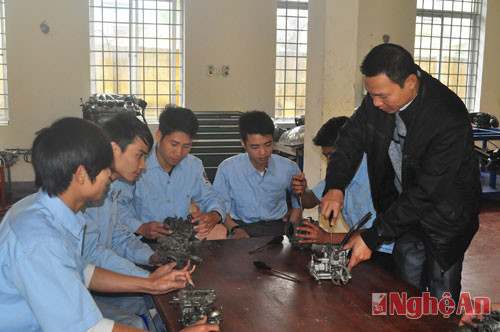 |
| Automotive Technology Vocational Training Class, Vocational College No. 4, Ministry of National Defence. |
According to the education sector's objectives, approximately 30% of junior high school graduates should be directed to vocational schools each year, while the remaining 70% should enter 10th grade in high schools. However, according to data provided by the Secondary Education Department of the Provincial Department of Education and Training, less than 10% of junior high school graduates participate in vocational training. For example, in the 2009-2010 school year, Nghe An province had 58,937 junior high school graduates, but only 42,971 entered high school, 4,088 entered supplementary education programs, and only 782 entered vocational colleges. In the 2010-2011 school year, there were over 51,000 junior high school graduates, but only over 42,000 entered high school, 3,081 entered supplementary education programs, and 164 entered vocational colleges. In the 2011-2012 school year, there were 58,000 students out of 47,104... Mr. Nguyen Viet Xuan - Principal of Quynh Di Secondary School, Hoang Mai Town, said: Each year, the school has about 100 students graduating, but most go on to high schools. About 10% who don't meet the requirements attend supplementary classes, and more than half of the rest drop out to follow their parents to work at sea, rather than pursuing vocational training at secondary schools.
Explaining this issue, Mr. Xuan said: Junior high school students are too young when they graduate, at only 15 or 16 years old. Parents are not comfortable sending their children to study far away, so even if their children don't pass the entrance exam to a public high school, they try to send them to a private school, at least where there are teachers to supervise them. If they pursue vocational training, it's difficult to find a job because they lack experience, and few organizations will hire them. Agreeing with the above opinion, Mr. Vo Van Mai, Head of the Secondary Education Department of the Department of Education and Training, added: “There are five reasons why the current vocational guidance system is ineffective: Firstly, due to the mentality of people who are obsessed with diplomas, still wanting their children to go to high school to at least get a high school diploma, especially when the 'door' to private high schools is so easy now. Secondly, the current vocational guidance system in junior high schools is ineffective; the staff responsible for vocational guidance are not well-trained and mainly perform this work as a side job, so they do not focus on career counseling for students. In addition, due to the scale and conditions of vocational training facilities not meeting teaching requirements, vocational training is not closely aligned with reality, many students still face difficulties after graduation, and there is no policy for junior high school students after vocational training… Therefore, the situation arises where students, after graduating from junior high school, determine that their academic ability is average or weak, so they do not apply to take the entrance exam to high school. But the number These students also didn't attend vocational schools (or didn't know where to study, what to study, or why), so they ended up dropping out midway through their studies.
So, should secondary school students be streamed into different educational paths? Having taught at a Continuing Education Center for over 20 years and now serving as the principal of Quynh Di Secondary School, Mr. Nguyen Viet Xuan believes that if implemented correctly, streaming should be encouraged. The lack lies in the mechanisms and conditions necessary for students to study and find employment after graduation. He cited examples of many students in Quynh Di who, due to limited abilities, initially attended supplementary education but later achieved success and secured good jobs through perseverance. For instance, Mr. Ho Phi Xuan, who previously studied construction, is now the director of a private construction company. Mr. Ho Phi Duoc, after studying at the Vietnam-Korea College, went to work in South Korea and is now financially well-off. Conversely, also in Quynh Di, because there were people in the village working in the mining industry, students in the village competed to attend the University of Mining and Geology; some even paid tuition fees to transfer to the Mining University. But now, due to changing circumstances, these people have precarious jobs or are unable to find work.
Vocational College No. 4, under the Ministry of National Defense, is one of the few schools in the province that still maintains enrollment classes for students who have just graduated from junior high school. Major Nguyen Anh Tuan, Head of the Basic Sciences Department, affirmed: The policy of educational streaming is correct because it shortens training time and saves costs for families and society. Moreover, this policy now has many "open directions" to create favorable conditions for students. Students no longer need to attend an additional year of general education classes before vocational training as before, because according to Regulation 02 of the Ministry of Education and Training, the Education Law, and the Vocational Training Law: Students who graduate from junior high school, when studying at vocational schools, if they still ensure sufficient time for general education subjects, only need two years of study to obtain both a vocational diploma and a high school diploma; they can also pursue higher education at college or university if they wish. Furthermore, at this time, not only demobilized soldiers but also civilians are exempt from vocational training fees and general education fees (according to the province's vocational training policy), so students receive all kinds of preferential treatment when pursuing vocational training.
According to a survey by the Department of Education and Training, our province currently has nearly 12,000 master's and bachelor's degree holders and graduates from universities and colleges who have not yet found employment. Meanwhile, the percentage of skilled workers in the province is only about 40%. To solve the problem of "too many teachers, too few skilled workers," it is necessary to review the career guidance policy that our province has implemented in recent years. We should organize forums for teachers to exchange ideas on career choices, school choices, and the chances of admission to universities and colleges for students. The Department of Labor and Social Affairs needs to guide and assign vocational colleges, secondary schools, and training centers to innovate their training methods, focusing on professions that are experiencing labor shortages and those that society needs. Finally, parents and families must change their mindset, not placing too much emphasis on academic qualifications, and providing guidance and support to help their children choose a path that suits their abilities and the family's economic conditions.
Text and photos:My Ha


