
Phan Sào Nam believed that the online gambling business was protected by the police.
Phan Sào Nam asserted that the greatest value of cooperating with CNC was that it was a front company for the police.
On the afternoon of November 17th, after nearly a week of deliberation, the panel of judges questioned the defendant Phan Sào Nam (39 years old, Chairman of the Board of Directors and Director of VTC Online Joint Stock Company) about his criminal conduct.
Our ambition is to be a pioneer in developing online card games.
Dressed in a white shirt, dark jeans, and neatly rolled-up sleeves, Nam calmly stated that he had no close family ties to Nguyen Van Duong (Chairman of the Board of Directors of CNC), only knowing him through a casual social connection since 2015. Regarding Hoang Thanh Trung (currently at large), Nam admitted to a five-year working relationship with him at VTC Corporation.
|
Phan Sao Nam - one of the three masterminds of the online gambling ring worth tens of trillions of VND.Photo taken on the afternoon of November 17th: Pham Du |

Nam had long heard that CNC was a front company for the police. When he met Duong, this was confirmed to him. Given VTC Online's long history in technology and internet business, Nam and Duong discussed plans to develop their business in this field.
Trung then met with Nam to discuss developing card games. However, according to Nam, obtaining game licenses in 2014-2015 was quite difficult. When he met with Duong, the defendant said he could do it in the role of publisher. From then on, the three collaborated.
At Nam Viet Company, Trung was in charge of the Hanoi branch, which licensed the software to VTC Online, and VTC Online then licensed it to CNC to distribute the game in Vietnam. Both Nam and Duong hoped to be pioneers in developing online card games.
During his time working with CNC, Nam realized the game was not yet licensed. "Why did you cooperate even though you knew licensing was difficult and it wasn't licensed?" the judge asked. Nam requested permission from the court to elaborate further.
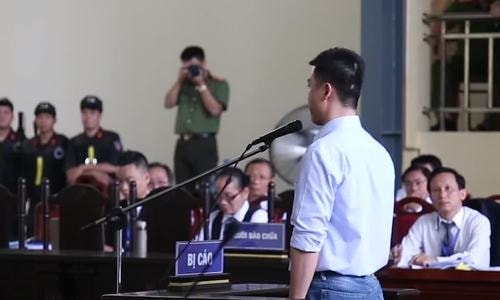
Phan Sào Nam spoke about CNC being a front company for C50.
When Phan Sào Nam returned, he learned that CNC was a front company for the police.
Accordingly, Nam was told by Duong that CNC was a front company that engaged in both economic activities and external intelligence gathering. As soon as Nam finished saying this, the presiding judge asked Officer Duong to leave the isolation room to listen.
Continuing his testimony, Nam stated that upon hearing Duong's explanation, he understood that even without a license, the Ministry of Public Security might have a mechanism to allow the company to operate without outsiders knowing. Therefore, the two companies had a formal contract, and Nam confidently proceeded with developing the game.
"In the collaboration between VTC Online and CNC, the greatest value lies in the fact that CNC is a front company for the police," Nam said.
|
Defendant Nguyen Van Duong, former chairman of CNC.Photo: Pham Du |

Nam stated that the initial phase of preparing the server infrastructure was handled by VTC Online. In the first phase, the game was called Rikvip, and in the second phase, it was changed to Tipclub. Nam said the reason for the change was unclear, but it was Duong's wish, and the service was essentially the same.
Explaining to the prosecutor, Nam stated that the Rikvip/TipClub card game has five payment methods: telecommunications card top-up, bank transfer, Gocoin, Vcard, and Mycard international payment. Nam had never tried playing Rikvip before, so he was unsure about the specifics of how to top up his account.
During the contract execution process with CNC, when connecting the game system, the two parties had to exchange a lot of information, including the IP address of the server. The prosecutor asked Nam to look at the screen. The projector highlighted several IP addresses allegedly given to CNC by VTC Online. Nam confirmed that these two IP addresses were indeed given.
In the first phase, Nam claimed that the revenue from operating the game was fully accounted for by VTC Online, totaling over 2,000 billion VND. In the second phase, Nam claimed that the revenue from operating the game was no longer accounted for by the legal entity.
Many agencies conducted inspections, but no one took any action.
During the interrogation this afternoon, Nam also stated that during the game's operation, several authorities, including the Ministry of Information and Communications and PC50 Hanoi, had inspected the system.
According to Nam,The authorities were aware of the release, and the company itself submitted a full report, but no action was taken. Therefore, the defendant firmly believed the defendant Duong's claim that the game was in testing and that it would later be officially licensed.
In the first phase, from April 2015 to August 2016, CNC signed a contract with VTC Online and performed its duties well. From Nam's perspective, CNC was very confident, and Duong was also confident, currently in discussions with relevant authorities to obtain a license.
In the second phase, according to Nam, Duong no longer used the CNC legal entity to operate the gambling system but used several other legal entities. However, Nam argued that the tasks that Duong represented were all carried out in accordance with the initial agreement.
Nam recalled that around August 2016, Duong had discussed the sensitive issue of CNC being a front company and wanted to "arrange things a bit to make it less sensitive." "I didn't feel comfortable asking how sensitive it was, because I knew it was classified information related to the Ministry of Public Security," Nam said.
The presiding judge asked, "Why weren't you punished when the authorities inspected you?" Nam said he didn't know, but he had discussed it with Duong during all the inspections. At those times, Duong said, "I will handle it and work with those agencies." Behind him, Duong intently watched Nam's testimony.
Nam also asserted that if the authorities had warned about the game's lack of a license during the initial inspection phase, the consequences of today's case would not have occurred.
Deposited $3.5 million in a bank account in Singapore.
While explaining and pondering, Nam explained that the game had a reward-based system, so the majority of the revenue, over 9,500 billion VND in nearly 30 months of operation, was used to reward players. Nam received the money to cover the costs of operating the hardware and software versions, but he did not directly manage the technical aspects; instead, he worked through a colleague, Hoang Thanh Trung, so he was unaware of the exact costs and only transferred the money as requested.
During more than two years of running the online gambling business, Nam claimed to have received 1.475 billion VND. Nam stated that he kept most of this money in cash, and invested some in establishing new companies, business ventures, and real estate.
The presiding judge asked him to explain how he used the money. Nam stated specifically, as in the indictment, that he transferred money to relatives and friends for safekeeping (his aunt, friends named Hung and Nhung), and invested it in digital content production companies, payment software industries, and tourism businesses. He transferred 236 billion VND to his aunt for safekeeping, with the intention of investing it for profit. When he entrusted the money to his friends, Nam did not disclose the source of the funds.
During the investigation phase, Nam confessed to paying 1.088 billion VND in cash to the investigating agency. The total assets recovered from Nam amounted to over 1.300 billion VND, equivalent to 90.7% of the illicit gains. Nam stated that he repaid this amount immediately after being detained for about a month, upon realizing his mistake. He also said that now that he understands his wrongdoing, he hopes that those who are currently on the run, who are also his close friends, will return to acknowledge their wrongdoing. After hearing Nam's statement, the Procuratorate assessed that Nam had actively cooperated with the investigating agency in mitigating the consequences.
With $3.5 million currently in Singapore, Nam claimed he lent it to a friend in Vietnamese Dong. However, that friend later repaid him in Singapore in USD through an account in Singapore. "There was no cross-border money transfer," Nam said.
Phan Sào Nam hopes those who are on the run will return.
The prosecutor then asked Nam to look at the screen. The projector displayed the minutes of the meeting with the prosecutor and investigator regarding the frozen assets. Nam said he believed the prosecutor's verification of the figures was correct.
In response to the lawyer's question, "Some people say Phan Sao Nam must be mentally ill to recover such a large sum of money. What do you think?", Nam replied, "That's a large sum of money, so saying it was recovered with a snap of the fingers isn't accurate. However, after working with the investigating agency for over a month, I realized my mistake. With the support of the investigating agency, I recovered the money in just over two weeks, which was less than two months since I turned myself in."
Nam also promised that during the period of serving his sentence and afterward, if he has the opportunity to work and contribute to society, he will help to mitigate the consequences of his actions.
"There was a time when the defendant went into hiding and was wanted. Why did he flee when he knew there was an investigation?" the panel of judges further inquired. Nam explained that he was on business trips abroad and did not receive information about the indictment or the arrest warrant. However, during that time, he heard about the case in Vietnam.
"It was a shock, and I wanted to reflect on the past. I had no prior legal experience and didn't know what prosecution, investigation, or arrest warrants were like, so I wanted to be alone to think things over before returning to my country," Nam testified.
The lawyer cited that on November 8, 2017, Nam had written a letter requesting...perform meritorious serviceatonementThe request included asking the investigating agency to facilitate contact with friends and colleagues such as Hoang Thanh Trung, Le Van Kien, and Phan Anh Tuan, to persuade them to cooperate with the investigation and to ask, "Why did you have that idea?"
Nam replied that, at that time and even now, he is aware that what he did was wrong. The other defendants should also realize that their actions were wrong and should quickly return to cooperate with the investigating authorities, resolve the case, and mitigate the consequences as soon as possible.
|
The court proceedings will resume on Monday, November 19th.Photo: Pham Du |

The game generated nearly 10 trillion VND in revenue in just 27 months of operation.
According to the case file, in 2014 Phan Sào Nam met Hoàng Thành Trung (currently at large, former director of the software center – VTC Technology and Digital Content Company - VTC Intecom) and Trung boasted about owning software and a skilled technical team that could develop and operate an online gambling software system in the form of card games.
Trung requested to borrow a legal entity to develop and operate an online gambling software. In response, Nam contacted Do Bich Thuy (owner of Nam Viet Housing and Land Development Company Limited) and they immediately opened a representative office in Hanoi, giving Trung full authority to manage it.
Knowing that the High-Tech Security Development Investment Company Limited (CNC) was a front company for C50 (the Department of Police for Combating High-Tech Crimes, General Department of Police), Nam invited Nguyen Van Duong (Chairman of CNC) to cooperate in releasing online gambling software, and Duong agreed.
In early April 2015, Duong instructed his subordinate, Luu Thi Hong (General Director of CNC), to sign a contract with Nam to provide software services and technology solutions for the commercial exploitation of online card games under the name RikVip.
After signing a contract with CNC company, Nam instructed Phan Anh Tuan (Deputy Director of Technology at VTC Online) to purchase equipment and sign a contract to rent server space in Cau Giay district. Tuan and other technical staff from VTC Online then set up a system of 262 machines for the RikVip online gambling game to operate.
In mid-April 2015, Hoang Thanh Trung completed the software and began organizing online gambling.
From April 19, 2015 to August 29, 2017, a total of nearly 43 million game accounts were registered. On August 9, 2016, there were over 18 million game accounts with real players, of which nearly 300,000 accounts included phone numbers. 500 of these accounts had single bets of 6 million Rik (equivalent to 5 million VND).
Authorities estimate that the total amount of money deposited into the Rikvip, 23Zdo, and Zon/Pen online gambling systems operated by Nguyen Van Duong and his accomplices was nearly 10,000 billion VND. This figure is incomplete as data from June 24, 2017, to August 29, 2018, is unavailable.
Of the 10 trillion VND, 8.8 trillion VND was used for gambling via telecommunication cards and game cards. After deducting investment and operating costs, the ring profited 4.7 trillion VND. Of this amount, defendant Phan Sào Nam received nearly 1.5 trillion VND, Nguyễn Văn Dương pocketed over 1.65 trillion VND, and the group including Phan Anh Tuấn, Hoàng Thành Trung, and Lê Văn Kiên (currently fugitives) received over 1.57 trillion VND.
Bao Ha - Pham Du


