
France does not rule out the possibility of a technical malfunction at Germanwings.
The head of the French investigation agency has not ruled out the possibility that the Germanwings plane experienced a technical malfunction when it crashed in the Alps.
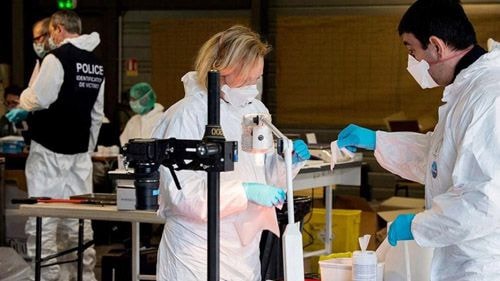 |
| Inside the DNA testing room near the Germanwings accident site. Photo: AFP. |
Jean Pierre Michel, head of the French investigation, said that some technical details to determine exactly what happened to the Airbus A320 are still missing. Therefore, "at this time, we cannot rule out the possibility of a technical malfunction," he said.
Responding to a reporter's question about information suggesting Lubitz might have a mental illness, he said, "The data from the investigation is confidential; we cannot address those issues today," and that he could not rule out any scenario of an accident.
“We have certain elements that allow us to pursue this lead, a serious lead, but not the only one,” Michel said. But so far, the investigation has not uncovered any “special clues” about co-pilot Lubtiz’s life that would explain his actions on the ill-fated Airbus.
Mr. Michel provided this information as French rescue teams continued searching for data in the second black box, which recorded the flight path. The black box casing was found on March 26th; however, the memory card containing data on altitude, speed, location, and the aircraft's status remains missing, possibly having been ejected from the box or destroyed by the impact.
Tom Enders, CEO of Airbus, also expressed his displeasure yesterday, criticizing television shows for making "unfounded, imaginative, and dishonest speculations" about the cause of the plane crash.
The German and European pilots' associations last weekend urged caution in drawing any conclusions about the accident until the second black box is found and the investigation is complete.
Many believe investigators were too hasty in blaming the Germanwings co-pilot for deliberately crashing the plane into the Alps in southeastern France on March 24, killing all 150 people on board.
"We remember the victims of this tragedy, and their families and friends, all of whom are going through a difficult time," read a note left outside St. Peter's Church in Montabaur, co-pilot Lubitz's hometown.
Prosecutor Brice Robin, one of the lead investigators, said the forensic team had identified 78 DNA sequences from body parts scattered across the remote Alps slopes where the Germanwings plane crashed.
He also added that a road leading to the site is being constructed, allowing off-road vehicles to access the area and clear the aircraft wreckage.
According to AFP, approximately 400 to 600 body parts have been identified and are currently being examined.
Most of the body parts were transported by helicopter to a laboratory in Seynes, a town near the accident site, where about 50 forensic and dental doctors, along with police identification specialists, are working.
"We didn't find any intact bodies," said Patric Touron, deputy director of the French police's Institute for Criminal Research. Forensic experts used dental records, DNA samples from family members, fingerprints, jewelry, and even identity cards in the identification process.
"In disasters, typically about 90% of identification is done through dental records," Touron said. Once DNA samples are collected, they are sent to a laboratory on the outskirts of Paris, where they are compared to DNA samples taken from family members.
According to VnExpress
| RELATED NEWS |
|---|


