
Discovery of a potentially oldest copy of the Quran in the world.
Fragments of goat or sheep parchment, hidden in an English library for nearly a century, have just been discovered to be extremely ancient, possibly dating back to the dawn of Islam and written by someone who knew the Prophet.
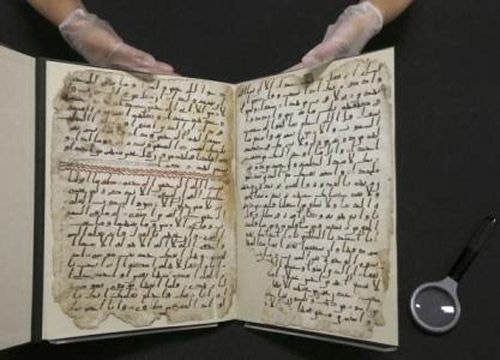 |
| A manuscript of the Quran found in the University of Birmingham library. Photo: Reuters |
For many years, the aforementioned ancient scripture was grouped together with another version written around the end of the 7th century. No one recognized its value until Alba Fedeli, a graduate student, discovered it while researching for her doctoral dissertation.
First, she noticed the calligraphy on the pages. Then Fedeli realized there were two pages that had fallen out of the Quran manuscript she was examining. Comparing the handwriting on these two pages with the handwriting on the rest of the manuscript, she found differences. Immediately, the University of Birmingham sent these two manuscript pages to Oxford University for dating.
On July 24th, they announced the results, stating that this is one of the oldest Islamic texts, and that the person who copied it may even have known the Prophet Mohammad.
According to the New York Times, experts at Oxford University used carbon dating to determine the manuscript, which was made of goat or sheepskin and written between approximately 568 and 645 AD, roughly the same period as the Prophet Mohammad, who is believed to have lived between 570 and 632 AD.
"We were absolutely astonished, utterly surprised," said David Thomas, professor of Islam and Christianity at the University of Birmingham. He believes this discovery will help scientists better understand the formative period of Islam.
"These manuscript pages help us understand how the Quran was once used and written," said Sajjad Rizvi, director of the Institute for Arab and Islamic Studies at the University of Exeter.
This manuscript, estimated to be at least 1,370 years old, comprises chapters 18 to 20, written in Hijazi – an ancient Arabic script – and handwritten with ink. Professor Thomas suggests that the person who transcribed this manuscript may have known the Prophet Mohammad well, possibly having met him and heard him preach.
In the time of the Prophet Mohammad, the sacred teachings given to him were not compiled into a book as they are today. Instead, they were written on parchment scrolls, palm leaves, stone pillars, or camel shoulder blades.
Tom Holland, author of "In the Shadow of the Sword," a book on the origins of Islam, argues that the University of Birmingham's discovery reinforces the view that the Quran was perfected and contained the content it has today since the time of the Prophet Mohammad. However, it does not clarify the questions of how and why the manuscript pages, comprising various chapters, were assembled into a single Quran.
Saud al-Sarhan, director of the Center for Islamic Studies in Riyadh (Saudi Arabia), doubts the age of the manuscript discovered in Birmingham. He argues that the Arabic script used in the manuscript has dots and separate parts, features that only appeared much later.
He also emphasized that the age of the parchment scroll does not prove when the text was written. This is because people usually cleaned and dried animal hides before using them for writing.
However, Jeff Speakman, director of the Center for Applied Isotope Research at the University of Georgia, who was not involved in the study, commented that the dating and accuracy of the text are highly reliable.
"Oxford has one of the world's leading carbon isotope testing facilities," Speakman said. In any case, for the Muslims in Birmingham, this discovery is a great joy.
Mohammad Afzal, chairman of the Birmingham Mosque board, said he was deeply honored and moved to tears to see the sacred text.
"This takes us back to the birth of Islam. All Muslims around the world are eager to see this manuscript."
Professor Thomas said the newly discovered manuscript pages will be displayed to the public in October. He added that Muslims don't actually need any written text to understand or learn more about the Quran, as every word of the holy book has long been passed down orally, memorized, and revered by them.
"For Muslims, the Quran is always at the heart of their thoughts," he said.
According to VnExpress


