
Fossils over 240 million years old discovered in Nghe An.
The Vietnam Museum of Nature has recently received the largest fossilized sea snail ever discovered in the Triassic geological strata of Vietnam.
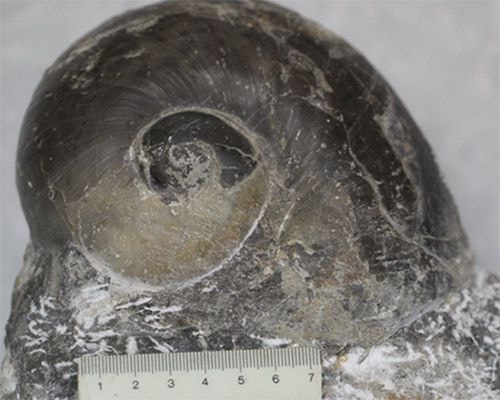 |
| Fossilized gastropods Naticopsis spp., dating back 247.2-242 million years. |
The specimen was collected by Truong Van Dai, 27, a quarry worker in Hoang Mai, residing in Quynh Loc commune (Hoang Mai town, Nghe An province). Seven years ago, while quarrying at Hoang Mai, Dai accidentally saw a broken piece of rock that closely resembled sea snails in shape and color, but much larger in size. Considering it unusual, Dai brought it home to show his family and neighbors.
Like Mr. Dai, the locals didn't understand where the strange rock came from, and it gradually faded into oblivion, even being used as a support for scaffolding at one point. Recently, Mr. Dai shared the story of the rock, which resembles seashells in shape and color, with his friends. They advised him to ask scientists at the Vietnam National Museum of Nature (Vietnam Academy of Science and Technology).
On July 15th, the Director of the Vietnam Museum of Nature, along with scientists from the Geology Department, examined and confirmed that this is a fossil of a species of sea snail. This snail belongs to the Mollusca phylum, Gastropoda class, Naticopsidae family, and Naticopsis genus.
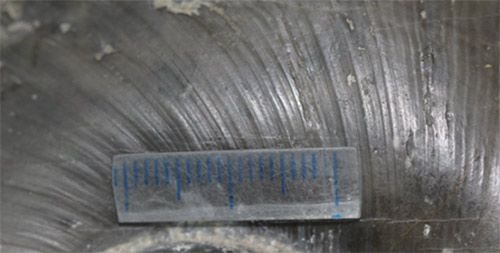 |
| Shell structure of Naticopsis spp. |
The collected fossil, measuring 145 mm high, 130 mm wide, and 7 mm thick, was confirmed to be located within a light gray limestone layer, dating back approximately 247.2-242 million years. The fossil specimen is perfectly preserved in terms of its outer shell structure, making it of high scientific significance and meeting the criteria for species-level classification.
"Currently, due to insufficient comparative literature, we are temporarily classifying it as 'Naticopsis spp.', but we have sufficient grounds to confirm that this is the largest species ever discovered in the Triassic strata of Vietnam," said Master Doan Dinh Hung, a specialist at the Natural History Museum.
Mr. Hung said that...To date, paleontologists worldwide have discovered fossils of 85 species of marine snails belonging to the genus Naticopsis in sedimentary rocks of shallow coastal facies, continental shelf facies, and ancient coral reefs; dating from 449.5 million years (Ordovician period) to 66.043 million years (late Cretaceous period) in Australia, South America, Asia, Europe, and North America.
According to vnexpress


