
Blood cells discovered in 75-million-year-old dinosaur fossil.
Scientists have discovered remnants of red blood cells and connective tissue in the fossilized claws of a 75-million-year-old dinosaur.
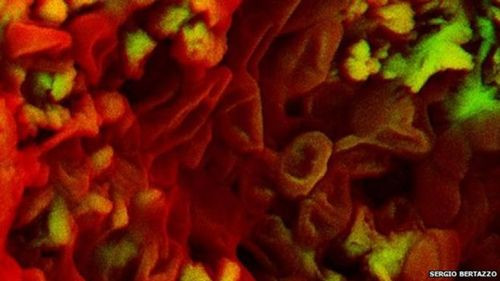 |
| These round-shaped structures are considered remnants of red blood cells. Photo: BBC |
According to the BBC, scientists at Imperial College London recently examined fossilized theropod dinosaur claws in the collection on display at the Natural History Museum. They found tiny, egg-shaped structures with a denser core inside, resembling red blood cells. In another fossil fragment, they obtained many long fibers similar to the collagen found in tendons, ligaments, and skin of modern animals.
The research team used spectrophotometers to analyze the chemical composition of what appeared to be collagen protein and red blood cells in the fossil. They discovered small fragments within the collagen that resembled amino acids, the building blocks of proteins. Furthermore, the theropod red blood cells were very similar to those of the emu, also known as the Australian ostrich, a descendant of dinosaurs.
"There's a very specific correlation within vertebrates: the smaller the red blood cells, the faster the metabolic rate. Animals with a fast metabolic rate tend to be warm-blooded, while those with a slower metabolic rate tend to be cold-blooded," said Maidment, a member of the research team.
Scientists have long debated whether dinosaurs were warm-blooded or cold-blooded, but they have yet to reach a definitive conclusion. The red blood cells in the study were smaller than those in emus. However, this is because they shrink and become smaller over time.
We still don't fully understand the relationship between red blood cell size and metabolic rate within dinosaurs. Therefore, the research team needs a larger sample from multiple dinosaur species to shed light on this debated topic.
"Most closely related animals will have similar collagen structures. If we can extract some collagen and find it in multiple dinosaur species, it would prove the relationship between individuals within the dinosaur family," Maidment said.
According to Vnexpress


