
More mysterious craters discovered in Siberia.
Scientists have identified four more large craters and several other similar structures in Siberia, Russia, after reviewing satellite imagery.
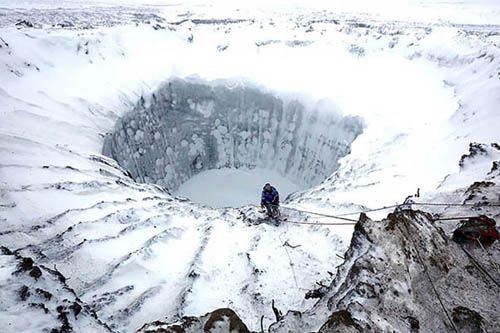 |
| The expedition descended to the bottom of the largest of the three craters on the Yamal Peninsula last November. The crater is approximately 60 meters in diameter. Photo: Siberian Times |
"We now know of seven craters in this icy region. We have identified four precise locations, and three others were discovered by reindeer herders. I am certain there are many more craters on the Yamal Peninsula; we need to search for them," said Professor Vasily Bogoyavlensky, a member of the Russian Academy of Sciences.
According to Bogoyavlensky, there could be around 20-30 more sinkholes. "The important thing is not to scare people, but to make them understand that this is a serious problem, and we must investigate this," he said. The call for an investigation aims to emphasize that this is a serious issue and that an early investigation could protect people living in the area.
According to the Siberian Times, an expedition team reached the bottom of one of the three craters last November and collected data to decipher its formation mechanism. The hypothesis is that global warming caused methane gas beneath the ice to be suddenly released, triggering large underground explosions and creating this phenomenon.
Scientists cannot predict the time and location of similar explosions, and studying them is dangerous, Bogoyavlensky said. Bogoyavlensky's team plans to conduct a new expedition, establishing a research station in the area to detect earthquakes that may form as the crater expands.
"The process of crater formation may continue to occur over a large area in the permafrost region of Siberia," Carolyn Ruppel, an American geophysicist, told the Huffington Post. Therefore, experts need to conduct more research to identify these processes and how they progress over time.
Since July 2014, experts have discovered three craters in Siberia. The cause of their formation remains unclear. Initial suggestions suggest they may be related to meteorite impacts, unidentified flying objects, or gas explosions.
According to VnExpress


