
Interesting discovery: Dogs also experience jealousy, just like humans.
Dogs are considered the closest animals to humans, and these adorable pets can also show signs of jealousy if their owners seem to enjoy playing with other animals or toys without paying attention to them.
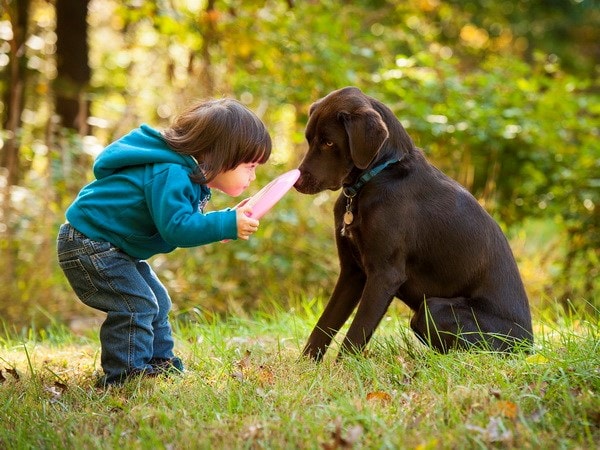 |
| Illustrative image. (Source: kika.lt) |
Dogs become particularly jealous when they perceive their owners as showing interest in another dog. This is the conclusion of a recent study published in the scientific journal Plos One on July 23rd.
This interesting study was conducted by scientists at the University of California, San Diego, USA. They selected 36 random dogs of various breeds such as Daschshund, Pomeranian, Boston Terrier, and Maltese.
Their owners were instructed to ignore their dogs' behavior and perform the following three tasks in order: play with a toy dog, a pumpkin-shaped plastic bucket, and read a children's story aloud. These were tests to assess the dogs' jealousy.
Scientists analyzed dog behavior according to levels of aggression, attention-seeking, and focus on their owners or toys.
The results showed that the majority of dogs (80%) pushed or touched their owners when they were playing with the stuffed dog.
At a lower rate, about 40% of dogs reacted when their owner played with a toy bucket without paying attention to them; whereas the owner's act of reading aloud only captured the attention of 22% of the dogs.
The study also found that about 30% of these dogs interrupted their owners' playtime with the toy, and 25% chewed on the stuffed dog. For the other two tests, only one dog chewed on the bucket and the book.
Furthermore, this study indicates that dogs also try to break the connection between people and objects they perceive as "enemies."
Psychologist and member of the research team, Christine Harris, suggests that animals often exhibit jealousy in all their relationships and behaviors, such as competing for food, attracting attention, or seeking care.
According to them, jealousy may have developed in dogs when these canine animals were domesticated and had close, prolonged contact with humans.
This study builds upon a previously conducted test on jealousy in six-month-old children.
According to VNA


