
Detection and control of red rot disease in sugarcane.
Sugarcane is a crop rich in nutrients that are very attractive to insects and harmful fungi. Red rot disease, caused by the fungus Colletotrichum falcatum Went, develops by converting sugar in the sugarcane into alcohol, hence it is also called alcohol disease. If severely affected, the entire plant can dry out and die, and the ratoon will regenerate poorly. Diseased sugarcane used as raw material results in contaminated juice, making the settling and processing difficult.
According to investigations published by the Institute of Plant Protection and the Institute of Sugar Cane Research, there are over 50 species of insects and about 30 types of diseases that harm sugarcane in sugarcane-producing regions nationwide. Among them, red rot is one of the most common pests affecting sugarcane.
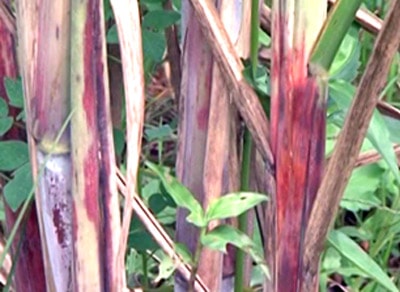
Red rot disease in sugarcane
Sugarcane crop of 2009-2010 in the provinces
During the planting and cultivation process, farmers need to understand the symptoms and characteristics of disease outbreaks to effectively protect their sugarcane fields. The following are guidelines from Engineer Ngo Van Dung, Institute of Plant Protection.
Symptoms of the disease:
Red rot disease can damage many parts of the sugarcane plant, from the stem, leaf blades, leaf sheaths to the young shoots and even the roots. However, the disease usually causes the most damage to the stem, leaf blades, and leaf sheaths of sugarcane plants when the stem has grown tall.
- On the leaf blade: The disease usually appears on the main veins in the leaf groove. Initially, the lesions are just small pink spots. They then gradually develop upwards and downwards along the leaf midrib into long, oval streaks (sometimes only about 5-7 cm long) that are blood-red in color, with a lighter center and a reddish-brown edge. Small black granules, which are fungal spore clusters, are also present on the lesions. The diseased tissue easily cracks and crumbles, causing the leaf to easily break and bend at the cracked area.
- On the leaf sheath: The lesions are dark brown, surrounded by a red border. In severe cases, many lesions merge together to form a large patch. Small black spore clusters later appear on the lesions.
- Inside the stem: The fungus invades the sugarcane stem through the holes drilled by sugarcane borers. Initially, the disease appears as a small, pale spot inside the stem, then spreads, extending along the internodes into patches of blood-red color. Between the red spots are horizontal white streaks. Because the symptoms remain inside the stem for a long time without appearing on the outer bark, it is initially difficult to detect the disease. The symptoms only become apparent when the sugarcane stem is split open with a knife.
The diseased areas later ferment and rot, the sugarcane core becomes slightly hollow in places and has an alcoholic smell and a mildly sour taste. The outer bark loses its shine, turning yellowish-red, slightly concave and shriveled, creating purplish-red indentations on the sugarcane internodes. Tiny black granules, which are fungal spore clusters, are present on these lesions. If severely affected, the diseased area may cover the entire internode or extend to other internodes.
Characteristics of disease origin and development
Sugarcane red rot thrives in conditions of high humidity, heavy rainfall, and hot, humid weather. However, under low temperatures of 15-20°C, sugarcane grows slowly and has weak disease resistance, allowing the fungus to still cause damage.
The fungus that causes red rot thrives at temperatures of 27-32°C and a pH of 5-6. Growth is poor at temperatures that are too low (below 10°C) or too high (above 37°C).
Fungi easily infect through abrasions and wounds, therefore the severity of the disease is also related to the level of sugarcane borer damage. The more sugarcane borers damage, the more severe the disease. On the other hand, heavy rain and wind, and poorly drained sugarcane storage areas also promote the development of the disease.
The severity of fungal disease outbreaks is closely related to the morphological and physiological characteristics of each sugarcane variety. Green-skinned sugarcane varieties are generally more susceptible to disease than yellow-skinned varieties. Production practice shows that the Roc.10 and 2714 POJ varieties are severely affected, while the 2883 POJ, 2678 POJ, and F103 varieties are less affected. Sugarcane varieties with high phenol content also have higher disease resistance.
Understand thecharacteristics of disease origin and developmentThis will help farmers implement the most effective pest control measures. This will prevent a decrease in sugarcane density due to fungal diseases and increase crop yield and quality.
Control measures
To minimize the damage caused by red rot disease in sugarcane, integrated pest management is considered the most important measure, helping to ensure greater crop safety while simultaneously combating multiple pests and diseases.
- Clean the fields thoroughly, collect all remnants of diseased sugarcane plants from the previous season and destroy them.
- Select healthy cuttings: discard any cuttings showing symptoms of disease. Before planting, treat the cuttings by dipping them in hot water at 54°C for 20 minutes, or dipping both ends of the cuttings in a 0.5% solution of Mexyl MZ72WP or Vinomyl 72BTN, or a 1% Bordeaux mixture for 2 hours.
- Plant when the humidity and temperature are suitable.
- Prepare the soil by tilling, filling, and compacting it during the dry season. Combine this with applying lime powder to treat the soil.
- The holes and bites made by stem borers and rats are entry points for fungal infections. Therefore, farmers need to remove diseased leaves and focus on burning and eliminating stem borers to reduce the number of holes drilled into the sugarcane stalks. This will limit the entry points for fungal diseases into the sugarcane stalks.
- Apply fertilizer in a complete and balanced manner, including nitrogen, phosphorus, and potassium. Fields that are frequently affected by disease each year should receive additional potassium fertilizer to increase the plants' resistance to disease. In acidic soils, add lime to increase the soil pH.
ButSugarcane leaf stripping method: During the sugarcane plant's growth stage, farmers need to pay attention to stripping away ineffective lower leaves. These are old, withered leaves or leaves affected by pests and diseases, which are no longer capable of photosynthesis and nutrient synthesis.Farmers should collect sugarcane leaves that are damaged by fungal diseases and take them to an isolated area for disposal. This will help keep the sugarcane field well-ventilated and reduce the source of disease.
During the sugarcane elongation period, farmers need to regularly inspect their sugarcane fields. When the plants grow tall, if they detect a significant increase in disease, they should take action.Chemical spraying is necessary. Some effective pesticides include Mexyl MZ72WP.,Ridomil 72WP...Before spraying chemical pesticides, farmers should carefully read the instructions on dosage and usage printed on the pesticide label.
For broad-spectrum, systemic chemical pesticides, farmers should spray directly onto the foliage. They can add 10ml of an adhesive agent or 5-7 drops of dish soap to 10 liters of pesticide solution before spraying. These ingredients help increase adhesion to the leaves, thereby enhancing the effectiveness of the chemical pesticide.
When using chemical pesticides, each type of pesticide should be sprayed 3-4 times per crop cycle, then switch to another type. The purpose is to limit the development of pesticide resistance in fungal diseases. When the disease is on the rise, farmers can combine two types of pesticides for better treatment effectiveness.
In areas severely affected by the disease, farmers need to isolate and eradicate the outbreak, and should not transfer seedlings to other areas to limit the spread. In fields already affected by the disease, farmers should harvest earlier than in other fields.
According to VTC16.vn - LY


