
Maximizing the functionality of concrete canals.
(Baonghean) - Following the principle of "the State and the people working together," many localities in the province have taken advantage of funding sources to build and reinforce irrigation canal systems, contributing to improving the efficiency of agricultural production. During the current hot weather, many concrete canal systems are proving effective in regulating water resources for the summer-autumn rice crop.
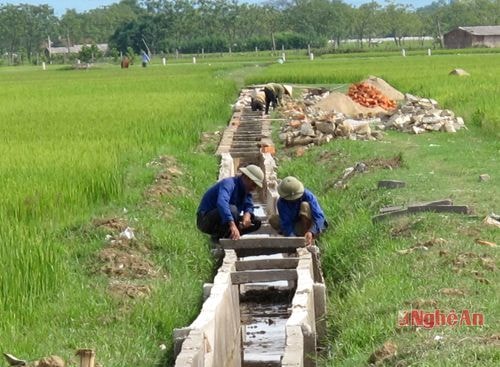 |
| Concrete paving of irrigation canals in Hung Thong commune (Hung Nguyen district). Photo: Minh Thu |
Along Provincial Road 532, in the Quy Hop district, many fields are dry and unsuitable for summer-autumn crop production, but the rice fields in Dong Huong village, Chau Quang commune, are thriving thanks to the reinforced branch canal system that brings water to the fields. Mr. Luong Van Doan from Dong Huong village said: “This summer-autumn crop, my family cultivated 5 sao (approximately 0.5 hectares) of rice, whereas last year, due to earthen canals and water loss, we could only cultivate 2 sao…”. It is known that before the canals were reinforced, the water supply was only sufficient to irrigate 5 out of 17 hectares of summer-autumn rice, but now it ensures irrigation for 100% of the rice area.
Mr. Vo Xuan Thanh, Vice Chairman of the Chau Quang Commune People's Committee, shared: “With nearly 2 billion VND from the New Rural Development support fund and the commune's budget, at the beginning of 2015, we reinforced 1.2 km of irrigation canals in Dong Huong village. This is an important section of canal, connecting the Tong Huong dam irrigation project in Chau Cuong commune with other canal sections to irrigate over 50 hectares of rice fields in Dong Tam, Quang Huong, and Diem Bay hamlets… Using integrated funding from various programs and projects, the commune has reinforced over 18 km of irrigation canals to date. With the irrigation fee subsidy, the commune will continue to build new canals and repair existing ones annually to complete the canal system.”
In Minh Hop commune, there are over 50 hectares of rice paddies, which have traditionally relied mainly on earthen canals, resulting in 50% of the area lacking sufficient irrigation water for the summer-autumn crop. During the New Rural Development program, the commune identified canal reinforcement as a key objective contributing to food security. Therefore, in May 2015, using integrated funding sources, the commune focused on constructing 5 km of canals worth 6.5 billion VND. To date, over 1 km has been completed. To ensure the quality of the project, each hamlet has assigned community supervisors to closely monitor the progress. The project is expected to be operational by November 2015.
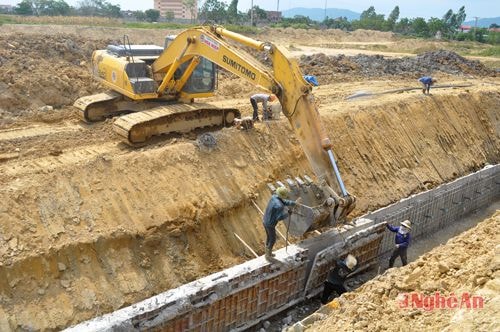 |
| Construction of the downstream canal for the Nam Dan sluice gate and canal system upgrade and expansion project. Photo: HV |
To date, Quy Hop district has reinforced 140 out of 223 km of irrigation canals, with the remainder being mostly earthen canals. The communes with the most reinforced canals are Chau Quang (over 12 km), Chau Dinh (9 km), and Chau Thai (7 km)... The funding for canal reinforcement mainly comes from the New Rural Development program, government bonds, Program 135, and contributions from the people. Canal reinforcement has brought practical results, enabling farmers in the district to gradually take control of their production plans. From only producing one precarious rice crop per year with low yields, farmers now grow two rice crops per year with double the yield. The district is striving to improve the irrigation system through "irrigation fee subsidies" and the spirit of "the State and the people working together," gradually completing the system to meet the irrigation needs of the people.
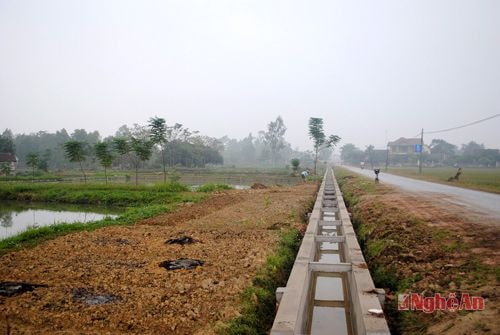 |
| The canal system in Thinh Son commune, Do Luong district, has been comprehensively reinforced. Photo: VT |
In Thinh Son commune, Do Luong district, where the irrigation canal system is the most comprehensively and reliably invested in the province, Mr. Hoang Ngoc Nga from Hamlet 8 shared: “Thanks to the reinforced irrigation canal system, we no longer have to stay up late and wake up early, competing for water like before. All 8 acres of rice fields are fully flooded with water in just one day.”
In 2014, the commune commenced the construction of a canal reinforcement project spanning over 6 km, valued at nearly 10 billion VND, with the Do Luong District People's Committee as the investor and Construction and Investment Company No. 16 as the contractor. The project was put into effective use for both the spring and summer-autumn rice crops of 2015. In addition, many communes in Do Luong have consistently focused on canal reinforcement over the years. To date, the entire district has reinforced 250 km out of 350 km. Many communes have performed well in canal reinforcement, such as Hoa Son, Tru Son, Luu Son, Thinh Son, and Thai Son… In 2014 alone, the entire district constructed irrigation canals worth over 60 billion VND.
During the discussion, Mr. Pham Huu Van, Deputy Head of the Provincial Irrigation Department, added: In recent years, to improve the efficiency of agricultural production, the entire province has reinforced over 4,700 km of canals and ditches serving rice cultivation and short-term industrial crops. In addition, during the upgrading of reservoirs, many irrigation works have been integrated with the canal system leading to the fields. Many localities are shining examples in the canal reinforcement movement, including the districts of Yen Thanh, Do Luong, Dien Chau, Quynh Luu, Hung Nguyen, Nam Dan, Nghia Dan…
However, despite the achievements, the canal reinforcement work still faces difficulties such as: Investment in canal reinforcement in some localities has not been implemented synchronously; in some localities, the main canals have been reinforced while the branch canals have not been built, leading to water loss and waste... On the other hand, due to limited annual maintenance funds, most canals are degraded and severely damaged, resulting in low irrigation efficiency and directly affecting crop productivity. This requires localities to continue integrating investment sources and improving the canal system to effectively serve agricultural production.
Van Truong


