
Building on the results of the Western Vietnam rural development project.
(Baonghean) - The Western Nghe An Rural Development Project (VIE/028), implemented in the three districts of Ky Son, Tuong Duong, and Con Cuong and funded by the Government of Luxembourg, has concluded after six years of operation (2009-2015). With an investment of 6,350,000 EUR over six years, the project benefited 100,960 people from impoverished households in 293 villages and hamlets across 33 particularly disadvantaged communes.
Along the road to Yen Na and Yen Hoa communes (Tuong Duong district), at this time of year, there are still corn fields stretching from the foothills to the mountain pass peaks. Mr. Vi Van Vuong from Bon village, Yen Na commune, happily shared: “In 2012, with support from Project VIE/028 (2 kg of corn seeds) and guidance from agricultural extension officers on the techniques and procedures for growing corn on sloping land, I achieved success in the very first harvest. I sold 400 kg of corn at 3,000 VND/kg, earning 1.2 million VND per harvest. Since then, we have increased our corn cultivation area, earning about 10-12 million VND per year from corn.”
"From growing corn, the family has the means to utilize by-products for raising buffaloes, cows, and pigs, improving their family's life." According to Mr. Vuong, for a long time, the rice fields had become barren due to years of cultivation, resulting in low rice yields. Thanks to guidance on soil improvement and corn cultivation, practical results have been achieved. Mr. Pay Van Ut, an agricultural extension officer in Yen Na commune, shared: "Corn has become the main crop in poverty alleviation for the people here. From a project that only implemented a model of growing corn on sloping land of over 3 hectares, now the people of Yen Na commune have developed corn cultivation on sloping land to nearly 100 hectares per year. The entire Tuong Duong district currently has over 2,700 hectares of corn on upland land, mainly using hybrid varieties such as LVN 14, CP A 88…"
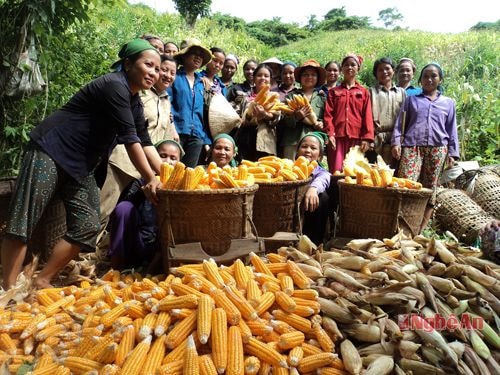 |
| The model of growing corn on sloping land in Yen Na commune (Tuong Duong district) yields high productivity. |
Project VIE/028 also contributed to promoting the development of poultry farming in the area. Specifically, the model of raising Muscovy ducks, aimed at restoring and expanding the local Muscovy duck breed in Tuong Duong district, has helped poor households increase their income. We visited the Muscovy duck farming model of Mr. Vi Van Viet's family in Noong Mo village, Xieng My commune. Mr. Viet's duck coop is built right near the stream, providing a cool and airy environment. In 2012, Project VIE/028 provided 50 Muscovy ducklings, which were fully vaccinated against swine fever and hemorrhagic septicemia, and also supported with 5 kg of mixed feed.
Mr. Viet said: “Before implementing the model, we received training in duck farming techniques, and agricultural extension officers checked the disease situation and growth of the duck flock monthly. After more than two months of raising them, the results were quite good, with a survival rate of nearly 96% and an average weight of 2 kg/duck. Recognizing the potential of raising Muscovy ducks here, which is quite convenient due to its proximity to the stream, I increased the flock to nearly 100 Muscovy ducks and over 20 laying ducks, earning an income of about 16-18 million VND per year from raising Muscovy ducks. Previously, my family only cultivated rice and raised pigs traditionally, so we never had enough to eat. Now, thanks to raising Muscovy ducks, my family has escaped poverty and has money to repair our house and support our children's education. Many households have followed my example in raising ducks. Currently, in Nga My commune, there are over 20 households raising Muscovy ducks, and in Xieng My commune, there are over 50 households raising Muscovy ducks.”
Mr. Lo Kham Kha, Head of the Agriculture Department of Tuong Duong, added: The effectiveness of Project VIE/028 is very clear. From 2009 to the present, 55 production models have been built, including in the fields of crop cultivation, livestock farming, veterinary medicine, plant protection, beekeeping, broom making, rattan and bamboo weaving... 22 small-scale projects have been constructed for 22 villages in the project area, benefiting over 10,000 people, and 2 medium-scale projects with a total budget of 13.77 billion VND have been completed on schedule as required.
In addition, Project VIE/028 also supported the development of many effective crop and livestock models in Ky Son. A typical example is the beekeeping model of Mr. Vi Van Hung's family in Na Khuong village, Na Loi commune. With the project's support of 2 beehives and guidance from technical staff, Mr. Hung has expanded his beekeeping to 15 hives, harvesting 50 bottles of honey annually, selling them for 180,000 - 200,000 VND per bottle. Mr. Lo Hai Phong, Chairman of the Ky Son District Farmers' Association, added: In 2012, the project supported 15 households in Na Loi, Bac Ly, Chieu Luu, and Pha Danh with 2 bee colonies each and provided training in beekeeping techniques. Most households engaged in beekeeping have achieved good results. For example, Mr. Luong Van Nam's household in Na Loi has expanded from 2 hives to 30 hives, earning 15-20 million VND per year.
Currently, nearly 70 households in the communes of Pha Danh, My Ly, Na Loi, etc., are continuing to expand the honey bee farming model. Project VIE/028 has also developed models for growing corn on upland fields, which have proven effective in Muong Tip and Muong Ai, and growing peanuts on high-lying, unsuitable paddy fields in Bac Ly (1 hectare, now expanded to 4 hectares). From 2012 to the present, Project VIE/028 has invested in the construction of 4 overflow bridges across Canh village, Ta Ca commune, Tay Son, Bac Ly, etc., helping people and vehicles travel safely.
As can be seen, Project VIE/028 has had a significant impact on the awareness of participating households through capacity-building activities. The project has built 91 small and medium-sized projects and 346 pilot models in agricultural production and income generation, benefiting over 8,060 farmers. The focus is mainly on crop models such as rice, corn, peanuts, mung beans, ginger, sesame, various vegetables, and bananas. Livestock farming activities include 201 models benefiting 1,661 farmers, focusing on market-preferred livestock such as chickens, ducks, pigs, and the VACR (Vegetable, Animal, and Crop) model. Technical farming models for cultivating corn on sloping land were developed in Tuong Duong and Ky Son districts. This is one way to replace traditional slash-and-burn farming methods, reduce soil erosion, enrich the soil, and protect the environment.
Project VIE/028 has significant importance in the socio-economic development of the western part of the province, contributing to raising awareness about social issues, the environment, production techniques, gender equality, climate change, etc. In particular, it has contributed to a rapid reduction in the poverty rate in three districts: Ky Son (90% in 2007 to 52.79% in 2014), Tuong Duong (85% in 2007 to 45.38% in 2014), and Con Cuong (65% in 2007 to 32.2% in 2014), exceeding the planned targets. The infrastructure projects built by the project have demonstrated quality and continue to be effective, and the production models are being maintained and further expanded.
Despite the project's positive results, there are still limitations. These include the vast mountainous terrain, difficult transportation, and unpredictable weather. The project still lacks technical staff, and some staff members lack the necessary knowledge and professional skills. Furthermore, some departments and offices in the districts that collaborated with the project are preoccupied with their own work and haven't shown sufficient interest. Therefore, some models haven't been effective. For example, the bamboo rat farming model, supported by the project for 20 households in Yen Thang, Yen Hoa, and Nga My communes (Tuong Duong district) since 2013, provided each household with 2 million VND to purchase breeding stock and guidance on farming procedures. However, improper care and management during the farming process led to the bamboo rats breaking out of their cages and escaping.
The project has concluded. To maximize its effectiveness, the districts will continue to manage, utilize, and maintain the facilities in accordance with regulations. The agricultural sector will continue to replicate effective models not only in the three districts but also expand them to areas with similar conditions throughout the province to help people develop production and increase their income.
Van Truong


