
Leveraging the advantages of the forest.
(Baonghean)Today, Quy Chau has learned to utilize its local advantages and resources to develop and progress; however, there are still difficulties and shortcomings that require more decisive leadership and intervention to help Quy Chau fully exploit its potential and strengths...
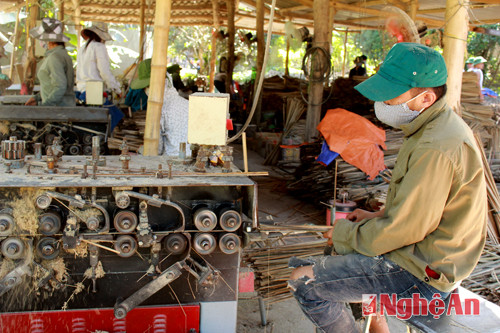 |
| Hien Thuong bamboo toothpick production facility is located in Chau Thang commune, Quy Chau district. |
During a field trip by the Chairman of the Provincial People's Committee, Nguyen Xuan Duong, to Quy Chau, I had the opportunity to visit several new economic development models and witnessed the hard work and dedication of the people of Quy Chau. First, it's worth mentioning the utilization of the local main crop (bamboo and rattan), with many private businesses boldly investing in bamboo toothpick production. One such example is the Thanh Phuc Lam bamboo toothpick production facility, which provides regular employment for over 20 workers with monthly salaries ranging from 3 to 3.5 million VND per person. Starting her business, Ms. Nguyen Thi Thanh had to scramble to raise capital to buy cutting and planing machines for separating bamboo, with only a few tens of millions of VND in hand. After many days of contacting the Policy Bank to find loan sources, she received a 30 million VND loan. Another challenge was finding a manager.
By chance, she met Lo Tuan Anh, a business administration student from the same village. Tuan Anh had been deaf and mute since childhood. However, when she wrote down the job requirements, Tuan Anh readily accepted and promised to do his best. For the past two years, Tuan Anh has helped her manage her business, which employs over 20 workers, mostly from her village, each with their own difficult circumstances. Under the strict management of this hearing-impaired young man, the business has become increasingly successful. With an annual production of 200 tons, generating 200 million VND in revenue, the products are sold as soon as they are made. Ms. Thanh said that at times she had to hire up to 100 workers to keep up with orders.
Also operating as a bamboo toothpick production facility, the Hien Thuong private enterprise in Hamlet 32, Chau Thang Commune, had a more favorable start. With an initial capital of 80 million VND, the Hien Thuong couple contracted with the Forest Protection Management Board to purchase bamboo and reed raw materials from local villagers. The raw materials are soaked, cleaned, and peeled using machinery imported from South Korea, resulting in high production and maximum utilization of input materials. After cleaning, the raw materials are supplied to bamboo toothpick centers of the Association of the Blind and the Association of the Disabled in the province and lowland districts to produce the final product. Approximately 20 workers are employed there, each receiving a monthly salary of 3-3.5 million VND.
Taking advantage of the forest land, many people have boldly invested in raising buffalo and cattle on farms. A typical example is the family of Mr. Hoang Dinh Son in Bai village, Chau Thang commune. With an initial loan of 50 million VND from the Agricultural Bank, he and his wife bought 7 buffaloes. After 3 years of grazing, utilizing the feed from their garden and surrounding forest land, their herd has now grown to 53 buffaloes. Each year, they sell about 10 buffaloes and cows, earning an income of 100-150 million VND. Sharing with us, Mr. Son said: “If we hadn't taken advantage of the land and forest around our house and just sat around waiting for support policies and working as hired laborers, when would we have ever escaped poverty? Since my wife and I boldly started raising buffaloes, we have been able to support our two children through university and build a solid, spacious house.”
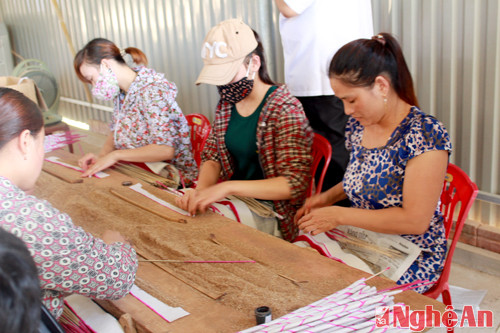 |
| Ha Loan Incense Production Facility. |
For a long time, Quy Chau incense has been a renowned product. Among the four incense-making villages with over 30 households in the town, the provincial delegation visited the Ha Loan incense production facility, which produces up to 3 million incense sticks annually, packaged and exported to other provinces, generating an annual revenue of 300 million VND. Even outside of the main production season, the scent of incense wafted through the air upon entering the gate. The Provincial Chairman was genuinely pleased, impressed by the professional operation of the facility. From packaging and soaking the raw materials to preserving them, everything is done according to a standardized process using advanced machinery. However, the mixing of ingredients and the wrapping of the incense sticks are still done using traditional manual methods. Ms. Nguyen Thi Loan shared: “To preserve the fragrance and ensure the incense sticks curl naturally after burning requires many family secrets that can only be achieved by hand.” However, the Provincial Chairman wondered whether there should be additional projects to produce incense sticks, diversifying products and thereby increasing income for workers in the craft village.
During the past term, forestry in the district experienced significant growth. The district directed local authorities to strengthen forest conservation, protection, and reforestation efforts. From 2011 to 2013, over 4,004 hectares were newly planted and replanted after harvesting, increasing forest cover to 76.6% in 2013. Small-scale industries also saw considerable development, with main products including incense sticks, brocade fabrics, and processed agricultural products (incense stick production increased from 25.5 million sticks in 2010 to 43 million sticks in 2013). Production value in 2013 reached 67.7 billion VND, a 20.5% increase. The average growth rate over the three years from 2011 to 2013 was 6.5%. In addition, commercial livestock and poultry farming was boosted, with the production of various types of meat increasing rapidly compared to previous years. However, what is concerning is that while many farms are thriving, the total number of buffalo and cattle in the area has decreased significantly, from over 27,000 in 2010 to just over 25,000 in 2013. This is also a matter of great concern to the Chairman of the Provincial People's Committee, Nguyen Xuan Duong, because farm and household livestock breeding is a strength of Phu Quy region, and the decrease in the number of cattle shows a lack of decisiveness from leaders at all levels in finding solutions to prevent and overcome this situation.
Furthermore, the district has yet to attract any investors to build industrial parks or factories to create jobs and increase the district's budget; the goal of shifting the economic structure towards reducing the proportion of agriculture and increasing the proportion of industry, construction, and trade is difficult to achieve. To date, industry and small-scale industries have developed slowly, lacking planning, and using outdated technology and equipment. Some goals regarding the construction of technical infrastructure and industrial production, such as building a tunnel kiln brick factory with a capacity of 10 million bricks/year to replace manual brick kilns, have not been implemented and remain only on paper...
Furthermore, poverty eradication efforts have not been highly effective, with over 45% of households remaining poor throughout the district. Therefore, more than ever, the Chairman of the Provincial People's Committee has requested the district to develop a detailed plan with a roadmap to help people sustainably reduce poverty. In particular, the movement for all citizens to contribute to building new rural areas has not been truly strong, and land consolidation and exchange have been slow due to the unique characteristics of mountainous farming terrain and a lack of funding. The Chairman of the Provincial People's Committee believes that decisive action is needed to ensure that at least two communes achieve the goal by 2015. To achieve this, it is necessary to effectively mobilize and educate each household to participate in building new rural areas, and to effectively utilize the efforts of associations and the Fatherland Front's working committee in disseminating information.
The Chairman of the Provincial People's Committee also requested the District Party Committee and the District People's Committee to develop a plan to complete the allocation of land and forest for stable and long-term use to farming households, linked with settled farming and resettlement, making forestry an important economic sector so that people can ensure stable lives and get rich from the forest. Continue to do a good job of enclosing, caring for, and protecting forests, especially in areas where bamboo and reeds are used as raw materials. The Chairman of the Provincial People's Committee emphasized: Special attention must be paid to the Co Ba forest case, and profound lessons must be learned from the allocation of forest land to the people.
Leveraging the advantages of the forest to make breakthroughs in building and replicating economic models is the direction Quy Chau needs to explore. Much work remains to be done to make Quy Chau a shining example in western Nghe An province, but with the efforts and unity of the entire Party committee and people of Quy Chau, the goal is not far off.
Thanh Nga