
Leveraging resources after labor export.
(Baonghean) - For many years, labor export has been considered an effective solution to address unemployment and alleviate poverty, especially in rural areas. However, how to effectively utilize financial and human resources after labor export remains a matter that needs consideration…
(Baonghean) - For many years, labor export has been considered an effective solution to address unemployment and alleviate poverty, especially in rural areas. However, how to effectively utilize financial and human resources after labor export remains a matter that needs consideration…
Hung Tan commune is one of the localities in Hung Nguyen district with the highest number of people working abroad. On average, 40-50 people from the commune go abroad for work each year, and currently, nearly 300 workers from the commune are working, mainly in markets such as Taiwan, South Korea, Japan, Malaysia, the Middle East, and Laos. Every year, over 20 billion VND is transferred back to Hung Tan from overseas labor export, contributing to raising the average per capita income of the commune to 22 million VND/year in 2012, and reducing the poverty rate to only 4.6%. Many poor families, thanks to their children working abroad, have been able to build spacious houses and purchase valuable household items. Many families have learned to effectively use the accumulated money from overseas labor export to develop production and make sustainable investments for the future.
Nguyen Dinh Trinh (born in 1988), from Hamlet 7, is the youngest of four siblings in a farming family. In 2006, after graduating from high school, realizing his academic abilities were insufficient to enter universities or colleges, Trinh chose to work in Malaysia. For three years, working as a factory worker in an export footwear company, Trinh earned an average salary of over 5 million VND per month – significantly higher than the average income of people in the commune at that time. However, after returning home and paying off his debts, Trinh only had enough money left to buy a motorbike. After two years of struggling to make ends meet working odd jobs in both the North and South of Vietnam, Trinh experienced the hardships of manual labor in the country and decided to go abroad for work again. In early 2011, Trinh was fortunate enough to be recruited for a three-year training program in Japan. Trinh said: “Working conditions in Japan are much better than in Vietnam. We get to work with modern machinery, and the salary is high, nearly 20 million VND per month. After 3 years working in Japan, I've saved over 600 million VND. Not only that, I've also learned from the Japanese the spirit of hard work and high discipline.” Returning home, Trinh used his savings to invest in production to help his family escape poverty sustainably. Noticing that there were almost no sausage production facilities in Hung Tan commune and neighboring communes, Trinh decided to buy machinery and open a sausage production facility at home. Although it has only been operating for a few months, Trinh's sausage production facility has already generated a relatively stable income. Trinh said that he plans to invest in eel and bamboo rat farming in the near future to increase his income.
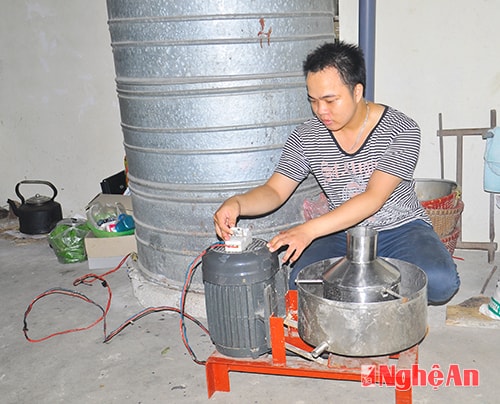 |
| Mr. Nguyen Dinh Trinh (Hamlet 7, Hung Tan Commune) next to his family's sausage-making machine. |
Hung Thinh commune (Hung Nguyen district) currently has 200 people working abroad on fixed-term contracts. Thanks to the effective use of money from overseas labor export, many families have escaped poverty sustainably. A typical example is the family of Ms. Ngo Thi Vinh in Hamlet 8, who was previously one of the poorest households in the hamlet. Her husband passed away, leaving her to raise five children alone. Ms. Vinh had to work many jobs to make a living and raise her children. But since three of her children went to work abroad in Malaysia, Taiwan, and South Korea, her family's life has changed for the better. Mr. Duong Van Thinh – Mrs. Vinh's second son, who recently returned from working abroad in South Korea, said: “Returning from South Korea last March, I had accumulated about 800 million VND. I set aside 300 million VND to build a spacious house. I invested the remaining capital in my mother opening a grocery store. With my skills, I applied for a job as a mechanical worker in the Bac Vinh Industrial Park, and our family's life is now basically stable.”
According to statistics from the Department of Labor, War Invalids and Social Affairs, from 2011 to the present, more than 11,000 people from the province have gone abroad for work each year. The majority of those who go abroad for work earn twice as much as they did domestically. In some high-income markets such as South Korea and Japan, after 2 to 3 years of work, laborers can accumulate between 500 million and 1 billion VND. Furthermore, they are all trained workers with improved skills and industrial work ethics compared to those working domestically. Thanks to these factors, upon returning, many have been proactive in creating their own jobs and opening their own production facilities to develop their family's economy. For example, in Hamlet 4, Nghi Thuan commune (Nghi Loc district), Mr. Nguyen Van Trung (born in 1985), after 3 years working as a welder in Malaysia, returned to his hometown in December 2012. With his skills and savings, Trung boldly opened a welding workshop at home. Trung said: “After graduating from a vocational school in welding, I couldn’t find a job, so I applied for a labor export program to Malaysia. There, I worked at the American oil and gas company Kennaca, earning approximately 16 million VND per month. After my contract expired, I returned home and opened this welding workshop, and now I earn 7-8 million VND per month.” Trung also shared that when going abroad for work, you have to understand from the start that the goal is to earn money. Therefore, you must comply with all regulations, work according to the industrial lifestyle of the host country, and most importantly, save money to send back to your family and accumulate for the future.
Currently, in the province, several wards and communes have done a good job of providing career guidance to returning migrant workers, such as Nghi Hai and Nghi Tan wards (Cua Lo town), and Nghi Dien commune (Nghi Loc district)... Mr. Le Van Phu - Vice Chairman of the People's Committee of Nghi Tan ward said: "In recent years, Nghi Tan has had nearly 1,000 workers going to work abroad in various countries, sending tens of billions of VND back to the locality annually. Every year, through the ward's leadership committees, we closely monitor the number of returning migrant workers and their family circumstances to meet with them and educate them on using their accumulated capital for investment in production and business. For those returning migrant workers with large accumulated capital, the ward has created conditions for them to rent premises in convenient locations to invest in service industries, fisheries logistics, etc., thus not wasting the human resources of returning migrant workers and contributing to the development of the local economy." "Promoting socio-economic development in the ward."
However, generally speaking, a reality persists in the province: many families still lack awareness of effectively utilizing the capital accumulated from overseas labor. Many families still spend the money sent back by migrant workers wastefully, without careful planning or investment for the future. This results in significant waste of resources (financial and human) after overseas employment. Therefore, first and foremost, each worker must be conscious of effectively using the capital they earn, developing the skills and expertise acquired during their overseas employment to enrich themselves, their families, and society.
Text and photos:Minh Quan


