
Leveraging the strengths of aquaculture.
(Baonghean) - Nghe An has the advantage of a long coastline with more than 3,872 hectares of brackish water surface, and very favorable climatic and tidal conditions, suitable for aquaculture. Stretching from Cua Lo town to Hoang Mai town, more than 2,500 hectares of brackish water surface have been renovated and put into exploitation for aquaculture with high economic efficiency.
With its evenly distributed system of estuaries and coastal areas, Nghe An has favorable conditions for developing shrimp farming. Over the past five years, Nghe An has emerged as a locality with rapid and strong development in whiteleg shrimp farming.
Before switching to whiteleg shrimp farming, people raised tiger shrimp, but due to persistent diseases and low prices, most suffered losses. In 2005, many boldly switched to whiteleg shrimp farming and achieved positive results. From then on, people flocked to whiteleg shrimp farming. From extensive farming, over 95% of the area is now intensively farmed, forming large farming zones with relatively basic infrastructure such as electricity and roads. Many households have boldly invested capital to upgrade their shrimp ponds by concreting the pond banks and bottoms and installing aeration systems. Some communes have hundreds of hectares of industrial shrimp farming, such as Quynh Xuan, Quynh Bang, Trinh Mon (Quynh Luu), Dien Kim (Dien Chau), Nghi Thai (Nghi Loc), and the farmers there are truly transforming their lives thanks to shrimp farming.
In Quynh Xuan today, tall buildings spring up everywhere, and the rows of streets built thanks to the shrimp farms inspire admiration for the boldness and initiative of the coastal farmers. While in the early 2000s, the total area for industrial shrimp farming in the province was only a few dozen hectares, it has now increased to 1,770 hectares. Not only has the area increased, but production has also risen rapidly. In 2009, the province's shrimp production was only 3,520 tons, but by 2013 it reached 9,100 tons, a 2.6-fold increase compared to 2009, generating billions of dong in revenue.
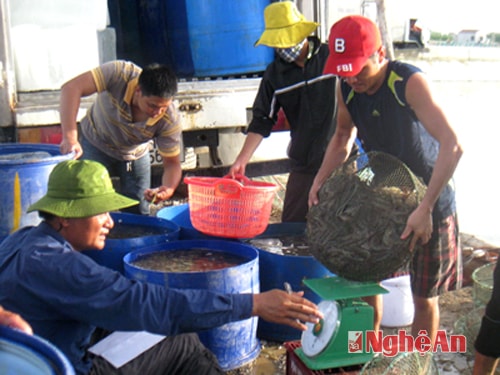 |
| People in Quynh Bang commune (Quynh Luu district) are harvesting shrimp. |
Thanks to whiteleg shrimp farming, many households have become wealthy, turning into millionaires in rural areas. These include Mr. Ho Dang Duong and Mr. Nguyen Duc Tai (Quynh Bang commune, Quynh Luu district), Mr. Dau Duc Huynh and Mr. Le Dang Duy (Mai Hung ward, Hoang Mai town)... these households can earn billions of dong annually from whiteleg shrimp farming. Mr. Ngo Xuan Dai in Dien Trung commune (Dien Chau district) is the first in the province to achieve VietGAP certification for his shrimp farming model. With 2.7 hectares of shrimp ponds, thanks to some government support, he boldly invested in building a warehouse, upgrading the ponds, and fully implementing the VietGAP process. As a result, in 2013, he harvested 45 tons with a yield of 17 tons/ha. Due to proper care and disease prevention, his shrimp grew well, reaching a size of 80-90 shrimp per kilogram. With a price of 140,000 dong/kg, he earned a profit of over 4 billion dong after the harvest. Mr. Dai shared: "Previously, farming based on experience relied entirely on luck; some years we succeeded, the next year we failed, resulting in a cycle with almost no profit. But since adopting the VietGAP farming model, everything has changed, from selecting the right breed and water treatment to feeding and disease prevention... And the final result is that the shrimp grow quickly, are disease-free, and yield high productivity and output."
With its advantageous location near the sea, the Mai Giang River (Hoang Mai district) has a moderate salinity and rich, diverse vegetation, making it very favorable for the development and growth of estuarine oysters. The story of oyster farming on the Hoang Mai River began not with policies or projects, but with the initiative of dynamic farmers and fishermen. Starting in 2000, some people began experimenting with oyster farming, and the results exceeded expectations after harvesting. Income from oyster farming increased steadily, leading many people to learn and establish stable farming operations. To date, approximately 300 households in Mai Hung and Quynh Di wards are involved in oyster farming. An entire stretch of the river is covered with oyster rafts, and further expansion is impossible. For example, the family of Mr. Van Duc Toan in Mai Hung ward (Hoang Mai town) has been farming oysters for 7 years. On average, he raises about 7,000 strings of oysters annually, earning around 60-75 million VND. The boldness and dynamism of the people here prove one thing: if you dare to think and dare to act, even in the most difficult conditions, you can find a way out for yourself and your family. Preventing saltwater intrusion and preserving freshwater in the Hoang Mai River has been impossible for many years. But the flexibility and creativity of the agricultural residents have transformed the river, previously infested with saltwater, into a major oyster farming area, producing tens of tons of oyster meat annually and generating tens of billions of dong in profit.
Returning to the Cấm River area in Cửa Lò town, dozens of households are nestled against the mountains, facing the sea, earning their living day and night through cage fish farming. After more than 3 years of implementation, from a few initial experimental households that yielded high economic returns, there are now about 40 households participating in the model in the Cấm River estuary area (belonging to Nghi Tân ward, Cửa Lò town and Nghi Thiết commune, Nghi Lộc district), with hundreds of cages raising various types of fish. This model opens up a new direction to help people rise out of poverty and transition from fishing to aquaculture. Each household invests in 1-3 cages. After 8-9 months of farming for red snapper and over 10 months for sea bass, the current selling price is 120,000 VND/kg for sea bass and 60,000 VND/kg for red snapper. After deducting expenses, the average annual income is about 60-70 million VND per household.
The economic benefits of this model have shown that it is a direction that not only ensures sustainable income for coastal residents but also contributes to protecting aquatic and marine resources that are being increasingly depleted due to overexploitation. However, a problem arises because this model is being implemented in the Cam River estuary area, near Cua Lo Port, thus affecting waterway traffic. Therefore, Cua Lo Town and the People's Committee of Nghi Thuy Ward are currently considering a plan to survey and zone suitable farming areas to both expand farming area and ensure safe waterway traffic for vessels.
Mr. Tran Xuan Hoc, Head of the Fisheries Department, assessed: "The brackish water aquaculture sector has seen outstanding development in both quality and quantity over the past period. Each year, the brackish water aquaculture production reaches approximately 9,000 tons. Besides partial support from the State, the boldness and dynamism of the people are the decisive factors in achieving these results."
Pham Bang


