
Sustainable livestock development
(Baonghean) - Since the implementation of Circular No. 27 of the Ministry of Agriculture and Rural Development, farm-based economy in Tan Ky district has developed dynamically. In 2012, the entire district only had 7 farms meeting the new criteria, but now there are 47 farms. A new feature in many models is that households focus their investment on specialized fields and sectors, with concentrated pig and cattle farming yielding positive results.
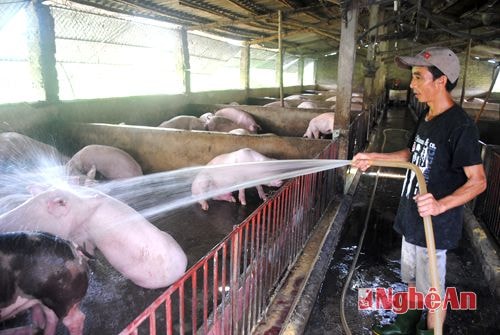 |
| The lean pork farm of Ms. Tran Thi Nga's family in Tan Phu commune (Tan Ky district). |
Visiting the lean pork farm of Ms. Tran Thi Nga in Ha Suu hamlet, Tan Phu commune, we were truly amazed by the hundreds of pigs weighing 100 kg each, raised in two rows of spacious and airy pens. Ms. Nga said: The entire farming area currently has over 400 pigs, divided into two batches. The batch of 200 pigs has been raised for over 3 months, with the smallest weighing about 110 kg and the largest about 120 kg, and is ready for sale. The other batch has been raised for 2 months. By raising them in a staggered manner, Ms. Nga's family sells a batch every month or so, totaling over 20 tons of pork. Currently, live pigs are sold at 44,000 VND/kg, and after deducting all expenses, she earns a profit of about 500,000 VND per pig.
Ms. Nga shared: "Previously, I ran a small business, working year-round, but I didn't have much money left over. In 2012, starting with 4 million VND, I boldly borrowed more from friends and built two pig farms on my parents' land. 'Small cats catch small mice,' initially I raised 10 pigs for meat, learning from technical documents on pig farming and gaining experience from practice, so each batch of pigs grew quickly. After more than a year of saving, I expanded the farm to accommodate 500 pigs at once. I ordered breeding stock from reputable farms in Hanoi. The market for pork products is crucial to the success of my farming, so I sought out customers by browsing the internet, finding business partners, and then visiting them in person to discuss supply and sales."
Currently, the company that buys pork from Ms. Tran Thi Nga is a canned meat processing company in Ha Tinh. Thanks to her keen understanding of market mechanisms, she proactively collaborates with companies supplying breeding stock, feed, and guaranteed product sales, ensuring timely pig sales without wasting time and investment costs. Ms. Tran Thi Nga shared: "Raising pigs for meat requires first and foremost choosing good breeding stock, ensuring quality, providing regular and complete vaccinations against livestock diseases, selecting appropriate industrial feed, and ensuring the barns are warm in winter and cool in summer." Thanks to the effective application of scientific and technological advancements and high technology in livestock farming, Ms. Nga has created regular employment for two workers; she sells 200-250 tons of live pigs annually. In addition, she also raises buffaloes, cows, and goats, earning an extra income of over 100 million VND per year.
For Mr. Le Manh Hung in Cua Den hamlet, Nghia Dung commune, pig farming was a stroke of luck. With enthusiastic guidance from the locals, we visited his enclosed pig farm on the hillside. Meeting us, Mr. Hung took a short break and explained: His family owns 4 hectares of land on the hillside, where they cultivate sugarcane, corn, beans, and peanuts year-round – hard work and toil, yet poverty and hardship constantly plagued them. During their struggle for survival, a friend enthusiastically suggested industrial-scale pig farming. After much thought and discussion with his wife, he decided to learn and implement the method. "What sets me apart is that I don't raise pigs using the traditional methods of local farmers, but rather lean pigs using high-tech methods," Mr. Hung explained.
With advice and guidance from a livestock company on how to build the pigpens, everything went smoothly at first. He boldly applied for a bank loan of over 200 million VND, and borrowed the rest from relatives and friends. After a short time, two rows of industrial pig pens were built on the land that his family had previously only used for growing crops. This enclosed pen system is large enough to raise 1,000 pigs at a time, but the district only allows raising 500 pigs per batch. The pens are divided into many rows and compartments, designed with convenient and scientific feeding troughs and watering systems for bathing the pigs, thus reducing direct labor.
Mr. Hung added: With his accumulated capital, he plans to invest in installing an automated feed transfer system from storage tanks to the farm. This will reduce the workload for workers and increase economic efficiency. After more than a year of applying scientific and technological advancements to raising lean pork, Mr. Hung's farm has sold 240 tons of live pigs, earning hundreds of millions of dong in profit. In addition, he utilizes the manure as fertilizer for sugarcane cultivation, achieving high yields and earning 160 million dong annually. His family has become the highest-earning household in the village and commune.
It can be said that the farm economy of Tan Ky district is developing rapidly in both quantity and quality. Mr. Nguyen Van Hoa, Vice Chairman of the District People's Committee, said: The movement to develop farm and household-based economic activities among farmers in Tan Ky has existed for decades, but concentrated lean pig farming has only appeared in the last three years and is being encouraged and facilitated by the district for further development. Household and farm-based economic activities have leveraged the advantages of the local land and human resources. This is the condition for the people of Tan Ky to move towards a large-scale, safe, commodity-producing agriculture, towards building a sustainable rural area.
Xuan Hoang
| Farms in Tan Ky provide regular employment for 426 workers. The total area of the farms is over 1,293 hectares. The farms produce a diverse range of products, estimated at approximately 5,300 tons of acacia, over 3,000 tons of sugarcane, nearly 1,600 tons of cassava, 4,300 pigs, 1,330 goats, and over 26,000 poultry… The total income from the farms up to 2014 exceeded 62 billion VND. To date, the District People's Committee has recognized 474 family farms, with a total income of over 102 billion VND up to 2014 (an average income of 215 million VND per family farm per year). |


