
Economic development linked to building a sustainable cultural life.
(Baonghean) - Entering the implementation phase of the 19th District Party Congress, term 2010-2015, in the context of a slow-recovering economic recession affecting businesses, especially those involved in the exploitation and processing of white stone and tin, the Quy Hop district's guiding principle is to focus on developing the agricultural economy, ensuring food security, maintaining the stability of business operations; and at the same time preserving, conserving, and promoting the unique cultural values of the area, focusing on the cause of nurturing human resources.
Breakthrough in 3 key crops
Since the beginning of its term, the Quy Hop District Party Committee has issued 15 resolutions, of which 5 are in the field of agriculture and rural development. Notably, Resolution No. 07-NQ/HU on "Intensive cultivation to increase productivity of key crops: rice, corn, peanuts, and sugarcane to reach and exceed the provincial average." It can be said that with the issuance of a series of resolutions in the field of agriculture and rural development and the decisive direction in their implementation, comprehensive results have been achieved. Food production in 2013 reached over 36,500 tons/32,000 tons (the Party Congress target), exceeding it two years ahead of schedule; average yield was 60 quintals/hectare, 4 quintals/hectare higher than the provincial average.
For Quy Hop, a mountainous district not very favorable for rice cultivation, achieving the above results is a tremendous effort. Comrade Hoang Van Thai, Head of the Department of Agriculture and Rural Development, said: Implementing the Resolution of the District Party Committee, Quy Hop's first achievement was to replace 12 degraded rice varieties with high-yield, high-quality varieties such as Kinh So Uu 1588, PHB71, TH 3-5, SL9... Simultaneously, a series of technical solutions were applied, such as using deep-placement fertilizer, compressed fertilizer to prevent leaching, sowing and cultivating according to the SRI method, and proper plant protection procedures... Chau Dinh commune - one of the communes with a relatively large area of rice cultivation in Quy Hop district (320 hectares), in directing agricultural production development, although the commune Party Committee did not have a separate thematic resolution this term, integrated support to promote agricultural development focusing on the two main crops: rice and sugarcane.
Specifically for rice cultivation, in addition to changing to new, high-yield, and high-quality varieties, investments have been made to upgrade the system of 5 electric pumping stations, 1 diversion dam, and 2 reservoirs, and to build 1.7 km of new irrigation canals to ensure regular water supply for the entire rice-growing area. To quickly introduce the new high-yield rice varieties to the farmers, Chau Dinh has established several control models, such as a 10-hectare model of Kinh So Uu rice in Moi and Ham hamlets, and a 5-hectare model of AC5 rice in Bu Sen hamlet... Comrade Nguyen Van Suu, Chairman of the People's Committee of the commune, shared his experience: "Building successful models is important, but it is also necessary to organize field workshops to clearly explain the technical solutions for cultivation and seed selection so that farmers can see the effectiveness. Only then can we expand the model."
In Chau Ly commune, located in the inland region, the most effective solution in implementing the Resolution on poverty eradication was the commune Party Committee's directive to review agricultural land to increase the area of stable rice cultivation under management. As a result, the rice cultivation area increased from only 190 hectares in the entire commune to 317 hectares after the review, generating an annual food production of over 4,300 tons. A major success for Chau Ly is that this winter, the commune boldly experimented with planting 40 hectares of winter corn on land previously used for two rice crops, yielding high economic returns.
Also in the agricultural sector, a landmark success was Quỳ Hợp's control of sugarcane grassy shoot disease and its associated risks, restoring its position as a key sugarcane raw material district. The implementation of the Resolution of the 19th District Party Congress coincided with the peak of the sugarcane grassy shoot disease, affecting up to 4,000 hectares and posing a high risk of rapid spread. A revolutionary effort to eradicate the grassy shoot disease involved replacing local varieties with new ones that had high sugar content and resistance to grassy shoot disease. The district resolutely decided to "not use local varieties but instead import foreign ones," and simultaneously established specialized seed areas in Bắc Sơn commune (70 hectares) and Thung Chạng (Châu Đình) (40 hectares) to become the main source of replacement seeds.
Thanks to this, Quy Hop has not only completely controlled sugarcane grassy shoot disease, but also replaced over 80% of its area with grassy shoot-resistant varieties such as QD 93-159, Roc 10, Roc 16, QD 00236. Sugar content, which was previously only 9.5, has now increased to 11.5, with some areas reaching 15-16%. Several models applying new techniques in intensive sugarcane cultivation using drip irrigation have also emerged in the area, resulting in sugarcane yields of up to 120 tons/ha, such as the model of Mr. Duong Dinh Tan's family in Dinh hamlet, Nghia Xuan commune.
On his 8-hectare plot in Minh Chua area, Minh Hop commune, Mr. Tan cultivates 4 hectares of sugarcane and 4 hectares of oranges, both using Israeli drip irrigation technology. This has significantly improved the yields of all crops, particularly sugarcane, which is twice the average yield and consistently maintains a sugar content above 12%. According to the summary report from the Quy Hop District Department of Agriculture, despite the current sugarcane area (6,300 hectares) exceeding the target of 9,000 hectares, the increased yield and sugar content have resulted in an annual sugarcane production of over 400,000 tons in Quy Hop district, accounting for 40% of the NASU sugar factory's processing output.
In Quy Hop district, the 2010-2015 term saw a revival in agriculture, restoring the once-famous "Vinh orange" brand after a period of quality crisis. Currently, the area maintains an area of 1,400 hectares, yielding a relatively large commercial orange production. At Xuan Thanh Agricultural Company Limited, a unit currently doing a good job of preserving and promoting the value of the Vinh orange brand, there are 700 hectares planted primarily with Xa Doai, Van Du, V2, and Song Con orange varieties, of which 300 hectares are for commercial production, yielding approximately 4,500 tons per year.
Visiting Mr. Le Tien Dung's household in Minh Ho hamlet, Minh Hop commune, we found that on a mere 0.5 hectares of leased land, this year's expected yield is over 20 tons of oranges. Since the beginning of the harvest season, the family has sold their oranges at the orchard for 50,000 VND/kg, earning no less than 800 million VND. “Our family strictly adheres to the process of selecting varieties, caring for, and pruning to shape the trees according to the guidance of the company's technical staff. We know that following this strict process not only extends the lifespan of the orchard but also enhances the value of Vinh oranges,” Mr. Dung said. In this area, it's not uncommon to encounter "millionaires" like Mr. and Mrs. Dung thanks to orange cultivation. Mr. Hoang Minh, the company's director, stated: “Our goal is for Vinh oranges to be consumed not only domestically but also in international markets.” Therefore, the company is striving to coordinate with relevant sectors and businesses to promote trade, build post-harvest storage and processing facilities, in order to increase the value chain of Vinh oranges in the Phu Quy region.”
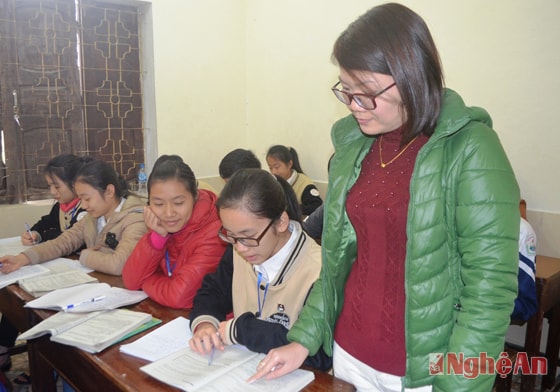 |
| A class at Quy Hop I High School. Photo: TD |
Preserving culture and nurturing future generations.
Following an introduction from Comrade Nguyen Tien Canh, Head of the Propaganda Department of the Quy Hop District Party Committee, who previously served as Head of the Culture and Information Department of Quy Hop District for a long time, we visited Vi village in Bac Son commune. This is a familiar and attractive destination for those who want to learn about and explore the living space and unique characteristics of the Thai ethnic minority in recent years. Currently, the village has 56 households and 248 inhabitants. All households live in stilt houses with the distinctive style and appearance of the Thai people. In this area, the people have also established folk culture clubs with groups preserving Thai folk songs such as the xuoi, lam, and nhuon melodies; a culinary group specializing in preparing Thai dishes; and a group preserving traditional musical instruments of the ethnic minority.
Comrade Vi Thanh Hai, Secretary of the Party Branch of Vi village, Bac Son commune, shared: “On traditional holidays such as Independence Day, the traditional New Year of the ethnic group, and the anniversaries of the founding fathers of the village, the people organize cultural performances, prepare traditional dishes, and wear traditional costumes, creating a unique feature for Vi village. In addition, the clubs also serve tourism activities if there are tourists. Through this, we strengthen solidarity in the village and educate the younger generation about the traditions of the Thai ethnic group before they are lost.” Not only Vi village, but in Quy Hop district there are also purely Tho ethnic villages (Mo village - Nghia Xuan) and multi-ethnic cultural villages (Hoa Thanh village - Chau Quang).
Many communes have established folk culture clubs and organized effective activities; they have also organized classes to teach the Thai language. Activities such as folk art festivals, culinary competitions, costume competitions, rice wine culture competitions, and competitions in traditional sports such as furrow carving, tug-of-war, bamboo pole dancing, throwing the ball, stick pushing, crossbow shooting, stilt walking, etc., are organized enthusiastically from the district to the grassroots level, especially during festivals and major holidays. As a result, many unique traditional cultural features of ethnic minorities such as their language, writing system, costumes, cuisine, housing, folk songs, folk music, and folk dances have been preserved.
Over the 10 years of implementing the Project to build a model district for mountainous and ethnic minority culture, from 2001 to 2011, Quy Hop district has achieved many successes in this field, especially in preserving and promoting intangible and tangible cultural values in the area. Based on the results achieved, the District People's Committee has developed the Project "Building a model district for mountainous and ethnic minority culture in Quy Hop, from 2012 to 2015". Building on the achievements and combining them with creative approaches suitable to the practical situation, the district continues to implement many effective solutions, especially the socialization of efforts in restoring and preserving cultural relics.
We visited Choọng Temple in Châu Lý commune, a place of worship dedicated to Nang Phốm Hóm, a woman who made significant contributions to gathering food supplies for the troops during the Lam Sơn Uprising. The rebels stayed there to recruit soldiers and gather provisions for the resistance against the Ming invaders. In the hearts of the local people, Nang Phốm Hóm is a beautiful symbol of the virtues of a Thai woman, representing the solidarity and brotherhood between the Thai and Kinh ethnic groups. “However, over time and due to historical changes, the old Choọng Temple has been damaged, with only the foundation and a few remnants remaining. Therefore, the restoration of Choọng Temple has always been a longing in the hearts of the local people.”
On July 8, 2011, the Department of Culture, Sports and Tourism issued a document agreeing to restore and renovate Choọng Temple,” said Comrade Cao Duy Thái, Deputy Secretary of the Party Committee of Châu Lý commune, who has many years of research on local culture. However, mobilizing funds for the project faced many difficulties. In response, the district established a committee to mobilize resources for the restoration and renovation of the temple, and received enthusiastic support from businesses in the Quỳ Hợp District Small and Medium-Sized Enterprise Association. Therefore, phase 1 of the Choọng Temple restoration project was completed on July 12, 2014, much to the joy of the people of Mường Choọng, with the completion of the main hall and auxiliary structures. It is noteworthy that the entire construction cost of 10 billion VND was entirely raised through social mobilization. Comrade Vi Văn Hóa, Secretary of the Party Committee of Châu Lý commune, stated: “Without social mobilization efforts, the Choọng Temple project would hardly have been completed as it was.” today. This also serves as the foundation for continuing the restoration of the temple in phase 2, including the Lower Hall and other structures belonging to phase 3.”
With the achievements made in the cultural field, especially in the preservation and promotion of intangible and tangible cultural values, Quy Hop district has paid special attention to education and achieved many clear results, despite the difficult teaching and learning conditions of a mountainous district. We visited Quy Hop I High School - a school that made many significant achievements in the 2013-2014 school year when 204 students passed the university entrance exams, including class 12A with 100% of its students passing and 20 students achieving 24 points or more. Overall, in the 2013-2014 school year, the school had 8% of students classified as excellent, 53% classified as good, the high school graduation rate reached 99.73%, and 24 students from grades 11 and 12 won provincial-level awards for excellence.
Sharing about these proud achievements, Mr. Cao Thanh Luu, Principal of Quy Hop I High School, said: “The achievements in teaching and learning are the result of a process. In the past school years, the school has assigned responsibility for quality to each teacher and subject group; strengthened management according to regulations on the content of the main curriculum; and at the same time built training programs to improve students' skills. In addition, the school has also given autonomy to homeroom teachers and subject groups, we only manage quality, thereby encouraging teachers to proactively seek solutions to improve the quality of teaching and learning; building solidarity within the school and mechanisms and policies to encourage teachers.”
On a general level, the 2013-2014 school year was the fourth year of implementing the resolutions of the Party Committee for the 2010-2015 term. During this school year, the district had two more schools achieving national standards (Van Loi Secondary School and Chau Tien Primary School), raising the total number of schools meeting the standards to 43 (22 primary schools, 10 secondary schools, and 11 kindergartens) out of a total of 69 schools, achieving 62.3%. With these results and in comparison to other mountainous districts and the entire province, the district's achievement in building standard schools places it among the high-performing units, ranking 5th out of 21 districts, cities, and towns in the province.
In a conversation with us, Comrade Vo Sy Son, Head of the Education Department of Quy Hop District, shared his experience: "To achieve the goal of building national standard schools, we have determined that social mobilization plays a crucial role. Based on the plan for building national standard schools, the district, the education sector, and local authorities have implemented specific solutions to mobilize and prioritize funding for infrastructure development, while simultaneously focusing on improving the quality of teaching and learning."
Speaking with us about the achievements made, Comrade Phan Dinh Dat, Permanent Deputy Secretary of the Quy Hop District Party Committee, said: “Based on the achievements we have made, we will focus on drawing lessons to find good lessons in how to formulate resolutions and direct their implementation in practice, creating a foundation for building Quy Hop district into a comprehensively developed district, with the goal of becoming the most prosperous mountainous district of Nghe An province, and preparing in the best way for the 20th District Party Congress, term 2015 - 2020.”
Huu Nghia - Nhat Le


