
Developing the aquaculture industry
(Baonghean) - In recent years, in addition to traditional freshwater aquaculture species, people in Nghe An have gradually introduced the cultivation and exploitation of marine specialty aquatic species such as oysters, clams, crabs, sea bass, red snapper, grouper, etc. The success of these models not only contributes to diversifying aquaculture species but also opens up a promising new direction in the development of high-value marine specialty aquaculture.
(Baonghean) - In recent years, in addition to traditional freshwater aquaculture species, people in Nghe An have gradually introduced the cultivation and exploitation of marine specialty aquatic species such as oysters, clams, crabs, sea bass, red snapper, grouper, etc. The success of these models not only contributes to diversifying aquaculture species but also opens up a promising new direction in the development of high-value marine specialty aquaculture.
DDien Van (Dien Chau district) has an estuary connecting to the sea, providing an abundant supply of seawater for the entire brackish and saltwater aquaculture area of approximately 65 hectares in the commune. In recent times, due to increasingly complex climate and weather changes, polluted farming environments, unstable shrimp seed quality, and constantly rising production costs, many shrimp farmers have suffered losses and are no longer able to reinvest. This is why aquaculture farmers in Dien Van are replacing a portion of their inefficient shrimp farming area with sea crab farming. This approach not only helps them recover losses but also significantly increases their income.
As one of the pioneering households to switch from raising tiger shrimp to commercial crabs, Mr. Phan Thanh (Van Nam hamlet) recalled: "Previously, my family raised tiger shrimp in an earthen pond covering nearly 1 hectare. But due to several consecutive disease outbreaks and unfavorable weather, we quickly lost our capital. Seeing that shrimp farming was becoming increasingly difficult in the area, in 2002 I boldly converted all the shrimp farming area to crab farming because there was a readily available source of juvenile crabs caught by locals from the mangrove forests. In the very first season, although I was learning as I went along, I made a profit, and the next two seasons were very successful, earning over 50 million VND per season. The advantage of crab farming is that you can harvest them year-round, so the income is steady. Now, not only me but many people in the commune are more fond of crabs than shrimp, because crabs are easier to raise and more reliable, with an abundant food source of small fish or small crustaceans caught from the forest." "Crabs are coming in from the sea. Currently, there's no need to worry about the market for crabs, especially during the upcoming tourist season or major holidays. For example, the price of Grade I crabs is currently 400,000-450,000 VND/kg, and Grade II crabs are 320,000 VND/kg. These prices are relatively high, and there isn't enough supply for traders to collect."
Mr. Tran Minh Tuan, Head of the Agriculture Department of Dien Van commune, said: Around the year 2000, people here became familiar with raising crabs alongside shrimp, using extensive farming combined with selective harvesting and restocking. Although the economic efficiency was not high, crabs "saved" shrimp farmers. Investing in intensive crab farming can be said to be a new approach that has developed strongly in the last 6 years. And with the goal of finding a suitable aquaculture species to increase economic efficiency per unit area, since 2012, the Dien Chau District Agricultural and Fisheries Extension Station has implemented a model of commercial crab farming at Mr. Tran Loc's household (in Xuan Bac hamlet) on a pond surface area of 0.5 hectares, stocking 5,000 crab juveniles. After more than 3 months of farming, the survival rate reached 60%, yielding a total commercial crab production of 750 kg; With a selling price of 320,000 VND/kg at the pond, after deducting expenses, Mr. Loc earned nearly 170 million VND...
Currently, Dien Van commune has 67 households raising crabs, mainly concentrated in Trung Hau and Trung Phu hamlets, with a total area of over 20 hectares; the annual production value reaches 1.3-1.7 tons/hectare, generating revenue of over 10 billion VND... In 2013, the Provincial Agricultural Extension Center organized a summary and evaluation of the results and discussed measures to expand the model. Based on the results of the experimental farming models, experts and farmers unanimously agreed that coastal communes in Nghe An province have the full potential to develop commercial crab farming models. Furthermore, commercial sea crab farming provides a basis for farmers to diversify their livestock species and farming methods, contributing to increased income and creating new products to meet market demands.
Mai Hung Ward (Hoang Mai Town) has the advantage of the Mai Giang River running through it for 6 km before flowing into the sea at Corn Creek. Thanks to its proximity to the river mouth and the sea, the Mai Giang River has a moderate salinity level, allowing for strong plankton growth. This creates an advantage for the local people, enabling them to develop oyster farming, a nutritious brackish water delicacy.
Oysters are planktonic aquatic organisms that thrive in saltwater. When they encounter obstacles, they attach themselves to them, forming clusters to reproduce. The people of Mai Hung have adapted to oyster farming by relying on the tides. They divide up the riverbanks, driving bamboo and concrete stakes to create support structures. According to Mr. Van Duc Nhiem, the first person to bring oyster farming to this section of the river, oysters are naturally sedentary animals, not moving like some other mollusks. They are passive predators, feeding on diatoms that float with the ebb and flow of the tides. Oysters only spawn during one tide cycle, from around March 15th to the end of March in the lunar calendar; after that, there are no more oysters.
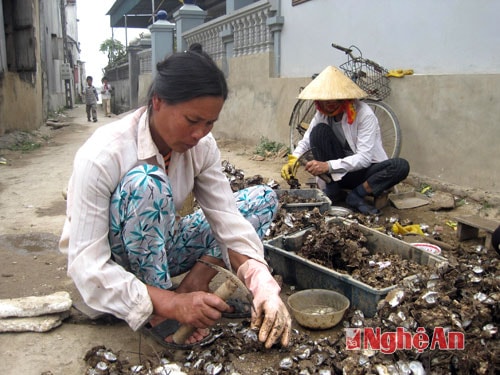 |
| Residents of Block 10, Mai Hung Ward (Hoang Mai Town) are harvesting oysters. |
To prepare new habitats for oysters, locals use old oyster shells, drilling holes in the center and stringing them together with fishing line (about 70cm long). Next, they drive stakes and build sturdy bamboo frames, placing them 4-5 meters from the shore. From mid-February (lunar calendar), they hang the strings on the frames with a distance of 20cm between each string. After about 10-15 days, the oysters begin to seek shelter. They are left like that until the end of the year for harvesting. Currently, in Nghe An province, oyster farming is mainly done in two ways: rack farming and cage farming. Each method has its own advantages and disadvantages, but rack farming is less expensive, so most people in Mai Hung choose rack farming. Currently, there are more than 80 households farming oysters in Mai Hung ward; even those with small farms release up to 2,000 strings, while those with larger farms release up to 10,000 strings. Mai Hung's oyster supply is currently providing for the markets in Vinh City and Hanoi. According to some locals, there has almost never been a year when the oyster supply was unsold; traders usually buy up everything they harvest. At this time, the cost of materials to complete a string of oyster shells to be dropped into the river is only about 10,000 VND. During the harvest season, coinciding with the hot weather, each string yields an average of 1 kg of oyster meat. With prices ranging from 80,000 to 100,000 VND, oyster farmers can make a profit of 8-10 times their initial investment. In 2013 alone, residents of blocks 10 and 11 earned over 5 billion VND from oyster farming...
Located in the planned area at the mouth of the Cam River in Cua Lo Town, Nghi Tan Ward currently has 21 households raising red snapper, sea bass, and grouper in 29 cages. Each household invests in 1-3 cages. After 8-9 months of raising red snapper and over 10 months for sea bass, the current selling price is 120,000 VND/kg for sea bass and 60,000 VND/kg for red snapper. After deducting expenses, the average annual income is about 60-70 million VND per household. They use a staggered farming method, harvesting and selling gradually, but during the tourist season, households usually harvest more to ensure sufficient supply for traders. In Nghi Thuy Ward, there are also 15 households investing in 20 cages raising the two types of fish mentioned above; each cage is 80-90 m³, stocked with about 4,000-5,000 fingerlings. In 2013 alone, the entire ward harvested over 100 tons of fish, supplying the seafood market and providing it to restaurants and hotels in the town, as well as supplying it to traders in Vinh City...
In reality, the introduction of new aquatic species for experimental farming requires not only stringent technical requirements but also very high investment costs. Meanwhile, the economic resources of the people are very limited, and only a few households dare to adopt these new species in small quantities. Therefore, policies supporting people with capital from programs and projects are needed. Simultaneously, planning aquaculture zones with species suitable to the environmental conditions of each region, farming practices, and consumer preferences is crucial; the issue of breeding stock and market outlets also needs attention. Currently, due to the small-scale nature of production, people source their own seeds, and many sources do not guarantee quality, resulting in low efficiency and price manipulation by traders. The effectiveness of scientific and technical transfer models in the fisheries sector, and the investment in building fisheries extension models by the province to introduce new, high-yield breeds for trial and widespread adoption, is very important. It contributes to improving economic efficiency per unit area for aquaculture households, increasing export value, and promoting the development of the fisheries sector in the future.
Ngoc Anh


