
Farm development - a path to sustainable wealth creation.
(Baonghean) - Yen Thanh is not only a "rice granary" but also has the advantage of being a semi-mountainous area for developing farm-based economy with many diverse and highly effective models. This is considered a sustainable way to get rich…
Upon arriving in the Ba Hon Len area of Dong Thanh commune, a semi-mountainous region in Yen Thanh district, we were overwhelmed by the verdant valley of orange trees. Mr. Nguyen Huu Binh, 60 years old, the farm owner, recounted: Having worked as a laborer in the Quy Hop orange-growing region, he returned to his hometown and saw that the gently sloping land of Ba Hon Len was only being used for eucalyptus cultivation, which was proving ineffective. In 2005, Mr. Binh and some friends boldly leased land from local farmers to invest in orange cultivation. Mr. Binh borrowed 1.1 billion VND from the bank and friends to focus on improving the land. He used excavators to remove eucalyptus stumps, then hired trucks to transport alluvial soil from the riverbanks and dried alluvial deposits. He divided the land into plots, furrowed rows, dug holes, and applied base fertilizer. He even went to the Fruit and Vegetable Research Institute to obtain high-quality orange varieties, mainly Xa Doai and Van Du oranges. Initially, he planned to cultivate 16 hectares of orange trees. To maximize land use, he intercropped vegetables under the orange trees for the first 2-3 years before the trees formed a canopy, in order to utilize the land, control weeds, and provide additional organic matter.
In 2009, the first orange crop yielded an average of 30 tons per hectare, resulting in a net profit of 4-5 billion VND after deducting expenses. With the profits from the oranges, in 2012-2013, Mr. Binh continued to plant an additional 11 hectares, bringing the total area to over 27 hectares. In 2013 alone, this generated revenue of over 12 billion VND. According to Mr. Binh, in addition to the main orange crop harvested in October (lunar calendar), he has used technical methods to ripen the oranges later for Tet (Lunar New Year), a period when prices are quite high, averaging 50,000 VND/kg at the farm. Mr. Nguyen Huu Binh's farm currently provides stable employment for 35 workers with an average salary of 4 million VND per person per month. Mr. Thai Van Thanh, Chairman of the People's Committee of Dong Thanh commune, happily stated: "The success of Mr. Binh's model has inspired many households in the Ba Hon Len area to learn how to grow oranges. Mr. Binh has directly advised the people on orange cultivation techniques, helping them purchase quality seedlings. To date, the Ba Hon Len area has created a specialized orange cultivation zone of over 50 hectares. In the 2014 orange harvest season, some households will have their first harvest, earning profits of approximately 500-700 million VND."
Heading up to the mountainous commune of Quang Thanh, we visited the integrated farm of Ms. Le Thi Toan's family in Quang Nhan hamlet. From a hardworking farmer, Ms. Toan has transformed the barren hills into a successful chicken farm. Ms. Toan said: Her parents left her 1.2 hectares of land, which had been mainly used for growing cassava for a long time without much success. In 2010, her family borrowed 270 million VND to reclaim the barren hills and transform them into a chicken farm and fruit tree plantation. On the higher ground, Ms. Toan planned to plant acacia and eucalyptus trees, while on the flat areas, she planned chicken coops. This hillside farm was developed on a closed-loop system, so it did not affect the community environment and isolated the livestock from disease. Initially, she raised over 1,000 broiler chickens and 200 laying hens. In the first batch, due to lack of experience, many chickens died during a cold spell. Undeterred, she continued to learn from experience and the technical procedures for raising chickens. By this time, she had expanded her investment in additional livestock facilities, currently owning 3 chicken coops with a total area of over 360 m2. In addition, she has a designated area for raising over 3,500 free-range chickens and 600 laying hens. Traders come directly to her farm to buy the chickens at an average price of 90,000 VND/kg. She also raises 3 cows, cultivates over 100 Thai mango trees, 50 jackfruit trees, and 0.7 hectares of acacia and eucalyptus trees. In 2013 alone, after deducting expenses, she earned a profit of over 300 million VND from livestock farming.
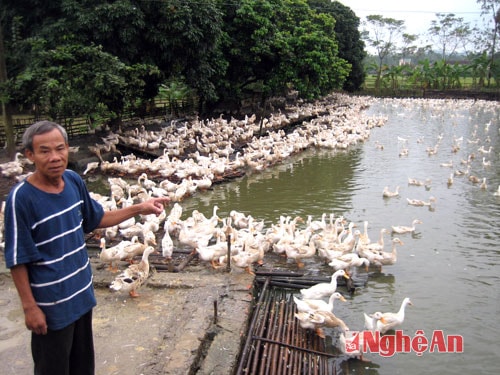 |
| Mr. Ngo Tri Ha's fish farm combined with duck farming in Nam Thanh commune. |
The farm movement in Yen Thanh district is developing quite strongly. Currently, out of 56 farms in the district, 45 meet the criteria of the Ministry of Agriculture and Rural Development. The development of farm economics has attracted a significant number of workers, with over 900 currently employed in the farm sector. During production and business operations, farms have applied scientific and technological advancements to achieve high efficiency, expanded joint ventures and partnerships, organized the collection of goods for sale, and signed bilateral trade contracts.
Mr. Thai Dinh Cau, Chairman of the Yen Thanh District Farmers' Association, stated: The development of farm-based economy in Yen Thanh still faces limitations such as inadequate transportation, electricity, and water infrastructure; many farms lack capital, leading to inconsistent investment; and credit institutions and banks have not yet adequately assessed the market for loans to develop farm-based economies. The loan terms offered by banks are not aligned with the production and business cycles, thus hindering long-term investment and development for farms. To ensure sustainable farm-based economic development, the province needs mechanisms and policies to encourage households with advantages to develop farms, expedite the issuance of land use right certificates, and quickly allocate land to farm owners when they meet the necessary conditions. It is also important to encourage households with the capacity to invest in leasing land for annual crop cultivation and water surface areas to facilitate concentrated commodity production. Banks need to prioritize funding for farms that meet the criteria, increase loan amounts for farms, and encourage production and consumption linkages between farms and businesses.
If obstacles and difficulties are promptly addressed, farm-based economy will develop sustainably, contributing to the transformation of barren and unproductive lands into potential, prosperous areas.
Van Truong


