
Developing a reading culture: Not just relying on book fairs.
To ignite and sustain a passion for reading, develop a reading culture, and make the annual book festival in Hanoi more effective, many cultural experts suggest that the book festival should be concentrated in one location and should include regular activities to maintain its momentum.
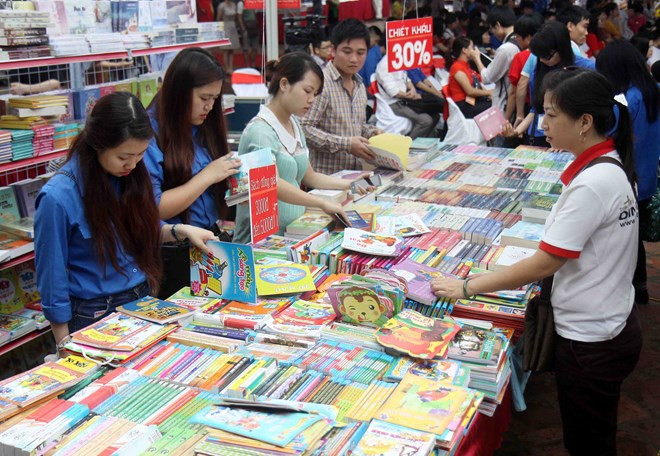 |
| A large number of readers attended the 2014 Book and Reading Culture Festival. Photo: VNA |
Focus on location and categorize target groups.
According to Decision 284/QD-TTg of the Prime Minister, April 21st is designated as Vietnam Book Day. This year, the first Vietnam Book Day was held from April 19-21, 2014 nationwide; with the main activities taking place in Hanoi.
Besides the two main locations, the National Library and the Temple of Literature, many activities celebrating the first Vietnam Book Day were also organized at other locations in Hanoi such as the Women's Museum, the East-West Cultural and Language Center, etc.
However, according to Mr. Nguyen Kiem, Vice President of the Vietnam Publishers Association, once an official decision has been made regarding Vietnam Book Day, the book festival should be concentrated in one location.
"Concentrating activities in one location will create an overall space where the public can experience many different activities without spending a lot of time traveling," Mr. Kiem expressed.
Sharing the same view, Associate Professor Dr. Nguyen Thi Minh Thai (University of Social Sciences and Humanities - Vietnam National University, Hanoi) suggested that activities for Vietnam Book Day should be concentrated at Van Mieu-Quoc Tu Giam because it is the first university in our country.
"This is of great significance in honoring the nation's tradition of valuing education," Ms. Thai shared.
Furthermore, this expert suggested that in the early years of organizing Vietnam Book Day, the organizing committee should categorize target groups attending the book fair and prioritize university and college students first. This prioritization should be concretized into activities such as introducing reference books for research and study; discussing effective reading methods, etc.
"We keep talking about organizing book festivals to save reading culture, but the specific question is how to save it? The biggest 'tragedy' for readers is not understanding the words. If reading culture among students is not saved, the immediate consequences are not difficult to imagine: Generations of students graduating will find it difficult to pursue their careers properly," Ms. Thai expressed.
Analyzing this issue in more detail, Associate Professor Dr. Nguyen Thi Minh Thai stated: Currently, according to statistics from the Ministry of Information and Communications and the Ministry of Culture, Sports and Tourism, the average reading rate of Vietnamese people is 0.8 books per person per year. Given this situation, organizing a book festival within a limited timeframe will not be able to change the awareness and reading habits of the entire society.
"Therefore, identifying priority target groups to develop appropriate action programs, avoiding the current scattered activities, is crucial; this will create a ripple effect throughout the community," Ms. Thai said.
"Keep the fire burning."
According to Mr. Nguyen Kiem, the selection of April 21st as Vietnam Book Day is an important milestone in the development of reading culture in Vietnam, contributing to promoting social awareness of the role of books and reading.
"This is an important premise. However, for this meaning to truly flourish, we need continuous activities, not just limited to organizing the annual book festival and hoping that this will change the reading habits that have been neglected over the past time," Mr. Kiem expressed.
Specifically, Mr. Kiem suggested that every family should build a home library, and schools should form reading clubs to encourage and cultivate reading habits among young children.
"Parents need to instill a reading habit in their children from a young age. We are not building a new one, but rather reawakening the inherent love of reading in our nation. Moreover, this will create a foundation for Vietnamese citizens to participate in global activities with a continuously updated source of knowledge," Mr. Kiem shared.
Sharing the same viewpoint, history professor Le Van Lan also believes that developing a reading culture needs to be nurtured regularly, alongside organizing annual book fairs as a highlight activity. "Maintaining the enthusiasm of book fairs is crucial; we shouldn't let it be like a fire that flares up for a few days and then dies down," the professor shared.
Specifically, according to Professor Le Van Lan, Hanoi should have a well-planned book street similar to Ho Chi Minh City's Nguyen Hue and Mac Thi Buoi book streets… “Let's build a book street as a regular cultural meeting point with activities for book exchange and interaction,” Professor Le Van Lan expressed.
He argued that Hanoi is the "heart" of the country. When Hanoi builds a widespread reading movement, it will have a significant ripple effect on other localities.
According to Vietnam+


