
Behind the violent videos
Our children may be intelligent, tech-savvy, and have thousands of followers online, but if their hearts are insensitive to the suffering of others, all those achievements become fragile and shattered.
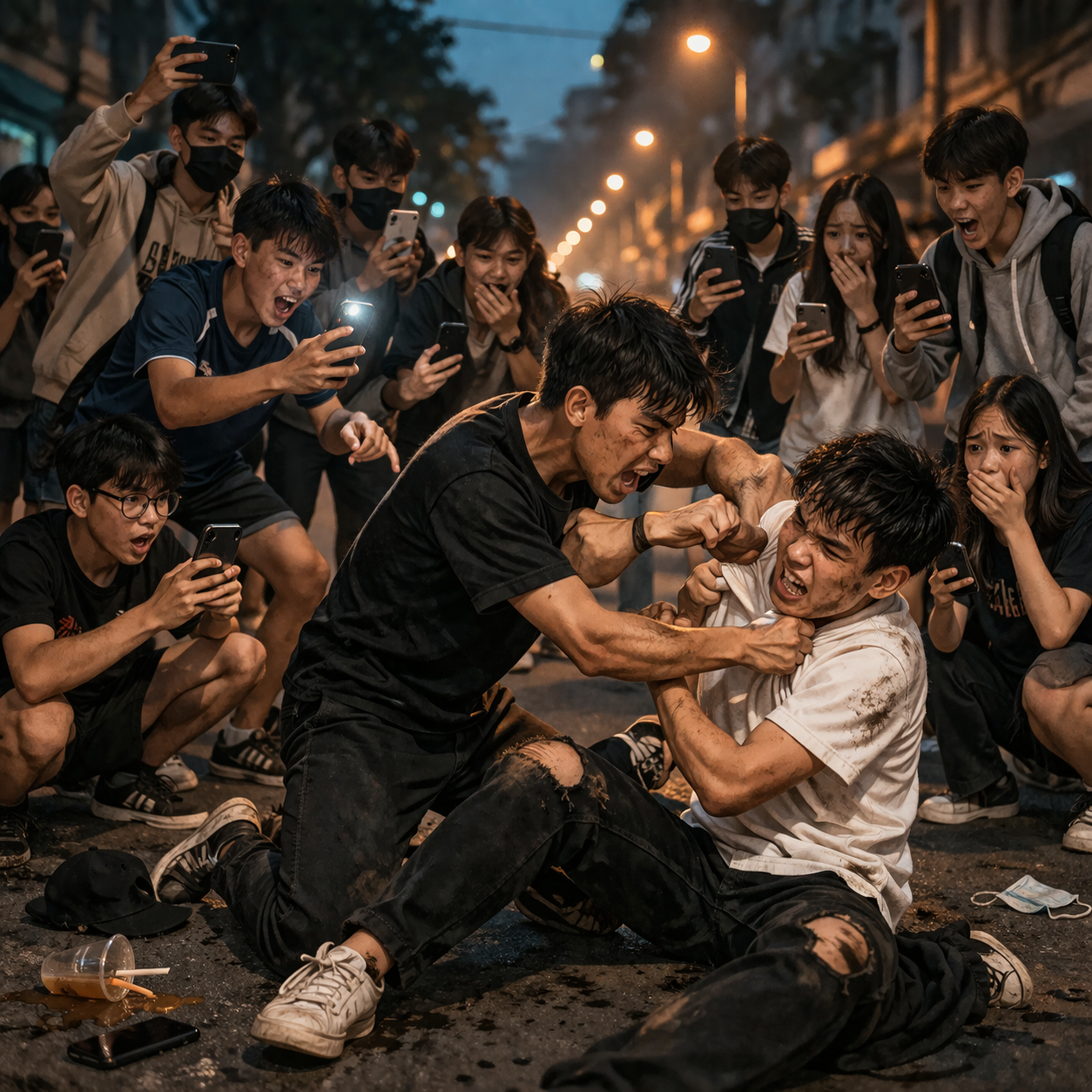

In recent days, social media has been circulating video clips of a fight between a group of teenagers on Dang Tat Street, Thanh Vinh Ward. Immediately afterwards, the teenagers involved were summoned by the police for questioning and legal action.
The story of youthful conflicts is nothing new, but what should make us—parents and those who are daily contributing to the preservation of social values—seriously reflect is what happens around that cycle of violence.
Amidst the insults and punches, not a single hand was raised to intervene. Instead, dozens of phones were excitedly raised. The young faces showed no sign of fear; instead, they were busy adjusting camera angles, pressing buttons to record videos and take photos, and cheering and inciting the violence. The real-life altercation seemed to be treated as a "dramatic scenario" to be spread online.
Are we perhaps facing a profound crisis of empathy among a segment of the younger generation?
In social psychology, there's a concept called the "bystander effect." When many people witness an emergency, the probability of each person helping the victim decreases. However, the issue here doesn't stop at passivity. Taking out phones to film, take pictures, or even livestream and shout incitement transforms the behavior from simply watching into complicity in violence.
The phone screen has inadvertently become a shield separating the videographer from reality. Looking through the lens, these young people no longer see their friend's pain, nor the danger of the illegal act. They only see the "content," the skyrocketing viewership numbers, and the virtual interactions on social media. Violence has been cruelly glorified for entertainment.
This is not the first time that real-life conflicts, violence, injuries, and suffering have become "clickbait content" online. It's time we frankly acknowledge that, in some people, indifference is being digitized. When the cries of pain from fellow human beings are no longer as impactful as a "like" notification, that's when the moral foundation within each individual is severely fractured.

I spoke with psychologists to try and understand the deeper reasons why these 15- and 16-year-old teenagers choose to film and cheer on violence instead of intervening. The answer lies in a "thirst for validation" online. In the world of some Gen Z and Gen Alpha, possessing unique, shocking, and sensational images gives them a kind of virtual power: the feeling of being the center of attention, the most well-informed person.
These young people don't understand that the price of virtual fame is the devaluation of true human values. A society where young people see witnessing violence as an opportunity to increase interaction is a society with deadly flaws in character education. We teach them to excel academically, to be proficient in technology, but we seem to have forgotten to teach them compassion, how to love correctly, and how to defend what is right when it happens right before their eyes.
Don't think that cheering during fights is just a childish display of competitiveness. Looking at photos and videos of street violence, hearing the inciting shouts, seeing hands raised high with phones to get the "perfect" shot, we can't help but question the role of the family. Where are the parents when their children carry aggression and phones full of distorted thoughts into the streets?
Many parents today are completely entrusting their children's education to schools. Many buy their children the latest smart devices, but fail to equip them with the necessary character traits to navigate the world. Many parents are preoccupied with making a living, only to realize, when their child appears in a fight as either the aggressor or an indifferent bystander, that it's too late.
Our children may be intelligent, tech-savvy, and have thousands of followers online, but if their hearts are insensitive to the suffering of others, all those achievements become fragile and shattered. Education is not just about grades on paper. Education is about instilling in children a sensitivity to the pain of others. If a child doesn't feel pity when they see a friend fall or be beaten, then all academic knowledge becomes meaningless.
The incident in Thanh Vinh ward serves as a wake-up call. Police summoning the perpetrators is a necessary legal deterrent, but addressing the root of the problem certainly requires coordinated public action. We need to condemn not only the teenagers involved in the brawl, but also the "image directors" standing around. They need to understand that filming violent videos for views isn't cool; it's cowardly and immoral. The law also needs clearer regulations regarding the dissemination of school violence and juvenile violence content on social media to prevent these unhealthy "contents" from the source.
Please don't just view this incident as a typical public order and security news story. Let's see it as an urgent message about revitalizing the culture of behavior among young people. Behind those brightly colored phone screens, sometimes lies a soul withering away due to a lack of guidance from compassion.
Parents, please take the time to sit down with your children and ask them, "If you saw a friend in trouble, what would you do?" Schools need to integrate moral education, life skills, and civic awareness more deeply, not just through theory but through real-life situations. Society needs to strongly condemn the act of encouraging violence through screens, while simultaneously encouraging positive behavior – young people who dare to intervene, who dare to say no to indifference. Kindness needs to be learned, and it must begin with caring, strict yet compassionate education starting today.


