
The Deputy Prime Minister finalized the investment plan of nearly 20,000 billion VND to expand Tan Son Nhat Airport.
Mr. Trinh Dinh Dung chose the option of expanding Tan Son Nhat airport on existing military land with an investment of nearly 20,000 billion VND, to be built within 3 years.
On January 20th, Deputy Prime Minister Trinh Dinh Dung held a meeting with leaders from the Ministries of National Defense, Transport, Construction, the Government Office, and the Ho Chi Minh City Department of Transport to find solutions to address the congestion at Tan Son Nhat Airport.
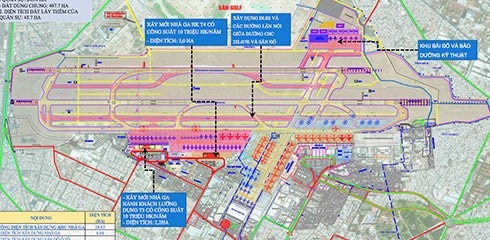 |
The proposed plan for Tan Son Nhat Airport. (Photo: VNE) |
At this meeting, the consulting unit, the Aviation Construction Design and Consulting Company (ADCC) under the Air Defense and Air Force Command, presented three options for adjusting the planning of Tan Son Nhat International Airport.
According to Option 3, the consulting unit proposed building parallel taxiways and connecting taxiways between the runway and the apron; renovating the current northern runway (runway 25L/07R); constructing a dual-purpose T3 terminal with a capacity of 10 million passengers/year; and constructing a T4 passenger terminal with a capacity of 10 million passengers/year in the southern area of the current airport.
This option utilizes existing military land, so the cost is approximately 19,700 billion VND, the construction time is 3 years, and it guarantees a capacity of 43-45 million passengers per year.
Leaders of the Ho Chi Minh City Department of Transport reported on traffic diversion plans and the construction of eight traffic projects to alleviate congestion at Tan Son Nhat Airport, as well as drainage and flood control projects for the airport area. Among these, the Ministry of National Defense has agreed in principle and allocated land for the Ministry of Transport to invest in the construction of a regulating reservoir of approximately 1.3 hectares.
After listening to the discussions, Deputy Prime Minister Trinh Dinh Dung affirmed that adjusting the planning and upgrading Tan Son Nhat International Airport is very urgent, therefore ministries, sectors, and the People's Committee of Ho Chi Minh City must be truly decisive and accelerate the implementation of assigned tasks. The Deputy Prime Minister also agreed to propose choosing option 3 from the above options to finalize and report to the Prime Minister before February 25th.
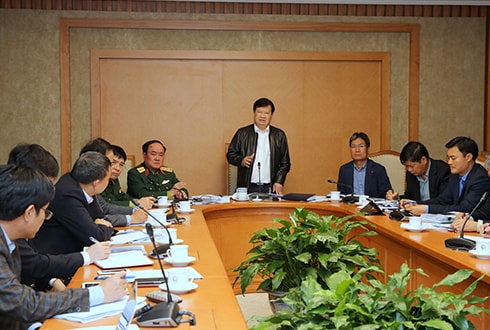 |
Deputy Prime Minister Trinh Dinh Dung has requested the urgent expansion of Tan Son Nhat Airport. (Photo: VNE) |
The Deputy Prime Minister instructed the Ministry of Transport to direct the consulting unit to review and finalize the planning, which includes the arrangement of the technical area in the north, parallel and rapid exit taxiways, passenger terminal area, parking area, transportation system connecting the airport with the outside, and drainage system. At the same time, they should proactively define the projects and determine the capital structure for investment to expand and upgrade the airport.
“The runway and apron projects will use state capital and be implemented by state-owned enterprises; passenger terminals, service areas, etc., will be invested in through socialized capital; and connecting transportation routes with the outside will be implemented using investment capital from the Ho Chi Minh City People's Committee,” the Deputy Prime Minister instructed.
Mr. Dung also instructed the Ho Chi Minh City People's Committee to effectively implement traffic congestion mitigation projects, invest in infrastructure, and connect the city center to the airport to facilitate travel for citizens.
Previously, Deputy Prime Minister Trinh Dinh Dung issued a directive requiring relevant agencies to plan and upgrade Tan Son Nhat Airport to handle 40-50 million passengers per year. Currently, Tan Son Nhat Airport's capacity by 2020 is 25 million passengers, but in reality, it is serving 28 million passengers per year.
Besides Option 3, the consulting unit presented two other options: Option 1 involves constructing a completely new system of runways, taxiways, aprons, terminals, and auxiliary facilities on the golf course area north of the airport, while also relocating surrounding residential areas. This option could increase the airport's capacity to approximately 60 million passengers per year, but would take 10 to 15 years to build, require the relocation of over 140,000 households, and cost an estimated 200,000 billion VND. Option 2 involves constructing parallel taxiways and connecting taxiways between the existing runways and aprons; building rapid exit taxiways and parallel taxiways between the two runways; upgrading the existing northern runway; and constructing dual-use terminals T3 and T4. This option requires 61,000 billion VND, takes 8-10 years to build, and increases the airport's capacity to approximately 43-45 million passengers per year. |
According to VNE
| RELATED NEWS |
|---|


