
The tradition of making traditional Tet candies in Thanh Chuong.
It's called Tet candy because only when the peach blossoms bloom and families prepare for the Lunar New Year do the people in my hometown make this traditional candy to treat guests during the Spring Festival. This rustic Tet candy has a distinctive and unique flavor characteristic of the midland region of Nghe An province.
On the last nights of the twelfth lunar month, Mrs. Ngo Thi Mai and her husband in Minh Duc hamlet, Kim Bang commune (Thanh Chuong district) continue to cook pots of Tet candy for their customers. In the kitchen behind the house, Mrs. Mai is stirring the molasses over a wood-fired stove. The pot of amber-colored sugarcane molasses boils and bubbles, filling the entire house with a fragrant aroma.
.jpg)
Ms. Mai shared: Her family has a long history of making and selling Tet candies at the market. Every year, around the middle of the twelfth lunar month, she and her husband start making these candies. The business lasts from the twelfth lunar month to the first lunar month. During the year, they make candies to serve families celebrating Tet. After the new year, customers mainly buy them as gifts for relatives far away.
According to Ms. Mai, Tet candies in her hometown are made from familiar ingredients such as molasses, roasted peanuts, puffed rice powder, and fresh ginger. The roasted peanuts are cleaned of their skins and ground into three or four pieces in a mortar. The puffed rice powder is made from finely ground glutinous rice flakes or puffed rice made from glutinous rice. As soon as the molasses pot is put on the stove, finely crushed ginger must be added to prevent the molasses from overflowing.
.jpg)
The candy maker has to sit and watch the pot of syrup, constantly stirring and stirring. After the syrup has been cooking for 10-15 minutes, when it becomes slightly thick and dark in color, roasted peanuts are added. Using two large chopsticks, the peanuts are stirred and mixed well with the syrup. Then, the rice flour is added, and the mixture is stirred until it becomes a smooth, pliable candy. "The stirring process should only be done over a low heat, not a high flame, as this can easily burn the candy," Mrs. Mai said.
.jpg)
While his wife was stirring the syrup, Mr. Nguyen Dinh Lam – Mrs. Mai's husband – took the opportunity to prepare the candy cutting mold, spreading layers of fine white rice flour onto the bottom of the mold. This mold, made of steel and plastic, was handcrafted by Mr. Lam himself during his time as a craftsman.
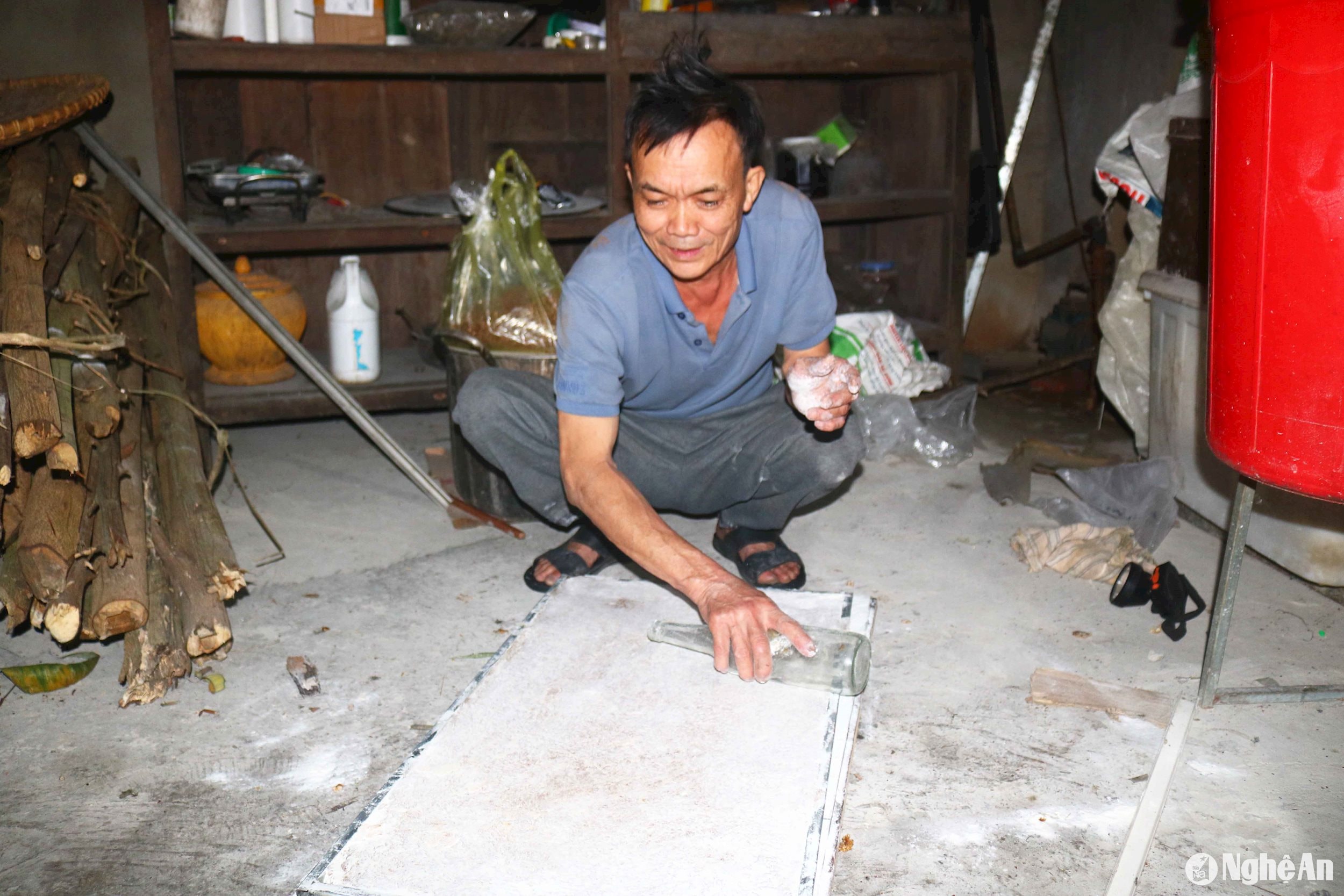
The mold is about 1 meter long and 0.6 meters wide. When the candy mixture is poured into the mold, the couple quickly use chopsticks to spread it evenly, then sprinkle a layer of rice flour on top and roll it around in the mold with a bottle.
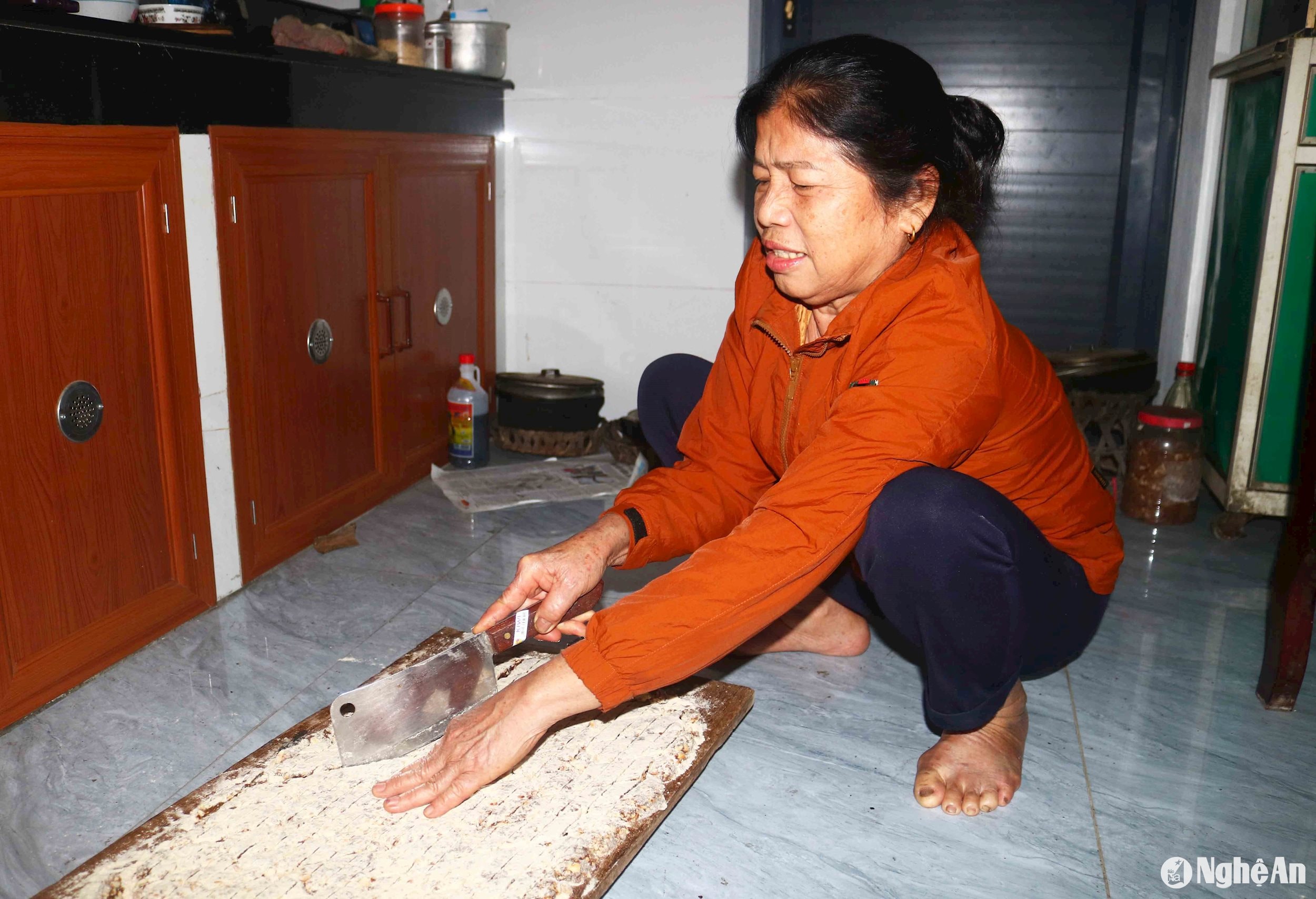
Once the candy mold was flat, Mr. Lam used a wooden stick as a guide and a knife to cut the candy into strips as thick as a finger, sprinkling flour as he cut. According to Mr. Lam, this was done to prevent the candy strips from sticking together. Mrs. Mai used scissors to cut each strip into shorter candies. After cutting, the candies were sprinkled with a layer of rice flour and packaged into individual plastic bags, each weighing 0.5-1 kg.
Ms. Mai explained that making a batch of delicious, crispy, and brightly colored Tet candy requires mastering the technique and mixing according to the correct ratio (1 part honey: 1 part peanuts: 0.4 parts rice flour). Timing the addition of peanuts and rice flour to the honey mixture is crucial. Mixing too early will result in soft, runny candy, while mixing too late and cooking the honey for too long will make the candy hard, dark, and unappetizing.
.jpg)
Also made from ingredients like molasses, glutinous rice flour, roasted peanuts, etc., but unlike the soft, chewy honeycomb cakes, these traditional Tet candies are crispy and have a distinctive flavor that's "loved once you've tried them."
Ms. Mai said that she used to make candy to sell at markets, but now, due to high customer demand, she sells out every batch she makes. Each batch usually yields 5-6 kg, and she can only cook two batches a night at most. The candy costs 100,000 VND/kg, and during Tet (Lunar New Year), many families in the area buy it to eat and offer to guests.
Besides the families who make traditional candy, many families in my hometown also make their own candy for Tet (Lunar New Year). They prepare for months in advance, and only start stirring the syrup when Tet is approaching or when the sticky rice cakes are already on the stove. Making this candy is both delicious and safe, and it creates a warm and cozy atmosphere of family reunion, so every Tet, people in my hometown eagerly make this traditional "homemade candy."
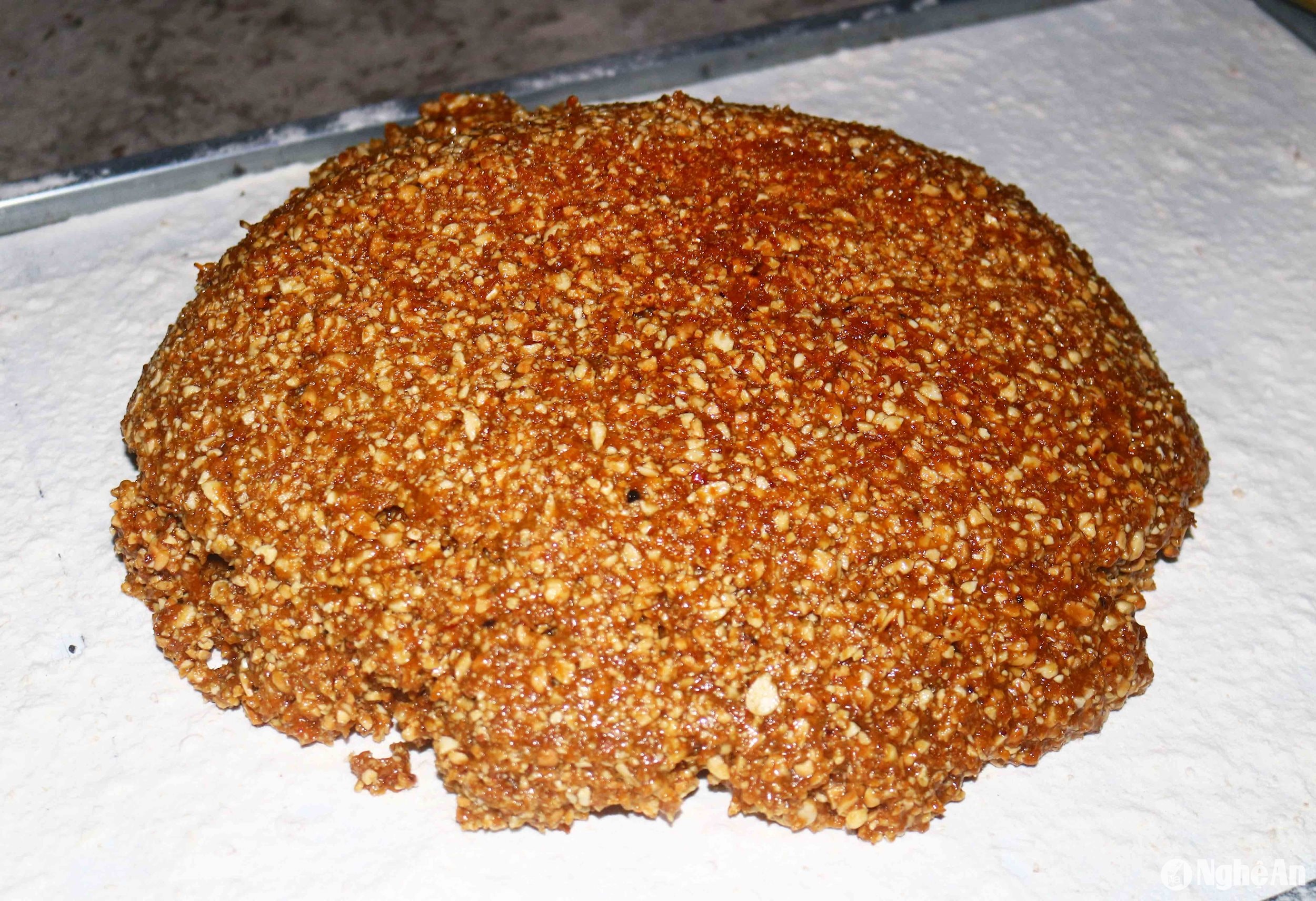
To make Tet candy, every family has to stay up all night pounding and grinding rice flakes, stirring honey, and shaping the candy... When the sticky candy mixture is poured onto a tray, everyone in the family will sit around the tray of hot candy, together shaping and rolling it into round or flat candies as they like.
Shaping the candy mixture for Tet (Vietnamese New Year) is the most laborious step, as it must be done while the mixture is still hot; the cooler it gets, the harder it becomes to shape. Many families have to cooperate in this process. Over time, many people have created ways to cut the candy using molds, making Tet candy making less strenuous.
Mr. Hoang Phi Hung (67 years old) – an experienced Tet candy maker in Minh Duc hamlet, Kim Bang commune – shared: "In the past, during Tet, every household in the village made candy. Some made a few bottles of syrup, while others made a whole can of syrup. Nowadays, compared to other candies and cakes on the market, traditional Tet candy may not be visually appealing, but it is high-quality, delicious, clean, and safe."
Over the years, as rural life has changed considerably, the bustling scene of families making candy during Tet (Lunar New Year) is no longer as common as it used to be. However, some families still preserve the old custom of "making candy to welcome Tet." Many households no longer make candy themselves but instead buy candy from other families.
Recognizing the demand for Tet candy – a local specialty – some people have started making Tet candy to sell in markets, supplying stalls and shops, and selling online. From a simple, rustic dish, traditional Tet candy has become a unique and unusual product on the market.
.jpg)
Traditional New Year's candies from my hometown are placed on ancestral altars and used to entertain guests during the Spring Festival. Enjoying these candies with green tea is a beautiful aspect of the New Year's culinary traditions in my village.
Amidst the cool weather and the faint scent of incense, people sit and sip tea, savoring each piece of candy, feeling the sweetness of honey, the richness of peanuts, the fragrant aroma of sticky rice flakes and fresh ginger, listening to the "taste of home" spreading in the atmosphere of the approaching spring.
.jpg)
For the people in my hometown, even though the market offers a wide variety of sweets and candies, Tet candies still hold a special place in the hearts of the people of my village – the place where they originated.
When images of Tet candy were posted on social media, people felt Tet drawing closer, and those who lived far from home felt a pang of longing to return home and reunite with their families around the pot of Tet candy, enjoying this "homemade candy" that holds so many childhood memories.
In my hometown, Tet candy is also an attractive local gift that travels with villagers to the South and North, warming the hearts of those who are far from home and cannot return for Tet.
.jpg)
In the final days of the year, amidst the joyful atmosphere of reunion, the fragrant aroma of Tet candies adds to the festive spirit of welcoming the New Year for each family. Tet candies, along with green sticky rice cakes and red couplets, contribute to making the traditional Tet holiday more complete and rich in the cultural identity of the homeland.


