Tet customs of the Tho ethnic group
(Baonghean) - As Tet (Lunar New Year) approaches, everyone completes necessary tasks to focus on celebrating and enjoying the holiday. For the Tho people, farming work is usually put aside on the morning of the 25th day of the 12th lunar month...
...On the 27th day of the Lunar New Year, the Tho people slaughter buffaloes (later cows), a ritual called "transforming" the buffaloes. On the 29th day, people go to welcome their brides (who are not yet married) home for the New Year celebration, while the men visit the graves of their ancestors. On the 30th day of the Lunar New Year, every household slaughters a pig. The pig's parts are cut up, with particular attention paid to the offal, cleaned and boiled to offer to their ancestors. This is also the day to plant the New Year's pole. They find and cut the tallest, straightest bamboo or ironwood tree, bring it back and plant it near the side of the house, where the rice mortar is placed. The New Year's pole must be as tall as the roof, sometimes even taller than the roof. They hang betel nuts, copper coins, zinc coins, and (fake) gold bars... on the New Year's pole. Around the house, in the pigpens, chicken coops, buffalo sheds,... they plant reeds (reeds with white flowers). Around 4 pm, every household sets up an offering tray, inviting their grandparents and ancestors to celebrate the New Year with their descendants. On New Year's Eve, the homeowner prepares an offering to their ancestors with wine, betel nuts, fried cakes, or glutinous rice dumplings. Young people and children go to the stream to "bathe in the sacred water." The Tho people believe that the water is purest at midnight, and that the fairies from heaven also come down to bathe. Therefore, bathing at this time will bring "good luck and health" throughout the year!
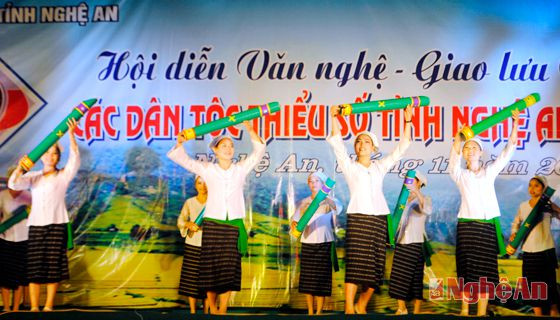 |
| A traditional dance performance by the Tho ethnic group, presented by the Quy Hop District Folk Arts Troupe. Photo: Cong Kien |
On the morning of the first day of Tet (Lunar New Year), all families reunite to worship their ancestors and other deities. These include the Earth God, the Dragon Vein God, and the Spring Guardian (specifically for the Dinh family). The ceremony is held at the temple. After the ceremony, they eat and drink on the spot. Elderly and respected people in the village visit each household to offer New Year greetings. Then everyone exchanges New Year greetings. Every house is invited to share a meal. At noon, they prepare to worship their ancestors again. This ceremony is special because it includes offerings brought by the descendants of the village (if the host is elderly, they are considered the "chief"). In the afternoon, they worship the village's tutelary deity, Cao Son Cao Cac, at the head of the family's house (there is no separate temple). This is essentially a "family" worship ceremony, with three families preparing offerings once a year. After the ceremony, they have a communal meal. On the evening of the first day of Tet (Lunar New Year), families with elderly members hold a longevity celebration called "Vai Xet," which means "Making the spirit of Tet," essentially a ceremony to honor their grandparents and parents. After the ceremony, the children and grandchildren tie a hemp rope around the hand (binding the spirit) of the person being celebrated; conversely, the person being celebrated also "wishes good health" to their children and grandchildren by tying a hemp rope around their hand.
On the second day of Tet, families with unmarried daughters-in-law returning home for the holiday prepare offerings for their sons to see them off back to their maternal grandparents' house. These offerings are used to worship the maternal grandparents and ancestors. Traditional folk games are organized, such as tug-of-war, rice pounding, gong and drum playing, and spring outings.
On the third day of the Lunar New Year, the Tho people hold a "farewell ceremony," meaning "sending ancestors back to heaven." On the morning of the fourth day, they hold the "Tơm Tru" ceremony (buffalo offering). This is a ceremony to "thank the buffalo" for helping them plow the fields throughout the past year and for helping them plow in the coming year. The offering includes a boiled chicken, various meat dishes, cakes and fruits, and, of course, fish. The prayer expresses the people's affection for the buffalo: "Tru ếnh tru oáng/ The buffalo has toiled and suffered all year/ In the new year, we pray for the buffalo to be healthy/ To plow with its owner/ To produce sticky rice in May and regular rice in October/ To fill the house with rice/ To fill the coop with chickens and ducks/ May the Earth god protect the buffalo/ To graze in the forest without being harmed by tigers and leopards…"
The fifth day of the Lunar New Year is considered a "lucky day" by the hunting community, when they hold the Xang Lai ceremony (casting nets to hunt animals, either real or symbolic) to start the year. If they catch a large animal on that day, it is believed that the whole year will be prosperous ("An Thuc Moong Nai, Cai Moong Ca").
The sixth day of the Lunar New Year is a day for continued festivities. Those who haven't yet visited relatives and friends to offer New Year greetings should do so.
The seventh day of the Lunar New Year is the day of "opening the New Year." This day is called "pổ nêu" (taking down the New Year pole). People take down the New Year pole, and the things hanging on it fall to the ground. Everyone scrambles to pick them up, considering them "luck" for the new year. Whoever picks up the most will have good fortune in the coming year! Families perform the opening ceremony: offering sacrifices to the earth god, the dragon vein, the village guardian deity, Quản Xuân (for those with the surname Đinh), and welcoming the Kitchen God back. The seven days of the traditional New Year celebration of the Thổ people come to an end.
The Tet (Lunar New Year) celebration of the Tho ethnic group has undergone many changes, but the best, most cultural, humane, and distinctly ethnic aspects remain enduring over time.
Vi Mien - Xuan Uy