Phu Tho - The cradle of the Vietnamese nation
No matter where people go, they'll find their way back.
Remembering the Ancestor Commemoration Day on the Tenth Day of the Third Month
Every year, during the third lunar month, Vietnamese people from all over the country and overseas Vietnamese flock to Phu Tho to participate in the Hung Kings' Commemoration Day.
Phu Tho is a province located in the central part of Northern Vietnam, serving as a gateway connecting the mountainous provinces of the Northwest with the capital Hanoi and the provinces of the Northern Delta. Phu Tho has a very diverse topography: rugged mountains, rolling hills, fertile plains, and attractions such as Ao Chau Lake (Ha Hoa), Xuan Son National Forest (Thanh Son), Thanh Thuy hot mineral spring (Thanh Thuy district), Ao Gioi Suoi Tien (Ha Hoa district), and Ben Got Bach Hac (Viet Tri).
|
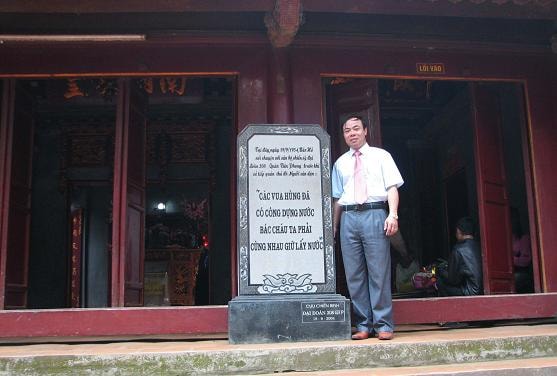
Phu Tho also has a long history, considered the birthplace of the Vietnamese nation. According to legend, this is where the Hung Kings chose to establish their capital, naming it Van Lang (the first capital of the Vietnamese nation). The Hung Temple historical site is now a particularly important national historical site associated with the history of the formation of the Vietnamese nation, including: the Temple of Queen Au Co, Bach Hac - Ben Got, Thach Khoan communal house, etc.
The Hung Kings Temple: built on Nghia Linh mountain, in the middle of Phong Chau land, which is now Hy Cuong commune, Lam Thao district, Phu Tho province.
Legend has it that, long ago, the Hung Kings considered many locations before finally finding this sacred place to establish their capital. This place is situated with a river converging in front and mountains flanking it on both sides. The fertile land is suitable for farming and cultivation. The high hills are ideal for establishing settlements.
|
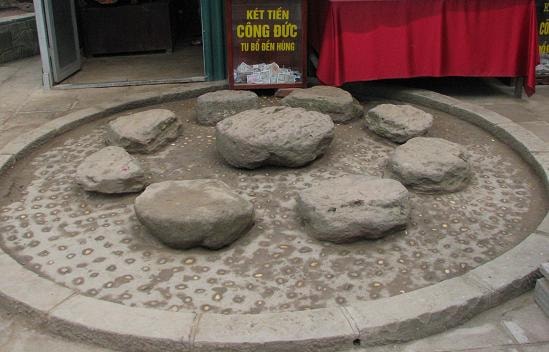
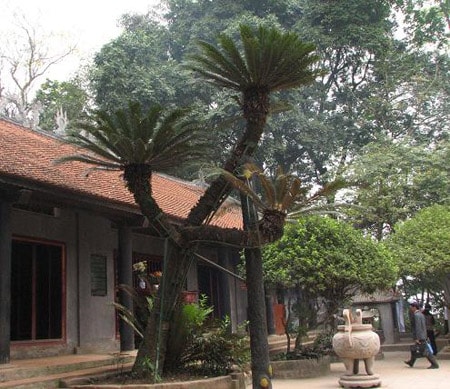
The Hung Temple complex consists of the Lower Temple, the Middle Temple, and the Upper Temple. From the foot of Hung Mountain, turn through the Great Gate (temple gate) and climb 225 brick steps to reach the Lower Temple. According to legend, in the area of the Lower Temple, Queen Au Co laid a hundred eggs, which hatched into a hundred children: 50 followed their father, Lac Long Quan, to the coast; 49 followed their mother to the mountains; and one remained to become the king of Van Lang. This was the first Hung King. In the area of the Lower Temple is Thien Quang Pagoda. In front of the pagoda is a 700-year-old cycad tree.
From the Lower Temple, climbing another 168 stone steps leads to the Middle Temple. Legend says that the Hung Kings established a rest stop here to rest and discuss matters with the tribal chiefs. It was also here that Prince Lang Liêu offered sticky rice cakes (bánh chưng and bánh dày) to his father, the king, during Tet (Vietnamese New Year).
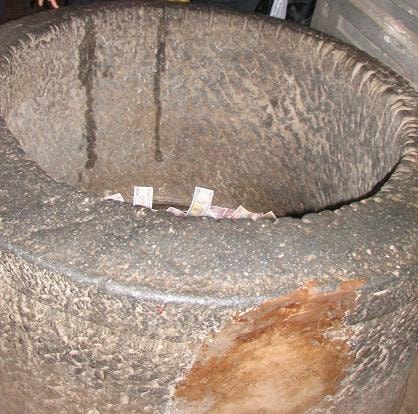
From the Middle Temple, climbing 102 stone steps leads to the Upper Temple, where the 6th Hung King established a temple dedicated to Saint Giong, who repelled the Yin invaders. This is also where the 18th Hung King abdicated the throne to Thuc Phan, erecting two stone pillars vowing to protect and preserve the Hung Dynasty. Not far from the Upper Temple is the Hung King's mausoleum. Legend says it is the tomb of the 6th Hung King. After Saint Giong defeated the Yin invaders and ascended to heaven, the Hung King passed away here. Descending from the mausoleum, the temple is located at the foot of the mountain to the southeast. Inside the temple is the Jade Well, full of clear water year-round, reflecting the sky like a mirror. The temple is dedicated to Ngoc Hoa and Tien Dung, the two beloved daughters of the 18th Hung King. Legend says that before their marriages, the two princesses often came here to comb their hair and gaze at their reflections in the well.
|
The Temple of Queen Au Co: built on Oc Son mountain, also known as Van mountain, over 147m above sea level. The temple's design is based on a unique architectural style deeply marked by the Dong Son culture. It is constructed in a traditional style with columns, frames, ribs, roofs, and partitions made of ironwood; the roof is covered with curved tiles, and the walls are built of brick. The main temple complex consists of a main temple and two side buildings, the Left and Right, in a T-shaped architectural style. The railings are carved with motifs of Lac birds and folk cultural activities from the Dong Son period. The interior of the temple includes a statue of the Queen Mother and two statues of Lac Hau and Lac Tuong, cast in bronze, weighing approximately 2 tons. On either side of the Left building are two bronze reliefs depicting the scene of 50 children following their father to the sea and 50 children following their mother to the mountain.
The Bach Hac - Ben Got historical site, located in the former Tam Dai district, still retains many historical and cultural relics, legends, and stories about the nation-building and defense efforts of our ancestors. Legend says that after Queen Au Co gave birth to a hundred eggs, which later hatched into a hundred children, Lac Long Quan didn't know how to name them. He set up an altar to the heavens, and a celestial being descended from heaven to name and divide the hundred children born to Queen Au Co. Afterward, the celestial being flew back to heaven, leaving behind the imprint of his heel on a rock at this riverbank, hence the name Ben Got (Heel Wharf). The Bach Hac communal house (also known as Viet Tri village communal house) is a place of worship for the Hung Kings. There is also the Lang Dai temple, where the two heroes Son Tinh and Thuy Tinh fought, and the Ha Than shrine, where the River God is worshipped for his role in helping King Tran Minh Tong defeat the Man Da Giang and pacify the borderlands. The Bach Hac Temple is a place of worship for a local deity whose given name was Tran Lan and his younger brother, Thach Khanh, whose given name was Tran Bao. They possessed magical healing powers, curing all kinds of illnesses for the people. After becoming deities, they were enshrined at Tam Thanh Quan on the banks of the Bach Hac River and were elevated to the status of sacred deities at the confluence of the Bach Hac River...
|
Thach Khoan Temple: dedicated to the holy deity Tan Vien Son from the Hung Dynasty, the three princesses who were daughters of King Hung, and four local chieftains of the Dinh family from the Muong ethnic group in Thach Khoan commune - who helped King Le Thai To repel the Ming invaders in the 15th century.
Phu Tho is home to a wealth of relics, stories, and legends about the cultural life, struggles for nation-building, and national defense throughout thousands of years of Vietnamese history. It also preserves a treasure trove of intangible cultural heritage such as poetry, songs, folk rhymes, and traditional Xoan, Gheo, Doi, and Vi singing styles.
Tran Dinh Ha