
Phung Phuc Kieu, a peaceful alleyway
(Baonghean) - In Vinh City, there are three things that always come to mind whenever I'm away: my childhood home, my mother's cooking, and the streets within the city. These things are present everywhere in my mind, on every path I take or whenever I look back. And quite by chance, these three profound memories are closely intertwined, like roads, no matter how far away, that will always lead back to home.
(Baonghean) - In Vinh City, there are three things that always come to mind whenever I'm away: my childhood home, my mother's cooking, and the streets within the city. These things are present everywhere in my mind, on every path I take or whenever I look back. And quite by chance, these three profound memories are closely intertwined, like roads, no matter how far away, that will always lead back to home.
I'm talking about Phung Phuc Kieu Street. This small road connects Tan Thanh I and Tan Thanh II blocks in Le Mao ward. The starting point of this nearly 1km stretch is shaded by a large banyan tree right next to Le Mao Secondary School. Phung Phuc Kieu Street is perhaps one of the streets that best reflects the changes in the city. From a narrow, dusty road, Phung Phuc Kieu Street is now a smooth, paved road, hugging impressive high-rise buildings. The name of the street might sound strange, but if you mention the street next to Le Mao Secondary School with its two famous table tennis clubs, many people will surely know it. For nearly 30 years, these two private table tennis clubs have been a highlight, attracting visitors from all over to gather on this small street. Table tennis is a sport that doesn't require a specific skill set and isn't too expensive, so around rush hour, it's always bustling with laughter, conversation, and applause.
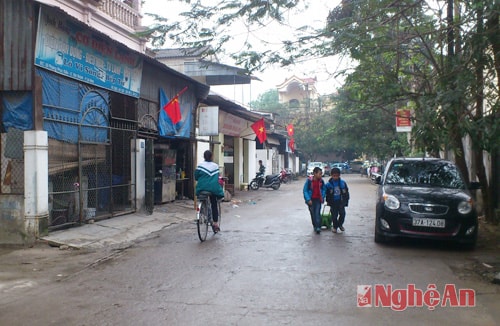 |
| Phung Phuc Kieu Street. |
The rhythm of the day also reflects the changes on Phung Phuc Kieu Street. Every morning, the street is bustling with the sounds of city life: children going to school, adults going to work, car horns echoing throughout the corner… Yet around 8 a.m., the street becomes quiet with houses locked and bolted, only the faint sound of a lesson being taught from Le Mao Secondary School can be heard. At this time, the street in the heart of the city suddenly transforms into a peaceful and tranquil village road, still filled with the clucking of chickens and the melodious singing of nightingales from nearby houses.
My small house was located right at the beginning of Phung Phuc Kieu Street. Being at the street corner had many advantages, something I only realized much later, when my eyes learned to observe and contemplate. From the second-floor balcony, I could gaze out at the bustling intersection of the Post Office, the Provincial Radio and Television Station, the North Central Bookstore, and Ho Tung Mau Street. Especially during holidays and Tet (Lunar New Year), that cramped and cluttered balcony became the envy of my friends, because without the crowds, I could still take in the magnificent spectacle of the New Year's Eve fireworks. It was there, in the quiet of the late nights, with only the rustling of bamboo brooms from Dinh Cong Trang Street echoing in, that I suddenly realized, with all my naive experiences, that the street of my childhood wasn't just the soulless streets of a chaotic urban life, but had become an integral part of my identity, a destiny intertwined with the lives and history of the people and the city. Mentioning the street brings to mind the lives and people who pass along it every day. The street is crisscrossed by many small alleys, each containing a dozen or so houses with diverse occupations: the teachers' alley, the factory workers' alley, the garment workers' alley, the soldiers' alley… The daily routines of each alley differ accordingly. Some alleys are mostly inhabited by teachers, like Alley 13, while others are predominantly run by self-employed workers, still bustling with activity until late at night. Phung Phuc Kieu Street thus continues to stir with the comings and goings of its residents.
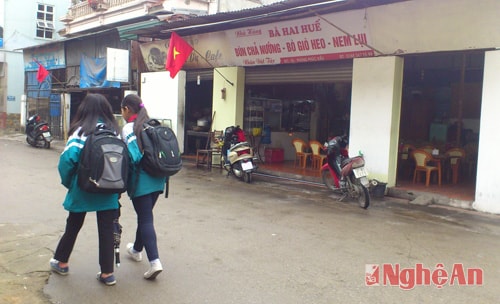 |
| The grilled pork vermicelli restaurant at the beginning of Phung Phuc Kieu street is a favorite spot for many discerning diners. |
The road has been there for a very long time, even before I was born. Countless generations have grown up and walked along this small road to reach distant horizons. This shows that human ingenuity has given Phung Phuc Kieu road its form, soul, past, and future. Speaking of the future, as Mr. Cao Van Ngoc, a resident in his sixties who has lived on Phung Phuc Kieu road for many years, confided: “I find Phung Phuc Kieu road incredibly appealing. It's located in the city center, near the market, schools, main roads, and bus stops… yet it's quiet and free from the constant noise day and night. The area is also very safe; for many years, there have been few complicated incidents, allowing residents to live and work in peace. In the future, Phung Phuc Kieu road will be very valuable!” Whether the prediction of someone who loves their place of residence will come true or not is unknown, but what is certain is that Phung Phuc Kieu Street is currently "transforming" every day. The street now boasts restaurants and eateries that serve until late at night, as well as services like table tennis, billiards, a fitness club, flower shops, and grocery stores… All the entertainment needs of the residents are being met.
Phung Phuc Kieu Street, like any other street in Vinh City, has its own ups and downs, its own hustle and bustle, its own quietude. Perhaps, for me personally, Phung Phuc Kieu Street is always different, truly special, because it's always the road back home. Like migratory birds, even when wandering to unfamiliar shores, they always need a familiar path to return...
Text and photos:Phuong Chi
Phùng Phúc Kiều was born in 1724 in Thu Lũng village, Hiếu Hạp commune, Chân Phúc district (now Nghi Thu ward, Cửa Lò town). From a young age, he showed intelligence and a thirst for knowledge. Growing up during a time of war and turmoil, he joined the army in the elite naval squadron of the Southeast Region. After graduating from the Military School in Phú Đức Quang (now in Đức Thọ, Can Lộc, Hà Tĩnh), he was assigned to command an elite squadron with the rank of Thiên Hộ (a thousand-household commander). Due to his many contributions in suppressing rebellions and pacifying the people, in 1784, King Lê Hiến Tông bestowed upon him the title of Thượng tướng quân (Supreme General), Đô đốc Đô Trung Hầu (Admiral and Commander-in-Chief of the Southeast Region), and entrusted him with a flag and insignia to command the army (naval defense) in the coastal region from Thanh Hóa to Hà Tĩnh today. While surveying the terrain, Phùng Phúc Kiều noticed many abandoned lands along the coast and requested permission from the imperial court to recruit people and establish several villages along the Cửa Lò coast, creating a solid base for his navy. His name and the name of the Phùng family from Nghi Thu are inscribed on the stone stele commemorating the founders of the villages, erected at the Thu Lũng temple. In 1792, Phùng Phúc Kiều passed away and was buried by the Lê dynasty. To facilitate worship by his descendants and villagers, the imperial court built a mausoleum in front of the Thu Lũng village communal house in the early 19th century. In 1999, the Phùng family's ancestral temple and the mausoleum of Phùng Phúc Kiều and his wife were recognized as a provincial-level historical and cultural relic. |


