
Self-built watercraft must meet certain standards before they can be registered.
The Ministry of Transport issued Circular 36/BTGT-TT on November 24, 2016, which officially came into effect on June 28, 2017, on national technical standards for technical supervision and construction of small inland waterway vessels.
Currently, in many localities, people build their own watercraft based on folk experience, using traditional materials such as bamboo, cement, and steel mesh.
To obtain technical safety inspection certification, small watercraft must comply with technical requirements as stipulated in the regulations. |
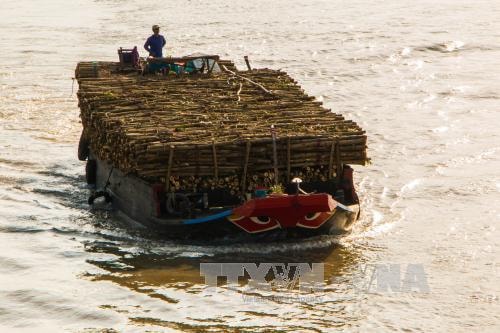
Small watercraft include: vessels with a length of less than 20 m, main engine power from 5 to less than 50 HP, with a carrying capacity of 5-12 people; traditional vessels (with or without engines, built according to traditional experience passed down through generations; carrying cargo with a total tonnage of up to 100 tons, with a total main engine power of less than 50 horsepower (in-carrying engine) or less than 100 horsepower (out-carrying engine); without a deck, carrying capacity from 5 to less than 50 people...).
Besides modern materials such as aluminum alloys, steel, and fiberglass-reinforced plastics for the hulls of vessels, regulations allow the use of traditional folk materials such as wood, bamboo slats, and steel mesh cement for the construction of small watercraft. However, to obtain technical safety certification, they must comply with the technical requirements of the regulations.
Therefore, Circular 36 stipulates that the material used to manufacture bamboo-framed vehicles must be mature bamboo with the core removed, treated to prevent insect infestation, and made into slats, 1 mm to 3 mm thick and 10 mm to 30 mm wide. The panels are woven from bamboo slats into a continuous, tightly fitted sheet according to the shape of the vehicle's body, using weaving techniques based on local experience. For cement-framed vehicles with bamboo slats, the structure is similar to that of bamboo-framed vehicles, but with the addition of Ø6 steel bars horizontally and vertically for reinforcement. The spacing of the reinforcing steel bars is 100 mm x 100 mm or 150 mm x 150 mm.
The Vietnam Register, its branches and sub-branches, and the registration units under the local Departments of Transport are responsible for supervising the technical aspects of small inland waterway vessels according to the regulations in Circular 36.
According to the News Report
| RELATED NEWS |
|---|


