
'Sweet fruits' on difficult land
(Baonghean) - The opening of major roads has created many prospects for Tuong Duong district, a commune classified as a 30a district, to rise out of poverty, including the prospect of developing passion fruit cultivation.
Speaking of Tuong Duong, first of all, it is the district with the largest natural area in the country, exceeding 2.8 million square kilometers (three times the area of Bac Ninh province and twice the area of Thai Binh province); its terrain is quite complex, with some areas in the communes of Nhon Mai, Mai Son, Huu Khuong, and Tam Hop having high altitudes, often inhabited by the Mong ethnic group; the climate is harsh, production practices are still backward, and the people have not yet developed a mindset of commodity production. These can be seen as "strongholds" of self-sufficient production thinking and a mentality of dependence and reliance.
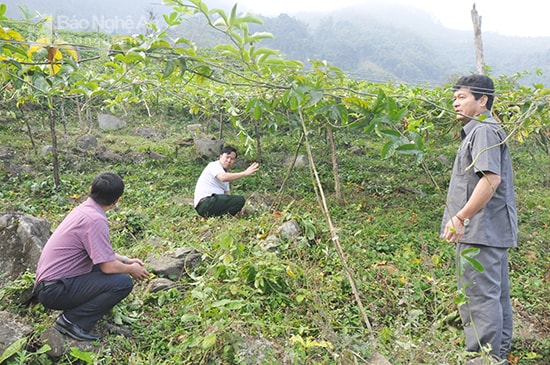 |
| Passion fruit cultivation model at Nhon Mai Border Guard Station (Tuong Duong). Photo: Cong Kien |
Recently, we had the opportunity to travel along the West Nghe An road - a major road running along the border, connecting the mountainous districts of Ky Son, Tuong Duong, and Que Phong.
Upon arriving at Tham Tham village, Nhon Mai commune (Tuong Duong district), we saw that the hillsides had been cleared and holes dug in straight rows by the Mong and Khmu people; in some places, they had even erected stakes and strung steel wires to plant passion fruit. When asked, one of the locals said: “The village is preparing for the passion fruit planting season; almost every household is planting it with the hope that this will be a poverty-alleviating crop for the village, creating opportunities to become wealthy…”
We met Va Ba Ka, the Party Secretary of Tham Tham village, who received 269 passion fruit plants as part of a pilot project implemented nearly two years ago. Upon arriving at his house, we found the door locked. Going up to the passion fruit plantation, we found Va Ba Ka and his wife busy pruning the vines, their nearly four-month-old baby slung over their backs.
And Ba Ka said: "I'm very busy, having to weed and prune this old garden, as well as clear the land, dig holes, and build trellises to expand the area, so I don't have time to rest."
In Tham Tham, 17 out of 20 households registered to grow passion fruit (the remaining 3 households lacked the necessary health conditions due to old age). Va Ba Ka's current passion fruit garden was planted in 2015 as a pilot model for the district. The first harvest yielded over 100 million VND, significantly higher than traditional crops like corn, rice, peaches, and plums. Therefore, this year his family has converted most of their farmland to growing passion fruit, with plans to add nearly 500 more plants.
In Tham Tham, there are also 6 other households that have been piloting passion fruit cultivation since 2015 and have achieved high incomes in the first harvest season; they are now continuing to expand their cultivated area.
Visiting the plantation of the Nhon Mai Border Guard Post. Thanks to the advantage of human resources, the passion fruit vines here have been weeded and pruned neatly, promising another bountiful harvest.
Lieutenant Colonel Nguyen Thanh Tung, the station chief, said: “At the end of 2015, we planted 1 hectare as a pilot project. The first harvest yielded over 100 million VND, not including the portion used and given as gifts to the families of officers and soldiers. Seeing the effectiveness of the border guards and 7 households in Tham Tham village, most of the remaining households registered to convert their hillside fields to passion fruit cultivation.”
Currently, the Chairman of the People's Committee of Nhon Mai commune, Mr. Luong Xuan Hiep, is working day and night in Tham Tham to supervise and direct the implementation of passion fruit cultivation. Mr. Hiep stated that Tham Tham village in Nhon Mai is only about 10 kilometers from the center of Tri Le commune (Que Phong district) – the "passion fruit capital" of western Nghe An province. With the road connecting to western Nghe An, Tham Tham has the opportunity to overcome poverty and gradually become prosperous.
The gently sloping hillsides, once barren from years of corn and rice cultivation, are now being replaced with passion fruit vines. Following Tham Tham, several other areas with colder climates, such as Huoi Co and Xoi Voi, will also implement passion fruit cultivation; it is projected that in 2017, the entire Nhon Mai commune will plant approximately 10 hectares, with high hopes for economic efficiency.
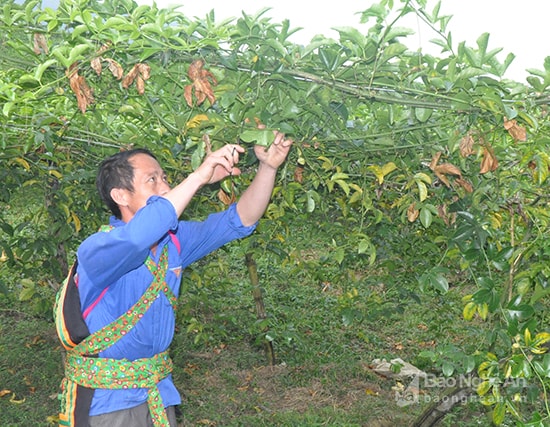 |
| The high-yielding passion fruit garden of Mr. Va Ba Ka, Tham Tham village, Nhon Mai commune (Tuong Duong district). Photo: Cong Kien |
Leading a delegation from the district to Nhon Mai to research and survey the area for expanding passion fruit cultivation, Mr. Nguyen Van Hai, Chairman of the People's Committee of Tuong Duong district, said that for many years the district has sought solutions to boost socio-economic development for remote, mountainous, and border communes, but has yet to find a suitable direction.
Now, a promising direction has been found for development in high-altitude, cold-climate areas: cultivating passion fruit. Previously, corn and rice cultivation for many years depleted the soil, and raising livestock and poultry also faced numerous difficulties, especially during the rainy and cold seasons when animals often died from disease...
Passion fruit cultivation will take advantage of favorable land, climate, and human resources, promoting a commodity-based development mindset and yielding high economic returns. Furthermore, transportation has become easier, product outlets are guaranteed, and one enterprise has committed to purchasing all passion fruit in the area.
Along with Nhon Mai commune, Tuong Duong district will implement passion fruit cultivation in several villages with similar climatic conditions, such as Mai Son, Huu Khuong, and Tam Hop communes. According to the plan, the entire district will have more than 30 hectares of passion fruit this year, contributing to job creation and increasing income for farmers in these "difficult land" areas.
From the passion fruit orchard on the gentle hillside, we gazed down at the winding West Nghe An road, nestled between the Nam Hy River and the endless mountain range. The villages were flourishing, trucks laden with goods traveled back and forth, and the long-awaited road had finally become a reality.
Looking at that road, one thinks of the corridor connecting passion fruit growing regions, from the "capital" of Tri Le (Que Phong) to Nhon Mai and Mai Son (Tuong Duong). And in the future, it could reach Muong Long (Ky Son) - a place considered the Sapa of Nghe An. More than just a transportation route, the Western Nghe An road also carries the significance of unlocking potential.
Leaving Tham Tham, leaving Nhon Mai while the locals were busy preparing for the new passion fruit planting season, I carried with me the hope that upon my return I would witness the tremendous changes in the people, from the orchards laden with passion fruit – continuing the seasons of "sweet fruits" that contribute to building a prosperous life in this challenging land...
Cong Kien


