"Gift" from Nam Non
(Baonghean) - This time of year, visiting My Ly commune (Ky Son district), we will witness the bustling scene of boats fishing on the Nam Non River. Since the Ban Ve hydroelectric dam was built, fish have been swimming upstream. From then until now, the fishing industry in My Ly has developed rapidly, helping many households escape poverty and accumulate wealth...
(Baonghean) - This time of year, visiting My Ly commune (Ky Son district), we will witness the bustling scene of boats fishing on the Nam Non River. Since the Ban Ve hydroelectric dam was built, fish have been swimming upstream. From then until now, the fishing industry in My Ly has developed rapidly, helping many households escape poverty and accumulate wealth...
In the early morning, the Xop Tu fishing dock was bustling with people. Without prior arrangement, residents of Xop Tu, Xieng Tam (My Ly), and neighboring communes such as Muong Long, Huoi Tu, and Bac Ly all flocked here to buy the freshest fish. From 3-4 a.m., fishermen would wake up, board their boats, and head out to check their nets. They finished their work just as dawn broke. They brought their catch back to the Xop Tu dock, where dozens of people were waiting to buy. As Luong Van Thang docked, he stepped ashore carrying a string of over 4kg of fish. Immediately, 4-5 customers crowded around him, asking to buy. He divided the fish into three portions and sold them to three customers, earning over 150,000 dong after two hours of work on the river...
Xop Tu is not the commune center, but the transportation is quite convenient. The slope of the riverbank is not steep, so it attracts hundreds of boats and customers every day to exchange and buy river fish. Six families here have built rafts and shelters on the riverbank to specialize in fishing and buying fish. They buy, preserve, and resell all the fish they catch each day to those who need them. The life of Mr. Lo Van Long and Ms. Vi Thi Huong's family used to depend entirely on their fields, with only one harvest per year. In years with favorable weather, they were lucky to have enough to eat, but in years of drought, they faced starvation. For the past few years, since fish started swimming upstream in large numbers, the couple decided to buy boats and nets to start fishing.
Initially, Mr. Long only thought of fishing as a way to improve his daily meals and earn extra money in his free time. But through the process of casting his lines and nets, his experience gradually increased, and the amount of fish he caught steadily increased. So he decided to abandon farming and focus solely on fishing. Soon after, he discussed with his wife the idea of building a shack and rafts at the riverbank to also engage in buying and selling fish. Seeing how effective it was, five other families in Xop Tu followed suit. Now, with six rafts, the Xop Tu riverbank has truly become a fish market on the river. Moreover, these rafts have become an ideal culinary spot for locals and tourists who enjoy sipping food while admiring the sky, water, boats, and the feeling of bobbing on the river. Whenever customers request it, the raft owners are ready to prepare various types of fish in different ways (braised, boiled, grilled, fried, hot pot) to serve them on the spot. Fishing, buying, and processing fish has provided Lo Van Long and his wife with an income of around 10 million VND per month, many times more than farming on hillside fields.
 |
| Xop Tu fishing port. |
It's not just Mr. and Mrs. Lo Van Long; in Xop Tu village, over 50% of households regularly engage in fishing on the river. Fishing has helped many families achieve stable lives and acquire modern conveniences. Mr. Kha Van Thanh's family was previously classified as poor, facing food shortages for 3-4 months each year. In early 2012, he boldly borrowed 15 million VND to buy a boat and fishing nets. Since then, he has earned income almost daily, typically around 100-150 thousand VND, sometimes 400-500 thousand VND, and even on slow days he still earns 50 thousand VND after deducting expenses. With this income, Mr. Thanh has paid off his debt and even bought a motorbike and invested in more nets to continue his fishing activities. Mr. Kha Van Thanh said: "Fishing is hard work; every day I have to wake up early to go to the river to check the nets. Some days it's freezing cold and rainy, and I feel like I can't stand it. But in return, I have a steady income, much more than farming."
Xop Tu is not yet the village with the highest percentage of households engaged in fishing on the Nam Non River. Hoa Ly village, with approximately 70%, is a prime example. Located about 1km downstream from Xop Tu, Hoa Ly is considered a "fishing hub." In the early days, when fewer people fished, there were an abundance of fish. Some say that standing on the shore, a quick hand could catch several fish swimming near the water's edge. And here, people have caught fish weighing over 10kg, and exceptionally, some weighing over 30kg. From Hoa Ly village, through Xop Tu, and up to the villages of Xieng Tam, Xang Duoi, and Xang Tren, the river's surface is covered with white floats and nets. These three villages in the upper reaches are not within the "fishing hub," and many residents still earn their income from fishing. They don't fish professionally like in Xop Tu and Hoa Ly; whenever they have free time, they take their boats out onto the river to cast nets and set lines. The fish they catch are primarily for their family's daily food needs. If they're lucky enough to catch a few kilograms or more, it's considered extra money to help support the family. Perhaps that's why, for many people in the border commune of My Ly, the boat, the nets, and the surface of the Nam Non River have become truly inseparable, like blood and flesh!
That night, we slept on the fish raft of Mr. Lo Van Long's family, and the next morning we woke up early to check the nets. In the quiet of the night, he told us interesting stories about fishing on the Nam Non River. When the water level in the Ban Ve Hydroelectric Reservoir rises, fish species such as carp, silver carp, catfish, snakehead, and other types of fish, unaccustomed to living in calm water, swim upstream to find a place to live. Because upstream, the water flows strongly, providing a clean environment for the fish to develop and reproduce. This "gift" from the Nam Non River has provided the villages along the river with abundant resources to exploit.
Fishing has helped many families "change their lives," transforming them from impoverished to well-off, with plenty to eat and save. In particular, in the beginning, many were lucky enough to catch large fish, such as catfish and snakehead fish weighing over 10 kilograms. A few lucky catches each month could bring in over 10 million dong. At exactly 4 a.m., we woke up and followed Mr. Long and his son onto the boat to check their nets. The motorboat towed a raft made of bamboo along the river. About 10 minutes later, Mr. Long and his son stepped onto the raft and went around to untangle the nets. The wind was bitterly cold, but they diligently worked with the nets on the river's surface. Around them, many other boats were also checking their nets. More than an hour later, Mr. Long and his son returned to the boat with a string of nearly 5 kilograms of fish. So, that morning, he had earned over 200,000 dong. On the raft, Ms. Vi Thi Huong was buying fish from other boats to resell to those who arrived late from afar. Fish from the Nam Non River are an extremely "clean" food product; there's no worry about them going unsold, whatever quantity is produced sells out immediately.
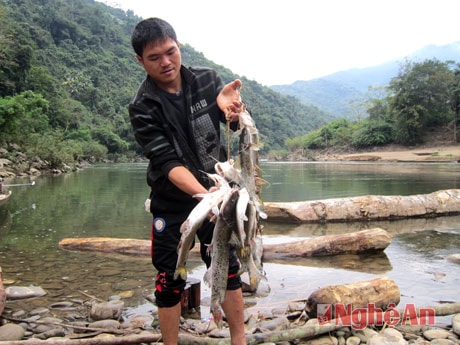 |
| Catfish, a specialty of the Nam Non River. |
The next day, we traveled upstream on the Nam Non River to Keng Du commune. Along the way, passing through the villages of Xop Duong and Cha Nga, we occasionally encountered small boats casting lines and nets. These people lived in Xop Tu and Xieng Tam but sailed all day to catch catfish and other small fish. Their trips sometimes lasted for weeks. They fished on the river during the day and stopped ashore at night to set up huts, light fires, cook rice, and grill fish to eat and rest. When they caught a decent amount of fish, they sailed downstream to the commune center to sell them. Each trip earned them over a million dong. Our boat docked at a riverbank where a small hut was occupied. The owner was Mr. Lo Van Chau (from Xieng Tam village) and several of his relatives. Mr. Chau and the others were preparing to set up their nets. Inside the hut, a string of freshly caught fish lay. Several trays of grilled grouper fish were being cooked over the fire, the fat sizzling and turning a golden brown. A nephew of Mr. Chau explained: “These grilled fish have been ordered by people from the lowlands for the Lunar New Year. Whenever we catch grouper, we bring them back to the hut, butcher them, marinate them with spices, and grill them over the fire. This way, the fish lasts longer while remaining fragrant and delicious, and people from the lowlands really like them…”
Traveling with us on the boat, Mr. Kha Ngoc Minh, Chairman of the People's Committee of My Ly commune, shared: "The fish from Ban Ve reservoir swimming upstream have truly become a 'gift' to the people of My Ly, bringing a significant source of income to the locality. Therefore, the commune government stipulates that exploitation must go hand in hand with protection. The use of explosives and electric shock is prohibited to prevent the destruction of the fish population, ensuring their reproduction and the long-term sustainability of this resource!"
Cong Kien