How does the braking process of a container truck work?
Container trucks are heavy-duty vehicles, so they require special braking systems to ensure safety while traveling on the road.
On the afternoon of January 2nd, on National Highway 1, at the Binh Nhut intersection, Hamlet 3, Thach Duc Commune, Ben Luc District, Long An Province, a container truck with license plate 62C-043.48, traveling at a speed of 45km/h (approximately 54km/h), crashed into several motorbikes stopped at a red light, resulting in multiple fatalities and injuries.
This incident has left many readers feeling confused and fearful about these "highway monsters." What's particularly concerning is that after crashing into the crowd, the container truck didn't stop even though it was traveling at a normal speed on the highway. So, in reality, does a container truck really need such a long time to brake?
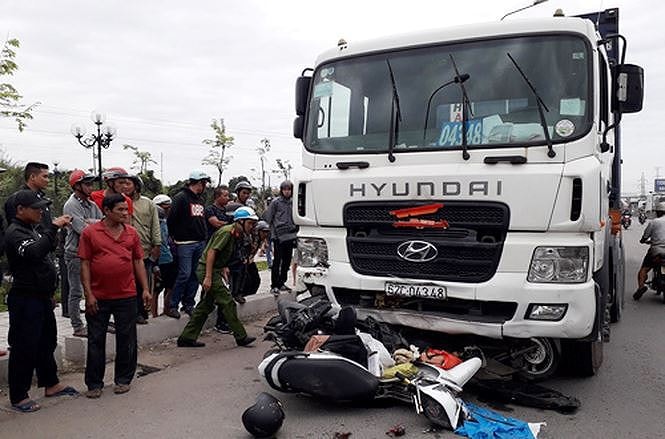 |
The accident involved a container truck crashing into motorcycles stopped at a red light in Long An on January 2nd. |
Time required for the driver to come to a complete stop of the container truck.
The total stopping distance is the distance the driver needs to travel to become aware of the danger, then react by applying the brakes, and the distance the vehicle slides on its wheels due to inertia to come to a complete stop.
According to the Utah Department of Transportation website, drivers of fully loaded container trucks (weighing 40 tons) will need at least 52 meters to come to a complete stop after braking at approximately 64 km/h; if the container is full and the truck is traveling at approximately 88 km/h, the driver will need a longer distance, at least 102 meters. All of these distances do not account for external factors such as slippery roads or brake delay.
However, that's not enough; container truck drivers also need special technical features to help heavy-duty vehicles stop more safely, namely pneumatic braking systems.
Pneumatic braking system on container trucks
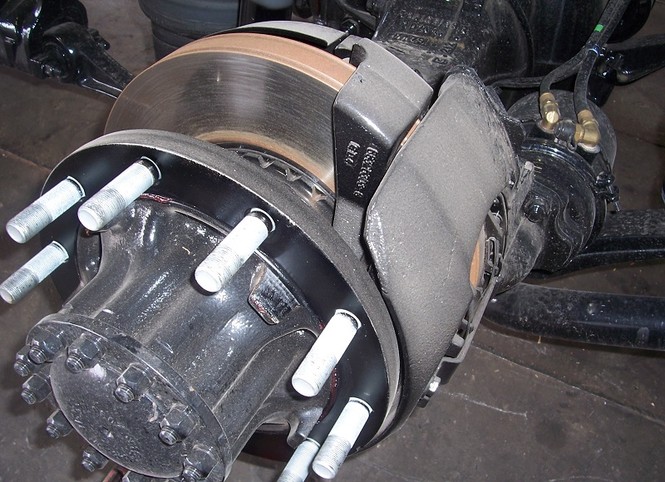
To stop heavy vehicles (container trucks, buses, trains) effectively and safely, manufacturers do not use hydraulic braking systems but instead equip them with pneumatic brakes. These vehicles can cause catastrophic accidents if their speed is not properly controlled; meanwhile, the use of hydraulic brakes is unsafe due to the risk of brake fluid leaks, one of the causes of brake failure.
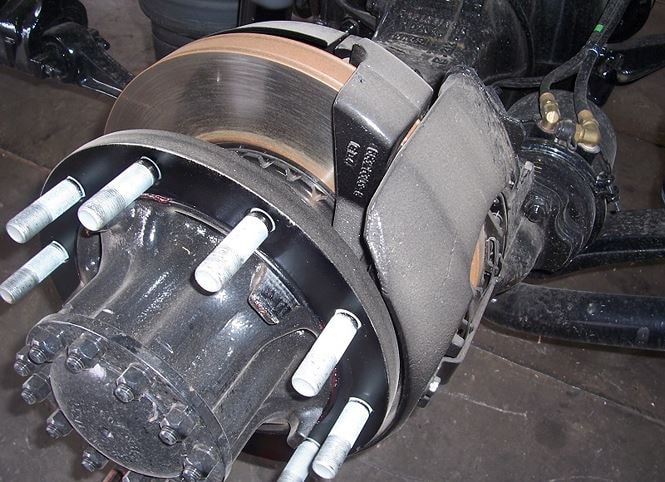 |
| Pneumatic brakes are fitted to container trucks. |
The first pneumatic brakes were used on extremely heavy trains.European Breaking SystemsPreviously, trains used air brake systems, but they were quite rudimentary, consisting of a compressor located at the locomotive and a brake line running along the length of the train, connecting to individual air cylinders on each carriage. When the brakes were applied, the system would supply air from the compressor to each cylinder to stop the entire train. While this braking system was more efficient than previous types, it still required too much time to pump air to all the cylinders and posed significant risks if any of the air cylinders malfunctioned or the brake lines leaked.
Because of this inconvenience, in 1869, George Westinghouse (founder of the Westinghouse Air Brake Company - WABCO) designed a new pneumatic braking system for trains. Its most important component was the three-way valve, along with the air reservoir on the train car. This system was the opposite of the previous air brake system, which used to pump air into the brake tubes to release the brakes, and to release the air from the tubes when the brakes were applied.
 |
George Westinghouse designed the pneumatic braking system for trains. |
Essentially, the three-way valve on a train's pneumatic braking system also operates in three modes:
- Air charging: When the ship is not in operation, the brake pads remain tightly pressed, preventing the wheels from moving. Therefore, the system needs to be charged with air before the brakes can be released.
- Using the brakes: When the brakes are applied, the pressure decreases. As the amount of air decreases, the three-way valve allows air to return to the reservoirs; meanwhile, the system also performs the braking function.
- Releasing the brakes: When braking, some air escapes; then, the pressure in the system increases again, releasing the brakes.
Later, in 1872, Westinghouse patented his pneumatic braking system and continued to improve it so that it could be used on other heavy-duty vehicles on the road, such as trucks, container vehicles, and buses.
Modern pneumatic braking systems include the following main components: air compressor, pressure regulator, air tanks, relief valve, foot valve (brake pedal), brake cylinder, push rod, brake pad clearance adjustment lever, S-shaped cam, drum brake pads, and return spring.
Furthermore, to achieve maximum safety, the pneumatic brake system also features an emergency braking (parking brake) function, which can be activated by a button on the dashboard. Before driving, the driver must press this button to inflate the brake system with air. Whenever the system reaches sufficient pressure, the emergency braking will not activate. If there is an air leak, the pressure may drop, and if it becomes too low, the emergency braking will be activated. This ensures the safety of container trucks and prevents situations where they are unable to brake or experience brake failure.
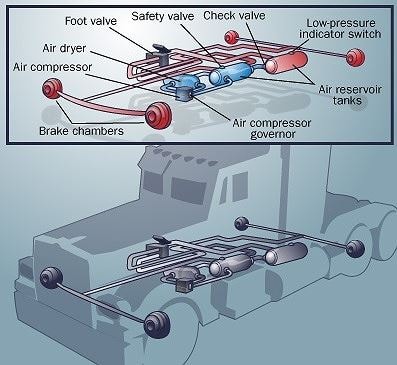 |
| The pneumatic braking system mechanism on a container truck. |
However, regardless of how advanced vehicle technology becomes, the driver of a container truck still plays a crucial role in ensuring safety. Therefore, they always need to be alert and focused while driving, because they not only hold their own fate in their hands but can also affect many other people.