
Legal perspective on the "territorial acquisition" rights of the disputing parties.
(Baonghean.vn) -Question 30: What is the legal perspective on the "territorial acquisition" rights of the parties disputing the Paracel Islands and the Spratly Islands?
Reply:To protect their sovereignty over the Paracel Islands and the Spratly Islands, the disputing parties have relied on the following main legal principles:
- China: Historical sovereignty.
- Philippines, Malaysia: Sovereignty based on geographical proximity.
According to international legal experts, these principles are completely worthless in proving and defending the illegal occupation by the disputing parties, especially their "historical sovereignty" claims.
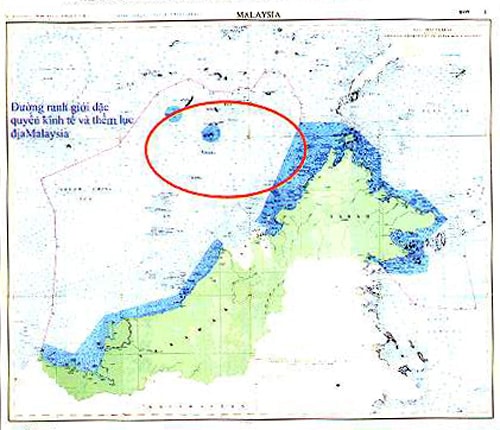 |
| Map of Malaysia published in 1979 |
Scholar Li Linghua, from the China Ocean Information Center, one of China's leading experts on maritime law both internationally, commented:
"When talking about interests in the South China Sea, we often like to say: 'It has always been this way and that way,' and sometimes we even add the word 'sacred'."
That is what is called historical evidence... But such evidence is becoming increasingly insignificant in modern international law... The truly persuasive evidence is actual control.
He says that place belongs to him, but has he ever managed it? Did the people there obey his management? Did others have no objections? If the answer to all these questions is "yes," then he's sure to win. In the South China Sea, we didn't achieve that...
During the Qing Dynasty (around the reigns of Emperor Xianfeng or Tongzhi), a French cargo ship carrying copper was passing through the "Xisha" sea area when it encountered pirates and was completely looted.
According to maritime cargo regulations, they had to report the incident to the local authorities, request assistance in apprehending the pirates, and obtain confirmation from the authorities as evidence to report to the cargo owner and claim compensation from the insurance company upon their return.
The French captain steered the ship to the nearest port, Yulin on Hainan Island, and reported to the local prefect (presumably the district magistrate).
The local official said to the French captain: "The place where we stand is called 'Heaven's Edge and Sea'. The territory of the Celestial Empire ends here. How would you know where you were robbed at sea? We are not responsible for your robbery, nor can we control it, and we do not want to control it."
Then they threw the robbed captain out of the magistrate's office. But the incident needed a resolution, otherwise how would he explain it back in France? The captain had no choice but to steer his ship into Hai Phong port.
The local officials there were very helpful; they vouched for him and even sent boats out to circle around, essentially chasing after the robbers.
What kind of evidence is that? It's evidence of actual control and management. This evidence shows that the Chinese government, even from the Qing Dynasty, did not recognize the "Paracel Islands" as its territory, nor did it assume responsibility for maintaining order there.
At that time, the Vietnamese government not only claimed the "Paracel Islands" as its territory, but also implemented measures to maintain order there.
Doesn't that prove that the "Paracel Islands" have always belonged to Vietnam? If you were a Chinese negotiating representative, fully trained in maritime law and international law, what would you do in the face of such evidence? I really wish I had a time machine to go back to that time and strangle that prefect!..."1
Regarding the right to "acquire territory" based on the principle of "geographical proximity": some countries have relied on geographical proximity to defend their territorial claims, often arguing that a territory is near their territory or lies within their territorial waters or continental shelf, and therefore "naturally" belongs to them. In practice, this argument is not accepted as a legal principle in resolving territorial disputes. This is because, around the world, there are many territories that, although close to one country, still belong to another, more distant country.
"In practice, national territories do not necessarily have to be contiguous; for example, the state of Alaska is separate from other US states. In the North Sea continental shelf disputes between Germany and Denmark and Germany and the Netherlands (1969), geographical contiguity was irrelevant; it was the natural extension of territory into the sea that gave sovereignty to the nation possessing that continental shelf. The significance of this principle also contributes to an objective and fair assessment of Vietnam's sovereignty over the Hoang Sa and Truong Sa archipelagos, while simultaneously exposing the ambiguous and coercive arguments in the claims of China and other countries regarding Vietnam's Hoang Sa and Truong Sa."2
---------------------------------
1. Source: Tien Phong Newspaper
2. Source: Assoc. Prof. Dr. Nguyen Ba Dien wrote on the website: nghiencuubiendong.vn
According to the Q&A on Vietnam's Law of the Sea
(To be continued)


