
Terrorists in Iraq: A persistent and intractable problem?
(Baonghean)On the night of June 9th and the early morning of June 10th, forces of the Islamic State in Iraq and Syria (ISIS) occupied the airport, television station, and government buildings of Mosul, Iraq's second-largest city. Half a million local residents were forced to flee the city as the Islamist rebels freed over 1,000 prisoners held in Mosul prisons. Faced with the expansion and threat of ISIS, the Iraqi government once again sought help from the United States, even though US troops had only withdrawn from Iraq three years prior.
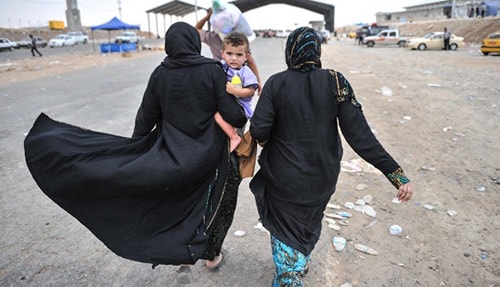 |
| Iraqi citizens flee cities occupied by terrorists. |
The protracted relationship between the US and Iraq has lasted for several decades, marked by three major events: the 1991 Gulf War, the 2003 invasion that overthrew Saddam Hussein's regime, and the 2011 US withdrawal from Iraq. Since then, the Iraqi government has continued to receive US funding to arm and train its military to fight terrorist insurgents. However, it is noteworthy that when terrorists stormed Mosul, Iraqi police and soldiers abandoned their weapons and fled. According to one resident, security checkpoints in the city were destroyed and seized by the insurgents. Simultaneously, a threatening message, allegedly from Abu Mohammed al-Adnani, a spokesman for ISIS, indicated that the violence would continue to spread to other cities, including the capital Baghdad. Thus, over the past few months, ISIS has seized control of a number of cities from the government, most notably the oil town of Baiji in Salaheddin province.
The ISIS organization originated from al-Qaeda in Iraq, with the support of the Sunni Muslim community. Initially operating only in Iraq, it was known as the Islamic State of Iraq and Syria (ISI). ISI is believed to have killed many American soldiers stationed in western Iraq. However, in 2006, its leader, Abu Musab al-Zarqawi, was killed by the US military, leading to the organization's weakening under a US-backed government offensive. By 2011, when the US military completely withdrew from Iraq, taking most of its intelligence forces with it, ISI found a new leader, moved to Syrian territory, and developed its forces and bases there. From there, ISI became ISIS, or the Islamic State of Iraq and Syria. Thus, Iraq and the US not only failed to eradicate the root cause of this extremist terrorism, but also indirectly spread the threat to Syria, as ISIS has now established a solid base in both countries, causing security and political instability for both. This organization is so extremist that it was rejected by al-Qaeda – its birthplace – and became an independent organization. Developing on the disagreements between the Shia and Sunni Muslim communities, and taking advantage of the fact that the Iraqi prime minister is Shia, ISIS incited Sunni Muslim groups, causing deep ethnic divisions, resulting in Iraq currently being temporarily divided into three parts: the North controlled by the Sunni community, the South by the Shia community, and a part controlled by the Kurdish community.
Why couldn't the US avoid intervening in Iraq? First, the US has long-standing ties with the country, and the current Iraqi government was established after the US-orchestrated overthrow of Saddam Hussein. Clearly, the US wouldn't want to lose a friendly state, especially in a Middle East region rich in oil resources but not particularly hospitable. Second, the US-ISIS feud over the killing of its leader would make the US a prime target once the extremist group gained complete control of the Middle East. Third, the US wasn't just involved in Iraq but also in the Syrian civil war – coincidentally, ISIS also played a leading role in Syria, further compelling US intervention. Of course, things would be different if Iraq could resolve its own "domestic issues," and this is also a concern for the US, as US President Obama stated: "Any short-term military assistance from the US will be meaningless if Iraq does not review its domestic policies."
It seems the U.S. has good reason to be disappointed and hesitant, as last Friday, the Iraqi army once again demonstrated its helplessness against ISIS advances to within 60 miles of Baghdad. Thus, the $15 billion spent on Hellfire missiles, weapons, helicopters, and other support seems to have been in vain. Furthermore, the U.S. Congress is currently discussing providing an additional $1 billion in aid to Iraq. President Obama stated: "They (the Iraqi army) are not afraid to fight the terrorists not because the enemy has overwhelming numbers; the problem lies in morale, in the sense of responsibility, which is the root cause of Iraq's long-standing political problems." Former Deputy Secretary of State under Clinton, James Rubin, also agreed with the president's view that Iraqis need more autonomy in resolving their internal conflicts: "It all depends on Prime Minister Nouri al-Maliki, it depends on his policy toward the Sunni community."
That being said, the Pentagon is still urgently devising a series of solutions for the situation in Iraq, while President Obama is under pressure from Republican criticism. According to Republicans, Obama's decision to withdraw troops from Iraq has left behind a seed of future threats to US interests. Despite this, Obama has declared that he will not send troops to Iraq again, but is considering other measures, such as air strikes. The shadow of his predecessor's nine years of entrenchment in the Middle Eastern quagmire is undoubtedly causing Obama a headache; abandoning the conflict is wrong, but continuing is even worse! Even deploying air power has limitations, as the enemy lacks bases, air forces, or anything else that could be targeted. Attacking ISIS would mean attacking civilians as well, a point of contention for the US. But with the astonishing expansion of an organization that may not be the largest, but is currently employing the most dangerous tactics – seizing cities as economic and military springboards – the US will have to act quickly before allowing this organization to achieve its goal of establishing an Islamic state. Currently, the situation in Iraq is attracting attention from countries in the region and the world, as some sources suggest that Iran is also preparing to intervene to support Prime Minister Maliki. Europe has yet to speak out, but it will likely not be able to turn a blind eye sooner or later, as recent terrorist attacks in Europe seem to be linked to this Islamic organization that is causing turmoil throughout the Middle East. Will this time, the "tumor" be completely eradicated, or will it simply be cut away in one place only to sprout again elsewhere? We'll have to wait and see!
Reishi Mushroom


