
Managing the operations of traditional medicine practice establishments.
(Baonghean) - Currently, there are nearly 400 traditional medicine establishments in the province, but only about 30% are licensed. Managing these establishments and inspecting the quality of medicines remains a difficult challenge...
Currently, traditional Chinese medicine is widely used and applied in treatment at all levels, with most hospitals and commune health stations having traditional medicine departments and medicinal herb gardens. Traditional Chinese medicine methods are based on the principles of mutual generation and mutual restraint according to the six internal organs and five viscera (fire generates wood, wood generates water, etc.) to address the root cause of the disease. Therefore, traditional Chinese medicine is primarily used to treat chronic diseases. Each year, the Provincial Traditional Medicine Association treats approximately 700,000 people.
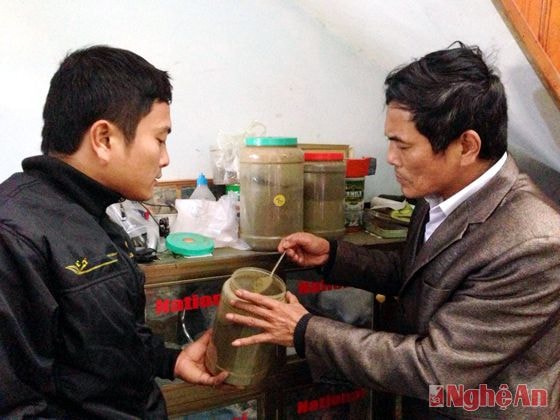 |
| Traditional medicine practitioner Bui Duc Luc (Lat Town, Tan Ky District) prepares medicine for patients. |
Traditional medicine practitioner Bui Duc Luc, from Lat Town (Tan Ky District), is known for his special remedy for venomous snakebites. He keeps many photos of seriously ill patients he has successfully treated. Practitioner Bui Duc Luc shared: "In rural areas, especially those with dense vegetation, there are many snakes, including many venomous ones like king cobras, red-tailed pit vipers, kraits, and banded kraits. People bitten by snakes are often confused and don't know how to handle it, so when they come to me, they are usually in a very serious condition… However, what I am proud of is that, to date, as long as the patient is still able to breathe, I have successfully treated 100% of them." His family's traditional remedy is very simple, combining three easily found leaves: *Centella asiatica* (commonly found in gardens or around rice fields), *Zingiber officinale* (a member of the *Zingiberaceae* family), and *Guava* leaves with thorns. With experience in preparing and treating snakebites through a combination of oral and topical application, soaking, or poultice, this traditional medicine remedy is truly effective. To widely disseminate this traditional medicine remedy, in August 2012, the Science and Technology Association and the Traditional Medicine Association of Tan Ky District organized a scientific seminar on the topic "Methods of preventing and treating venomous snakebites with traditional medicine," specifically and detailedly introducing the experience of traditional medicine practitioner Bui Duc Luc in treating venomous snakebites. In addition, he also possesses remedies for treating osteoarthritis, herniated discs, and bone fractures…
According to Mr. Tran Khanh Hoanh, Permanent Vice Chairman of the Provincial Traditional Medicine Association: Compared to many other localities nationwide, Nghe An is one of the provinces with a fairly developed traditional medicine sector, boasting many skilled practitioners such as Physician Dinh Van Kiem (Dien Chau) who treats gynecological diseases with the famous Tam Binh Tu Bao remedy; Physician Nguyen Trong Phung (Do Luong) with his family's traditional remedy for liver diseases; Phuong Ty Pharmacy in Truong Thi (Vinh City) famous for treating kidney diseases; and Mr. Bat Van Pharmacy specializing in treating colds and flu… Currently, 20 out of 21 districts, cities, and towns in the province have Traditional Medicine Associations. At the commune and ward level, there are 297 associations with 207 clinics, treatment centers, and private clinics. In addition, there are hundreds of traditional medicine practitioners scattered throughout rural and mountainous areas who have contributed to saving thousands of patients with effective home remedies.
The current challenge is that, alongside reputable traditional medicine practitioners with effective family remedies, there are still many establishments practicing traditional medicine that misuse low-quality drugs, leading to unpredictable consequences; and many individuals impersonating traditional medicine practitioners to practice illegally. Even well-known practitioners, recognized by the public, are struggling to operate due to the difficulty in meeting the necessary licensing requirements. This leads to a situation where genuine and fake practitioners are mixed together, causing confusion among the public and making the management of traditional medicine establishments very challenging.
Currently, there are nearly 400 traditional medicine establishments in the province, but only about 30% are licensed. For example, in Tan Ky district, although Traditional Medicine Practitioner Bui Duc Luc is the Vice Chairman of the District's Traditional Medicine Association, even his own clinic has not been licensed, and other establishments in the area are in a similar situation. Regarding this difficulty, Traditional Medicine Practitioner Bui Duc Luc stated: According to Circular No. 41/2011/TT-BYT, dated November 4, 2011, of the Ministry of Health, to be licensed to operate a traditional medicine establishment, practitioners must have professional qualifications, facilities and equipment, and land for construction... This is difficult; few traditional medicine practitioners meet the conditions to be granted a license, as most of the remedies are passed down through generations within their families, and the practitioners are mostly elderly and unable to attend professional schools…
According to Mr. Tran Khanh Hoanh, to be eligible for a license to practice traditional medicine, the head of the unit must be a traditional medicine practitioner or a general practitioner of traditional medicine. However, most traditional medicine practitioners today are 40 years old or older and often work in rural areas, making it difficult for them to obtain a medical certificate. While the association organizes one or two training courses annually for its members, regulations do not grant certificates, discouraging many members from attending. Statistics across the province show that only 204 out of 1,565 members of the Traditional Medicine Association currently hold practice certificates.
Currently, the inspection and monitoring of traditional medicine establishments are still limited. Mr. Ho Son, Chief Inspector of the Department of Health, acknowledged that the origin of traditional medicines, especially those still sold in markets, is very difficult to manage. The reason is that the industry lacks the necessary equipment to test the quality or quantify the substances in the medicinal herbs. This situation leads to cases of poisoning from traditional medicines, with many people taking advantage of customers' trust to sell medicines of unknown origin and poor quality. Dr. Vu Ngoc Lan, Head of the Intensive Care and Toxicology Department at Nghe An Friendship General Hospital, said: The most common condition patients encounter in the emergency room is adrenal insufficiency. This is a common problem due to the use of traditional Vietnamese medicine from street vendors, especially for patients with joint pain and bone aches. While using it for a few weeks might bring rapid relief, prolonged use is extremely dangerous because, although it's called traditional Vietnamese medicine, many practitioners often grind up the herbs and mix them with dexamethasone to quickly relieve pain. After a while, patients will experience symptoms such as facial swelling, emaciation, and limb atrophy, also known as pseudomyelosuppression syndrome. When the disease affects the kidneys, cardiovascular complications can occur, and treatment is incurable. Dr. Hoang Hoa Tham, Head of the Neurosurgery and Spinal Surgery Department, stated that traditional medicine is fundamentally very good for patients if used correctly, especially for bone and joint diseases. However, currently, because most traditional medicines in the area lack clear origins and many establishments use chemicals for preservation, it leads to adverse effects.
Given this situation, rectifying the practice of traditional medicine in the province is an urgent task to ensure both the preservation and promotion of traditional medical methods and the strict management of unqualified establishments. To achieve this, it is necessary to strengthen inspection and supervision, and provide opportunities for traditional medicine practitioners to pursue further education and improve their skills. For establishments using family-inherited remedies, there needs to be testing and evaluation of the accuracy and effectiveness of their treatments. Those inheriting family-inherited remedies should be guided on hygienic drug preparation methods and the use of ingredients from the list prescribed by the Ministry of Health. This aims to eliminate illegal traditional medicine establishments while preserving and promoting the valuable remedies passed down from our ancestors. The Ministry of Health should promptly issue specific regulations on the recognition of traditional medicine practitioners and pharmacists so that these individuals can practice legally; addressing the issue of overly cumbersome administrative procedures. Local Traditional Medicine Associations need to be proactive in mobilizing, gathering, and uniting members and traditional medicine practitioners to contribute their talents and experience to the examination and treatment of patients. On the part of the people, during the use of medicine, they should follow the doctor's instructions, not arbitrarily use traditional medicine without a prescription, and not increase the dosage or extend the duration of use on their own. Some simple folk remedies and prescriptions can be used independently, but it is best to have full consultation with a specialist. When using medicine, if any unusual signs appear, stop taking the medicine immediately and report it to the doctor for timely treatment. In addition, when seeking medical treatment, patients should go to legitimate and reputable facilities.
My Ha - Dinh Nguyet


