
Concerns about China lead the US, Australia, and Japan to strengthen their alliance.
(Baonghean) - The United States and Australia yesterday began a large-scale military exercise in Northern Australia and Queensland. Notably, this is the first time Japan has participated in this exercise with approximately 40 soldiers. Although Japan claims that Tokyo simply wants to improve military cooperation with Washington and Canberra, it is not difficult to see that this exercise is a subtle message to China about the cohesion of the US-Australia-Japan alliance.
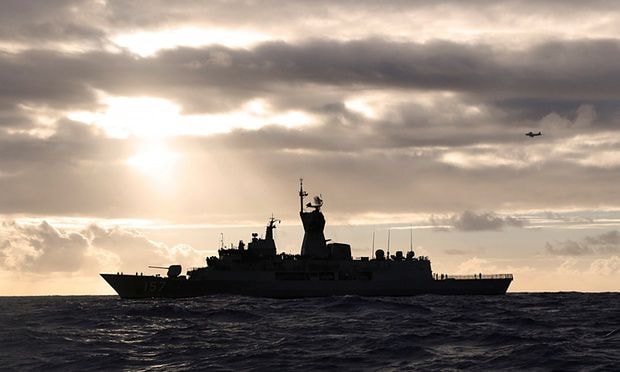 |
| The Talisman Sabre exercise will last until July 21st. (Photo: The Guardian) |
An unprecedented collaboration
This exercise, named Talisman Sabre, lasted two weeks and involved 30,000 US and Australian troops. The drills encompassed maritime, air, and land operations. This was the sixth Talisman Sabre exercise, but the first time Japan participated, sending 40 troops from its Ground Self-Defense Force. Thus, this marked the first time the US, Australia, and Japan jointly conducted a large-scale military exercise involving over 30,000 troops. Analysts believe that while Japan claims its participation is solely aimed at enhancing its military's response capabilities in international missions, China will undoubtedly feel uneasy, understanding the subtle message the US-Australia-Japan alliance intends to send to China through this exercise. Just before the exercise, Australian Prime Minister Tony Abbott, speaking from aboard the flagship USS Blue Ridge, stated: “This is an extremely important alliance, and we are now facing many challenges.” Although not specific, the “challenges” he referred to are believed to include China’s recent concerning actions in the region, particularly its large-scale land reclamation and island building despite strong international opposition. In a commentary, John Lee, a China expert at the University of Sydney, also stated that “the exercises show that the US and its allies are working closely together to counter China’s expansion.”
In fact, when China recently illegally reclaimed reefs to create artificial islands, the US, Japan, and Australia jointly voiced strong concerns about freedom of navigation in the region. While Australian Defence Minister Kevin Andrews spoke out against any "unilateral or coercive actions" in the South China Sea and East China Sea, demanding freedom of navigation for ships and aircraft of all countries through the region, US President Barack Obama and Japanese Prime Minister Shinzo Abe pledged to strengthen joint military deterrence, agreeing on a commitment to freedom of navigation, respect for international law, and "peaceful resolution of disputes without oppression."
Strengthening the weak link in the alliance.
This is not the first time the public has witnessed the close cooperation of the US-Australia-Japan alliance. Previously, on the sidelines of the G20 summit in Brisbane, Australia, last November, US President Barack Obama, Japanese Prime Minister Shinzo Abe, and Australian Prime Minister Tony Abbott held an important meeting to discuss ensuring security in the Asia-Pacific region. More recently, in late May 2015, during a trilateral meeting between US Secretary of Defense Ashton Carter, Australian Defense Minister Kevin Andrew, and Japanese Defense Minister Gen Nakatani, the three sides affirmed their determination to strengthen the alliance, viewing it as essential to ensuring peace and security in the Asia-Pacific region. Australia and Japan emphasized their long-term commitment to the US "rebalancing" strategy in the region.
There's no denying the close relationship between the US-Australia and US-Japan bilateral alliances. However, the relationship between Japan and Australia is considered less robust and the weakest link in the trilateral US-Australia-Japan defense cooperation. Nevertheless, security cooperation between Australia and Japan has improved significantly under Prime Ministers Tony Abbott and Shinzo Abe, particularly following Prime Minister Shinzo Abe's visit to Australia last year, where the two sides agreed to cooperate on submarine development projects and the training of Japanese military personnel in Australia. Japan's deployment of troops to Australia for the Talisman Sabre exercise also demonstrates a stronger connection between the Australia-Japan link.
Naturally, the US strongly supports this alliance, as it means the US has two extremely solid "anchors" guarding the Northwest and South in the Asia-Pacific region when implementing its "pivot" strategy. And the "pincer" formation of the US-Australia-Japan alliance will certainly "cause difficulties" for China - although containing China is something that neither the US, Australia, nor Japan have ever admitted.
Thuy Ngoc
| RELATED NEWS |
|---|


