
Casting nets at night on the Nam Trong River
(Baonghean) - Once, while on a work trip to Quy Hop, over a glass of strong wine, Mr. Tho, a district Party committee official, confided to us: "You gentlemen must go out at night to cast your nets to better understand the lives of the Thai people in this region." Intrigued, we agreed...
Around 9 PM, we, along with a few strong young men from the village, eagerly set off with our nets and flashlights. The night in the highlands grew colder with each passing moment. About a dozen of us went to the banks of the Nam Trong River to begin our night fishing trip. The sky was pitch black. We had to use flashlights to find a suitable spot to cast our nets. Casting nets at night sounded strange, so I asked, "Why not fish during the day instead of waiting until night to go?" A young man from the village quickly replied, "The fish and crabs in the Nam Trong usually hide in the crevices of the rocks and pebbles at the bottom of the river; they only come out to feed at night, so we can catch them then."
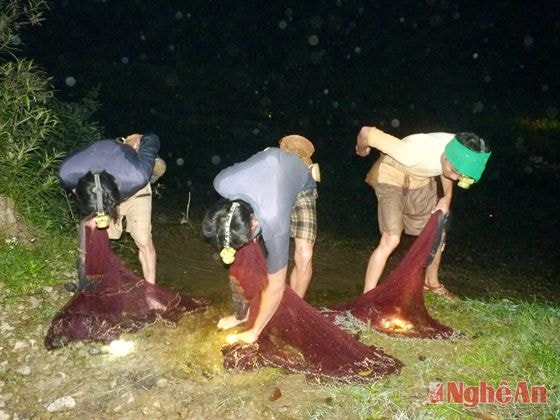 |
| Casting nets at night. |
The Nam Trong River, flowing through Chau Dinh commune (Quy Hop district), is crystal clear this season, with some areas only waist-deep and others knee-deep. Our night fishing group divided up tasks: some shone flashlights to catch crabs, others cast nets. The flashlights illuminated a stretch of the river. This was the first time in our lives we had experienced such a delightful feeling alongside the young Thai ethnic men at night in the highlands. The nets were quickly cast into the calm Nam Trong River. Every now and then, they would shout with joy when they caught a plump mudfish or a fresh, green catfish. Among the night fishing "hunters," Vi Van Long, from Cang Diem hamlet, Chau Dinh commune, is considered the best fisherman in the area. Each night, after about three hours of casting nets, he would gather a basket of crabs and several kilograms of various stream fish, small but considered a specialty of the Quy Hop highlands.
Quickly pulling in his heavy net, Mr. Long said: “The fish and crabs in the Nam Trong River have nourished the Thai people here for generations, and this stretch of river has been connected to our childhoods until now. As children, we knew how to go fishing in the river. Even after growing up and getting married, we still consider this a supplementary occupation, both to improve our meals and to earn extra income.” The Nam Trong River originates in the western part of the district, in Nam Son commune (bordering Con Cuong district), connecting with the Nam Thong River, Minh Hop River, Con River, and many other streams. It always has water, even during the dry season, creating favorable conditions for crabs and fish to thrive.
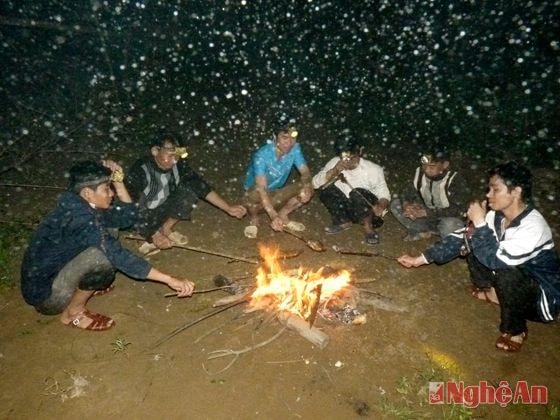 |
| Enjoy grilled fish by the Nam Trong River. |
As night fell, the Nậm Trọng River grew colder. Around 11 or 12 midnight, the baskets and buckets we carried were full of crabs and fish. Stopping our fishing and crab-collecting activities, our night fishing group went ashore and lit a fire. The grill and dipping sauces were already prepared. The cleaned fish were placed on the grill and roasted over the glowing coals. The rich, savory aroma of the fish and eels filled the entire stretch of the river. The feeling of enjoying grilled fish right on the riverbank, sipping on a glass of strong, traditional Thai rice wine, was truly incomparable.
For many young men in the highlands of Quy Hop, casting their nets at night is not just about earning extra money; it's another opportunity to participate in a cultural ritual and showcase the life of the Thai people in the area. Elderly villagers recount that about 30 years ago, the Nam Trong River was much deeper than it is now, creating a favorable environment for larger fish to thrive.
In early spring, the locals often organize a fishing day to bring good luck. Even if it's just for good fortune, everyone is overjoyed when they catch many large fish. Nowadays, these nights spent casting nets together also demonstrate a spirit of solidarity, mutual support, and helping one another. However, due to time and war, this ritual has been interrupted and has yet to be restored.
Duy Ngoi


