
Around the topic of visiting temples at the beginning of the year...
Visiting temples at the beginning of the year has become a beautiful tradition for Vietnamese people.
From the third to the fifteenth day of the first lunar month, people from all over the country make pilgrimages to nearby and distant temples such as: Can Linh Temple, Hong Son Temple (Vinh City), Ong Hoang Muoi Temple (Hung Nguyen), Corn Temple (Quynh Luu), Qua Son Temple (Do Luong), Cui Temple, Huong Tich Temple (Ha Tinh), Bai Dinh (Ninh Binh), Dau Temple (Bac Ninh), Ba Chua Kho Temple... During these days, temples and shrines are bustling with people, due to the belief that "Going to worship all year round is not as important as going on the fifteenth day of the first lunar month."
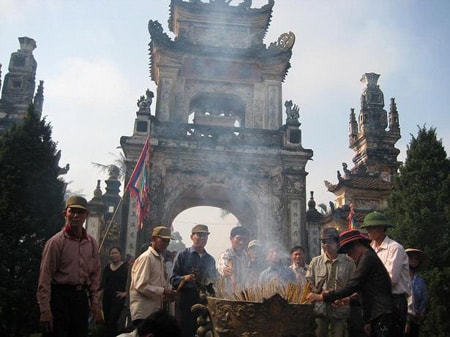
Temple and pagoda management should provide guidance to visitors on how to light incense.
Offer the sacrifice in the proper manner.
With the belief that visiting ten temples at the beginning of the year brings blessings for the whole year, starting from the fourth day of Tet (Lunar New Year), Ms. Thuy, a small business owner at Vinh Market, along with several families of friends, rented a car to visit temples near and far within the province and neighboring provinces. "At the beginning of the year, we go to temples to light incense and pray for peace, prosperity, and wealth for our family and loved ones. This is also an opportunity for family and friends to change the atmosphere, visit places, and start a new year with new work and plans..." Unlike Ms. Thuy, Mr. Quang's family, a civil servant in Thanh Chuong, does the same every year. From the afternoon of the third day of Tet, he and his family organize a trip to light incense and make donations at temples and shrines in the district. For him, going to temples and shrines is not about praying for peace or prosperity, but about finding inner peace and shedding the hustle and bustle of life.
However, recently, in temples and pagodas, especially large and renowned "sacred" ones, "distortions" have emerged that detract from their inherent beauty. These include the indiscriminate burning of votive paper, the widespread offering of real money, and the scattering of small change around Buddha statues. The sight of temple-goers carrying stacks of small bills and scattering them anywhere—stuffing them into hands, sticking them on the heads and shoulders of Buddha statues, placing them on tree trunks, or on shrines—is very distasteful. Along both sides of the temple entrances, beggars swarm, pestering visitors for money. Stalls selling incense, superstitious books, and offering services like writing prayer petitions encroach on the temple grounds. In some temples, superstitious activities such as palmistry, fortune telling, and shamanistic gambling are also taking place. The practice of overcharging visitors to temples has become common nowadays: parking fees reach 5,000 VND per motorbike, and in some places even 7,000 VND per motorbike; incense sticks are sold for 3,000 VND each. In large temples with a high concentration of visitors, pickpocketing and theft have also occurred.
It is suggested that the management boards of historical sites, scenic spots, and temples should have plans to ensure security and order during the peak days of the Lunar New Year temple festival; to prevent the current chaotic situation, and especially, relevant authorities need to step in to eliminate superstitious practices, theft, etc.
Thanh Phuc


