
Homeland, a place of profound meaning and deep affection.
President Ho Chi Minh was born and raised in Hoang Tru village (1890-1895), and spent his adolescence in Kim Lien village (1901-1906). Both periods lasted exactly 10 years, but his affection for his hometowns of Kim Lien and Hoang Tru was profound! Whenever someone from Kim Lien, Hoang Tru, or Nghe An met President Ho Chi Minh, he would affectionately inquire about all aspects of their homeland.
President Ho Chi Minh was born and raised in Hoang Tru village (1890-1895), and spent his adolescence in Kim Lien village (1901-1906). Both periods lasted exactly 10 years, but his affection for his hometowns of Kim Lien and Hoang Tru was profound! Whenever someone from Kim Lien, Hoang Tru, or Nghe An met President Ho Chi Minh, he would affectionately inquire about all aspects of their homeland.
|
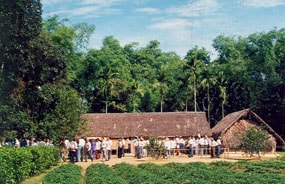
At 11:30 AM on Sunday, October 27, 1946, Mrs. Nguyen Thi Thanh visited President Ho Chi Minh at the Presidential Palace (Hanoi). This was the first time Mrs. Thanh and President Ho Chi Minh had met since he left his homeland to travel the world in search of a way to save the country. In a heartfelt conversation, Mrs. Nguyen Thi Thanh asked President Ho Chi Minh: "You've been away for so long, do you miss your homeland? Do you remember me rocking you to sleep in the hammock, singing lullabies about our country? Back then, our family had a hard time." At this point, Mrs. Thanh wept again. With tears welling up in his eyes, Uncle Ho wiped them away with a handkerchief. Smoking a cigarette and looking out the window, he said, "Sister, the homeland holds such deep meaning and profound gratitude. Those decades were filled with so much affection. True revolutionary fighters are all filial sons and daughters, deeply devoted to their homeland. Sister, when I was abroad, sometimes in the quiet of the night, hearing a lullaby from a family member would only intensify my longing for home and country..."
Mrs. Nguyen Thi Thanh then asked Uncle Ho, "When will you be able to visit your hometown?" After a moment, Uncle Ho replied, "I also want to visit my hometown, but it will certainly be a long time from now, because I still have very heavy responsibilities for the country!"
Exactly one week later, on the same Sunday (November 3, 1946), Mr. Nguyen Sinh Khiem returned to Hanoi to visit Uncle Ho. In a cheerful conversation filled with the warmth of brotherly affection after decades of not seeing each other, Mr. Nguyen Sinh Khiem asked, "When do you plan to visit your hometown?" Uncle Ho calmly replied, "Coming here is like coming home. The current situation and work don't allow me to think about it yet; it will probably be a long time from now!"
As predicted by Uncle Ho, it wasn't until 11 years later (1957) that Uncle Ho had the opportunity to visit his hometown.
For his hometown of Kim Lien, Hoang Tru, and Nghe An province, from the time he became President until his passing, Uncle Ho wrote 35 documents in the form of letters, speeches, and telegrams to encourage and celebrate outstanding events such as excellent production, excellent fighting, and exemplary individuals and good deeds. These include a letter to the provincial leaders written on September 17, 1945, exactly half a month after he read the "Declaration of Independence" giving birth to the Democratic Republic of Vietnam (September 2, 1945), a letter to his uncle Hoang Phan Kinh and his father-in-law Tran Le Huu (April 1949), and his final affectionate letter to the Executive Committee of the Nghe An Provincial Party Committee (July 21, 1969).
In 1957, the domestic and international situation was favorable. After three years of economic recovery and healing the wounds of war, North Vietnam had achieved many great victories, the country had entered a stable period, and was on a strong path of development in foreign relations. President Ho Chi Minh wanted to visit fraternal countries and friends around the world. Before embarking on a long journey, he wanted to visit his homeland to create a new mindset. Therefore, the Politburo planned for him to visit Nghe An and several provinces in Zone IV.
After more than 50 years of separation, on Sunday, June 16, 1957, which was the 19th day of the 5th lunar month of the Year of the Rooster, President Ho Chi Minh visited his homeland for the first time.
When the local leaders and villagers invited Uncle Ho into the guesthouse, he cheerfully said, "The guesthouse is for receiving guests, but I am the host, so let me go home to visit." Then, he walked towards his house. There, the bamboo gate was already open, and everyone invited him inside, but Uncle Ho pointed and said, "The old gate was over there." His feet had returned home, following in the footsteps of his youth.
Uncle Ho entered the outer room, where the ancestors were worshipped and a portrait of Deputy Scholar Nguyen Sinh Sac hung. Pointing to the newly rebuilt altar, he said to the villagers: "In the past, my family was poor, the altar was only made of bamboo, without legs, just two pieces of wood nailed to the two pillars to support the altar, the frame was made of bamboo, and a plain mat was spread on top."
Entering the inner room, Uncle Ho saw the wooden bed where he and Mr. Khiem used to sleep. He said, "Oh, this bed is still here! The villagers have preserved it so well, but it seems shorter than before." The villagers explained that before Ms. Thanh was imprisoned by the French colonialists, they had given it to a family in the extended family to use as a heater in the winter, burning one end, so they had to shorten it. Uncle Ho saw a hammock woven from jute fibers for coolness in the summer, a writing desk for reading and drinking tea, a wooden chest for storing food, a two-compartment cupboard for dishes, and on the cupboard a painted wooden tray used by the family when they had distinguished guests. On the wall hung a lamp with vegetable oil. Uncle Ho went down to visit the three-room annex, where the family cooked their daily meals. Ms. Thanh was the main cook, and Uncle Ho and Mr. Khiem often helped her carry water and cook rice. Uncle Ho was moved to see that all the family's belongings were still intact...
Visiting the courtyard and garden, Uncle Ho recalled the old days. He said, "In the past, right at the entrance gate there was a guava tree with many sweet fruits, a pomelo tree in front of the house, an orange tree by the side of the house, and a beautiful row of betel nut trees behind the house." Some of the ornamental trees that the villagers had brought and planted in 1901, when Mr. Nguyen Sinh Sac passed the imperial examination and returned here in glory, were lost before he could replant them.
The garden where the family of the late scholar used to grow seasonal crops was boldly asked by a provincial official for permission to plant flowers in it to beautify it. The President pointed to the potato field already in bloom and said, "Potato flowers are still beautiful." Everyone understood his meaning.
Upon reaching the gate, Uncle Ho repeated once more: "This is the way to the house, in the old days." To the right, he pointed to the neighbor's fence, which belonged to Mr. Nguyen Danh Uoc, with its row of apricot blossom trees. He held a branch of the apricot blossom tree in his right hand, tugging at it as if to emphasize the point for everyone to remember. To the left, he pointed towards the garden inside the house, where there was a hibiscus hedge. He inquired about the Coc well, a historical site associated with the uprising of the scholar Vuong Thuc Mau, where he often fetched water for his family when he lived in Kim Lien village.
Turning to the left of the gate, next to a banana tree by the roadside, pointing to a path, Uncle Ho asked: "Is the blacksmith's forge of the late Mr. Dien (Hoang Xuan Luyen) still there?" Mr. Dien was a diligent, honest, kind, and cheerful blacksmith, loved by the people in the area. During his time living in Kim Lien village, Uncle Ho often visited the forge in his free time. He respected Mr. Dien, and Mr. Dien also greatly admired Uncle Ho. Uncle Ho helped Mr. Dien with building forges and hammering anvils. In particular, Uncle Ho often inquired about, exchanged ideas with, and discussed social and current affairs with Mr. Dien and the villagers about the people's concerns at that time.
Next, Uncle Ho went to the Nguyen Sinh family church to light incense and pay respects to his ancestors. As he was about to enter the church, he pointed to the left and said, "In here is the house of the late Mr. Phuong. Does he have enough to eat now?" Hearing this, everyone was deeply moved, because everyone knew that Mr. Phuong's family was the poorest family in Kim Lien village when Uncle Ho left his hometown to find a way to save the country.
That day, Uncle Ho spoke with the people of Kim Lien commune and representatives from neighboring communes under the banyan tree in the village's stadium. He instructed the Party committee and the government to correct mistakes in land reform, enhance solidarity and mutual assistance, and avoid a situation where "everyone's light shines only in their own house." He reminded everyone to take care of and educate children, ensuring they are not thin, weak, or suffer from trachoma. He addressed almost everything and offered specific, practical advice. Before leaving, he added: "If the cadres and people of Kim Lien do well, I will come back to visit!"
Keeping his promise, four years later, on December 9, 1961, Uncle Ho visited his maternal hometown of Hoang Tru and his paternal hometown of Kim Lien. During this second visit, he went to the Sen Village Temple to work with the Party Committee and the People's Committee of Kim Lien commune. Afterwards, under the same banyan tree as four years earlier, he had a cordial conversation with the people of the commune. He hoped that everyone would take responsibility for making the people prosperous and the country strong, enhancing the spirit of solidarity and mutual assistance, building increasingly strong cooperatives, contributing to the construction of social democracy in the North, and providing a solid foundation for the victory of the national democratic revolution, the liberation of the South, and the reunification of the Fatherland.
At the end of the speech, Uncle Ho led the crowd in singing the song "Unity." Everyone enthusiastically sang along to the rhythm guided by his hand gestures.
During his first visit to his hometown, before going to Kim Lien, on the morning of June 14, 1957, Uncle Ho spoke to representatives of the people of Nghe An province at the Provincial Party Committee hall in Vinh Citadel. He said:
"I am a son of this province who has been away from home for over 50 years. Today, returning to visit my home province for the first time, I can say: 'My homeland holds profound meaning and deep affection / Fifty years have passed, and how much love there is...'"
On this occasion, Uncle Ho also visited the Vinh Power Plant construction site, visited Unit 324 of the Quang Ngai province army that had gathered in the North and was stationed at Ru Dun, Nam Dan district; and visited the children at the Southern Children's Camp in Vinh...
During his second visit to his hometown on December 8, 1961, Uncle Ho worked with the Provincial Party Committee and the Provincial Administrative Committee. He said: "Everything concerning national development and people's welfare in Nghe An province is your responsibility. To achieve this, what principles must you firmly grasp?"
First: the principle of internal unity.
Secondly: the principle of collective leadership and individual responsibility.
"What else is needed to do well? Internal democracy. And what else is needed for good internal democracy? Criticism and self-criticism..."
When speaking to the people and officials of the province (also in Vinh Citadel, on December 9, 1961), Uncle Ho instructed: "The people and officials must be determined to strive to build our province into one of the most prosperous provinces in the North!"
During his second visit to his hometown, Uncle Ho met and spoke with revolutionary fighters who participated in the Nghe An - Tinh Hoa Soviet movement (1930-1931), and visited several factories, schools, and localities, including the Vinh Mechanical Factory, the Nghe An Mountain Teacher Training School, the Thai Lao Martyrs' Monument, Vinh Thanh commune, and Dong Hieu Farm.
During his visit to the Vinh Mechanical Factory, Uncle Ho instructed: "The working class is the leading class; they must strive to be worthy leaders so that people trust them... They must excel in four areas: speed, quantity, quality, and affordability."
Visiting students and staff at a teacher training school in the mountainous region of Nghe An, Uncle Ho said: "What does it mean to study well? Studying well means that politics and culture must be closely linked to productive labor, not drawn out. The purpose of studying is to make the economy, politics, and culture all progress, and to unite all ethnic groups. What else is studying for? To build socialism."
Many documents and stories about President Ho Chi Minh's visits to his homeland could be cited, but even just the points mentioned above are enough to fully illustrate his feelings for his homeland. Within that feeling, there is a simplicity like that of an ordinary person, yet overarching it is the sentiment of a great man, as Prime Minister Pham Van Dong said: "He humbled himself to be at the level of all Vietnamese people in order to elevate all Vietnamese people to his level!"
The people of Nghe An province, including Kim Lien village in Hoang Tru commune, deeply cherish the profound and pure love of President Ho Chi Minh and pledge to forever follow his kind guidance to build Kim Lien into a model commune and Nghe An into a model province, as he always wished.
Tran Minh Sieu



;)