
Que Son: Bountiful sugarcane harvest
(Baonghean) - Thanks to the introduction of new sugarcane varieties and the application of science and technology in cultivation, sugarcane yields in Que Son commune (Que Phong district) have reached over 82 tons/ha.
In Que Son - Que Phong at the end of the sugarcane harvest season, the faces of the farmers shone with joy at the bountiful harvest. Mr. Thai Huu Linh from Hai Lam II hamlet said: “My family cultivates 1 hectare of sugarcane, and this year's yield is exceptionally high, estimated at over 90 tons per hectare. The average price of sugarcane is 850,000 VND per ton, which isn't as high as in previous years, but thanks to the high yield, sugarcane growers are still making a profit.” According to Mr. Linh, this season's high yield is due to his family using new sugarcane varieties such as Roc 27 and the super-sweet variety… The super-sweet variety has the advantage of not being susceptible to stem borers, having fewer brown planthoppers, and producing tall but sturdy plants. The Roc 27 variety has a negligible flowering rate, thus maintaining the sugar content in the sugarcane. “We focus on improving the soil according to the guidance of agricultural extension officers. Que Son mainly has sandy loam soil on hillsides, but it retains little water and the soil is compacted due to the practice of burning sugarcane leaves after harvest. Therefore, we have to improve it using deep plowing to limit erosion and nutrient leaching, applying organic microbial fertilizers, manure, and lime to reduce soil acidity. The total investment from plowing to fertilizers… is over 25 million VND/ha,” Mr. Linh added.
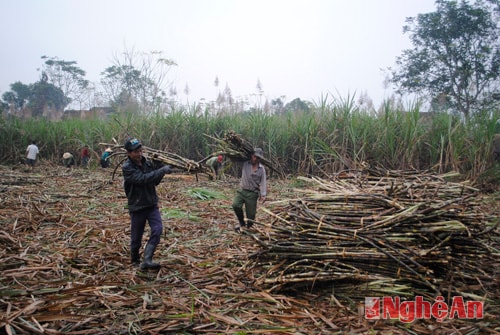 |
| Sugarcane harvest in Que Son - Que Phong |
This season, Mr. Nguyen Viet Thang's family planted 1.5 hectares of sugarcane, achieving a yield of nearly 95 tons/ha, the highest ever. Besides guidance from officials on sugarcane planting and care procedures, according to Mr. Thang's experience, during the two-month growth period, they focus on applying base fertilizer, weeding, disease control, and especially tilling the soil to improve aeration. Mr. Thang happily stated: “The advantage is that the sugar factory provided us with a preferential loan of 7 million VND/ha/year, which gave us additional funds to rent a plow and buy fertilizer for sugarcane care. In addition to the loan from the factory, my family invested an extra 15 million VND to buy NPK compound fertilizer to care for the sugarcane according to technical procedures.” Mr. Quyet Thang – Head of Hai Lam II hamlet – said: “The hamlet has 89 households with nearly 50 hectares of sugarcane, with an average yield of 87 tons/ha. Basically, 100% of the villagers use new, high-yield varieties.” As a result, many households have had the opportunity to rise out of poverty.
According to Mr. Nguyen Tien Dung, Chairman of the People's Committee of Que Son commune, the entire commune currently has over 240 hectares of sugarcane. For several years now, sugarcane has been the main crop for poverty reduction, so farmers have focused on intensive cultivation to increase income per unit area. In the 2013-2014 sugarcane season, the average yield for the entire commune was 82 tons of sugarcane per hectare, with some households achieving 90-100 tons per hectare. Entering the new planting season, the commune directed farmers to clean the sugarcane fields, eliminate weeds and disease pathogens; and apply fertilizer according to the correct procedure: applying 8-10 tons/ha of organic base fertilizer, 250 kg of phosphorus fertilizer/ha, and two topdressing applications of urea nitrogen at approximately 200 kg/ha. However, the current difficulty is the lack of irrigation for sugarcane in Que Son, while according to the procedure, each sugarcane crop requires 12-15 irrigation cycles. During the hot season, many areas remain dry, with only a few near streams being able to irrigate their sugarcane fields with electric or diesel pumps.
Mr. Hoang Duc Nghia, Head of the Que Phong Agricultural Extension Station, said: "To further develop sugarcane cultivation in Que Son, it is necessary to continue applying technical solutions in cultivation, increasing lime and phosphorus fertilization to improve and raise the pH level, using organic microbial fertilizers to help improve soil aeration, ensuring oxygen needs for the sugarcane root system to develop and penetrate deeply; at the same time contributing to moisture retention and improving soil fertility... We encourage the use of machinery in land preparation to reduce sugarcane lodging, ensure soil moisture for the sugarcane plants and contribute to creating a loose topsoil layer 20-30 cm thick. Farmers should use new high-yield sugarcane varieties in production and proactively prepare seed production fields to serve the new planting plan."
Text and photos:Van Truong