
Quy Chau - An attractive destination
(Baonghean) - Phu Quy, a name used to refer to the vast area in northwestern Nghe An province, is now divided into many district-level administrative units. Within this colorful cultural landscape, visitors to each locality will have their own unique and interesting experiences. But if you want to experience Phu Quy in its most complete and pristine form, you should visit Quy Chau...
Starting from Vinh City, travel north along National Highway 1A, then connect to National Highway 48 at the Yen Ly intersection in Dien Chau district, continuing for over 100 km west to reach Quy Chau. The journey, lasting over three hours, can be tiring. However, upon arriving in Quy Chau, the vast expanse of mountains and forests, the diligent turning of waterwheels in the evening light, and the friendly smiles of the Thai ethnic women seem to vanish all fatigue. The serene beauty transports you to the past of Phu Quy. Tan Lac, the district town of Quy Chau, is quiet and unhurried, evoking a sense of peace. But life here is far from monotonous. Visitors can find everything they need, but perhaps the most interesting are the stalls selling local specialties like sour bamboo shoots at very reasonable prices. In the eateries, the owners will happily guide you in choosing a menu with distinctive local dishes such as: Quy duck, catfish soup, black sticky rice... A meal rich in local flavors will surely satisfy even the most discerning palates.
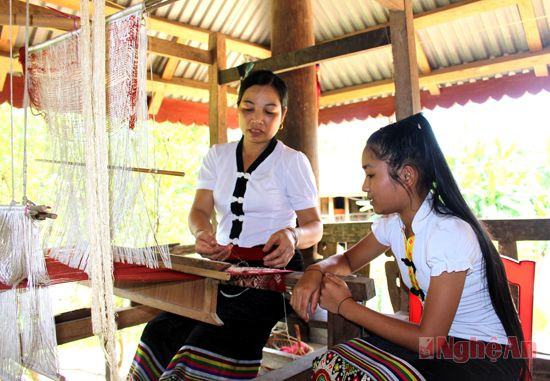 |
| Thai women in Hoa Tien village, Chau Tien commune, guide their children in weaving brocade. |
Tan Lac also boasts a very interesting destination: the Quy Chau Ethnic Culture Museum, which displays over 750 artifacts. The museum evokes a sense of curiosity because it's quite different from the museums many people imagine; it's a stilt house built in the traditional architecture of the Thai ethnic group. As you step up the last step of the staircase leading to the stilt house, the main door opens, transporting you to a bygone era through the commentary of Mr. Vi Van Dung, an official from the Quy Chau District Cultural and Information Center.
The exhibits are displayed and arranged thematically and chronologically, giving visitors the most complete and comprehensive understanding of the land and people of Phu Quy. Looking at each exhibit and listening to each explanation, one is amazed to realize that Phu Quy has a rich and admirable history. All of this is built upon the depth of culture, the labor, and the daily lives of the ethnic communities living in the area. “The museum is an attractive tourist destination, highly appreciated by many visitors, including foreigners. It is also a place where many generations of Phu Quy people come to better understand the lives of their ancestors in the past,” Mr. Dung shared.
While a visit to the Quy Chau Ethnic Culture Museum provides a wealth of general knowledge, a journey to the villages of the Thai ethnic group offers fascinating experiences. From Tan Lac, traveling north for just under 30 km, you will reach places like Chau Tien, Chau Binh, and Chau Thuan. First, take the time to explore the stunning cave systems bestowed upon this land by nature. Not only are there fascinating stalactites in various shapes, but many of these caves also contain rare archaeological treasures.
Recently, a Vietnamese archaeological team led by Associate Professor, Dr. Nguyen Khac Su, Senior Researcher of the Vietnam Institute of Archaeology, surveyed caves in Quy Chau district and discovered many artifacts providing important evidence about prehistoric human life. At Tham Om cave in Chau Thuan commune, archaeologists found 10 tools, including one made of quartz, considered the first production tool crafted by prehistoric humans, as well as many human remains and teeth of Homo sapiens. Meanwhile, at Co Ngun cave in Chau Binh commune, many stone tools dating back 7,000 to 8,000 years and many pottery fragments from the Metal Age, about 4,000 years ago, were also found... The artifacts collected from many caves in Quy Chau district have helped us visualize the life of prehistoric people who once flourished in Quy Chau, further affirming the historical depth of this land.
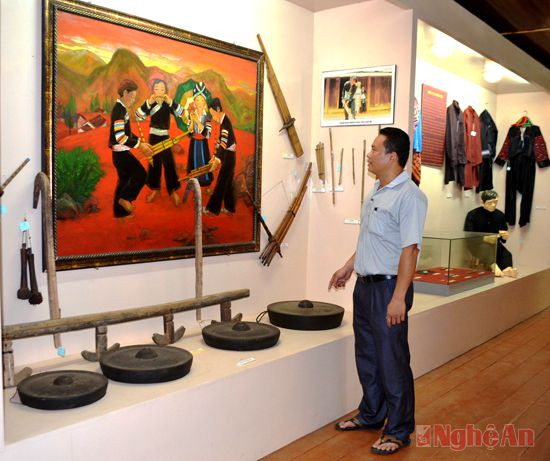 |
| Traditional musical instruments of various ethnic groups are on display at the Quy Chau Ethnic Culture Museum. |
Amazement followed amazement as we continued along the small paths to the ancient Thai villages in Chau Tien commune. The neatly arranged stilt houses in Hoa Tien 1 and Hoa Tien 2 villages will captivate your attention. It seems that the people of this mountainous region know how to harmonize modern life and tradition. Day after day, the villagers still go to the fields to work, and the women still diligently work at their looms weaving exquisite, colorful brocade fabrics. In recent years, besides farming, the people of Hoa Tien have also become accustomed to tourist groups, both Western and Vietnamese, visiting the village. Although the number of tourists is still small, it brings them much joy and additional income through community tourism.
Visiting the brocade product display booth of the Hoa Tien 1 Brocade Weaving Cooperative, besides traditional products associated with Thai women's clothing such as skirts and scarves, the skillful hands of Thai women also create products such as carpets, handbags, and belts made from brocade. Ms. Sam Thi Huong, the head of the cooperative, said that the cooperative's brocade has reached the markets of Hanoi, Laos, and even Thailand. The brocade weaving craft has also brought income to dozens of workers. It turns out that, contrary to the slow pace of life, the people of the ancient Thai village are also very quick-witted in the marketplace. Chau Tien also has the Muong Chieng Ngam Temple, which worships the three patron deities, who were also the three brothers Xieu Bo, Xieu Ke, and Xieu Luong, who contributed to the establishment of the village in the Chieng Ngam area, and Hang Bua, a scenic spot that holds a very important position in the lives of the local Thai people. The Hang Bua Festival, held at the beginning of each spring, attracts many locals and tourists from all over to participate.
Quỳ Châu is also a land that preserves the heroic achievements of our nation's history. Have you ever wondered where the "Thunderous Battle of Bồ Đằng" mentioned in Nguyễn Trãi's Bình Ngô Đại Cáo took place? Well, it was right here in Châu Nga commune, Quỳ Châu district. Visiting this mountainous region, tourists can also hear the story of the hero Lang Văn Thiết, also known as Đốc Thiết. He was a leader of the anti-French colonial activities in western Nghệ An during the Cần Vương movement in the 19th century. In 1896, the French captured and beheaded him, hanging his head on an apple tree in Châu Hội commune; he was later buried by the people in Châu Nga commune. In 1998, the Apple Tree and Lang Văn Thiết's tomb were classified as a National Historical Monument by the State.
Embracing the sun and wind of Nghe An province, and navigating the arduous, unfamiliar roads to reach Quy Chau, visitors will find moments of tranquility, profound reflection, and even astonishment at the history, culture, and people of this vast region in northwestern Nghe An. For there, a pristine Quy Chau district, steeped in nostalgia, is still preserved!
Text and photos:Nhat Le
| Mr. Tran Viet Duc, Head of the Culture Department of Quy Chau District, said: "In Quy Chau district, there are 14 historical sites and scenic spots, including 2 that are classified at the national level: Bua Cave in Hong Tien 2 village, Chau Tien commune, and the Apple Tree - Lang Van Thiet Tomb in Chau Hoi and Chau Nga communes. With these potentials, Quy Chau has great potential for tourism development." |
| RELATED NEWS |
|---|


