
Quy Chau: Poverty reduction through buffalo and cattle farming.
(Baonghean) - With its potential and advantages in land, natural food sources, and abundant agricultural by-products, in recent years, along with a strong transformation of the crop structure, Quy Chau district has focused on leading and directing the people to promote livestock development, thereby contributing to poverty reduction.
Like many young couples in the mountainous region, after getting married, Mr. Tran Xuan Hop and his wife, from Tan Huong 1 hamlet, Tan Lac town, faced numerous difficulties in making a living. Besides their three acres of rice paddies, they also had to work as laborers, carrying loads, harvesting bamboo shoots, and chopping firewood to sell, but their family life remained impoverished.
After much deliberation, recognizing the advantages of the local hilly and forested terrain for livestock development, in 2003 he sold everything he could, borrowed money from relatives to buy 12 cows, and brought them to the top of Pù Nghìn mountain to clear land and graze.
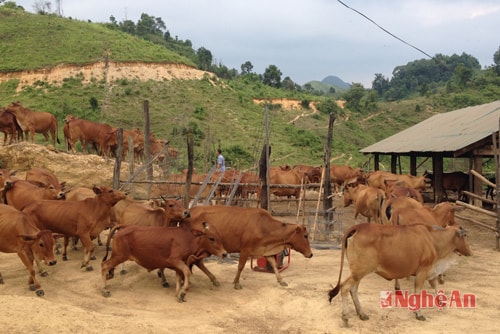 |
| The herd of 185 cows belongs to Mr. Tran Xuan Hop's family. |
Starting from small-scale livestock farming in the early days, after more than a decade, his family has sold hundreds of cows. Besides stabilizing their family's finances and becoming wealthy, his family has expanded their model to include raising goats, pigs, and chickens.
Mr. Hop said: "My family's total cattle herd currently has 185 head, including 76 breeding cows, 35 Laisin F3 bulls, and 74 cows of various sizes. On average, we earn around 600 million VND per year from selling breeding and beef cattle alone. If you include income from planting acacia trees, slaughterhouse services, and raising goats, pigs, and chickens, after deducting expenses, my family earns over 1 billion VND per year," Mr. Hop added.
Having only invested in livestock farming for four years, the model of Mr. Nguyen Van Huu's family in Hamlet 1, Chau Hoi Commune, is considered a prime example. Currently, his family's total herd of cattle and goats has reached 50 animals.
"Raising cattle doesn't cost much in feed, as we can utilize readily available food sources like grass, corn stalks, banana plants, etc., and it doesn't take much time for grazing... In just the last four years, our family has earned over 100 million VND in profit annually from cattle farming alone, not including income from goats," Mr. Huu shared.
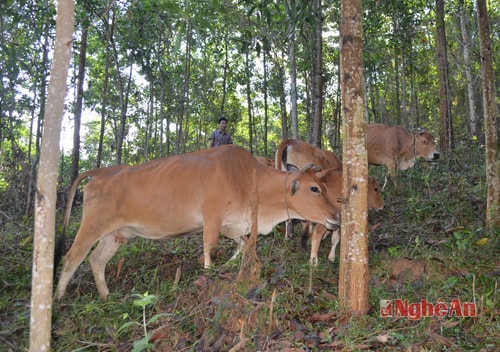 |
| The herd of cattle belonging to Mr. Nguyen Van Huu's family. |
Mr. Dinh Khac Tung, the agricultural officer in charge of Chau Hoi commune, said: "Thanks to the effectiveness of pioneering livestock farming models, most families in the commune have now invested in livestock farming, with some families raising 2-3 animals and others raising 30-50. As a result, the total livestock population in the commune has reached over 9,000 animals."
Over the years, following the policy of promoting the development of commercial livestock farming coupled with expanding the area of grass cultivation to over 2000 hectares, the total livestock population in Quy Chau district has now reached over 56,000 animals, including 18,815 buffaloes, 8,310 cows, 26,500 pigs, and approximately 3,300 goats… The development of livestock farming has contributed to generating significant income for hundreds of households, thereby reducing the district's poverty rate to 36%.
Dang Nguyen


