
Quy Chau: Enhancing production capacity, creating a comprehensive breakthrough.
(Baonghean) - During the 2015-2020 term, Quy Chau continued to promote infrastructure development; focusing on developing industry, agriculture, services, and tourism in a way that enhances production capacity to accelerate poverty reduction.
With the view that infrastructure is the "runway" for economic and social development to "take off," based on the adjustments and additions to the overall socio-economic development plan until 2020 and the approved medium-term public investment plan for the period 2016-2020, the district will develop phased investment plans for the construction of projects in each sector and field: transportation, irrigation, electricity, water supply, and essential infrastructure serving socio-economic development, national defense and security in an effective manner and mobilize capital sources well for implementation. In particular, the district will focus on effectively implementing the planning and resettlement for the Ban Mong water reservoir project and the following programs and projects: Program 135, the New Rural Development Program, Program 229, and Government Decision 293/QD-TTg dated February 5, 2013. Integrating, managing, and effectively utilizing programs and projects funded by the Central Government, the province, and Military Region IV invested in the area.
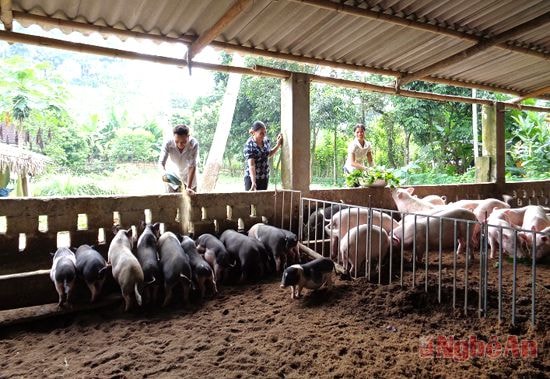 |
| The model of pig farming using biological bedding by Mr. Luong Van Luyen in Ke Le village, Chau Hoi commune. Photo: Ke Kien. |
In addition, focus on completing the agricultural sector plan to attract investment, promote the application of scientific and technological advancements in production, and rationally restructure crop seasons and crop patterns. Continue to build and upgrade irrigation systems, reinforce canals, and ensure proactive irrigation. Invest in intensive rice cultivation, focusing on expanding the area of hybrid rice, and accelerate land consolidation and exchange to invest in the development of large-scale model fields. Continue to promote the construction and replication of economic development models such as: afforestation, and large-scale livestock farming in concentrated farm settings...
Promote the development of commercial livestock farming in regional areas, focusing on semi-industrial, concentrated farming, and the breeding of buffaloes, cattle, grass-fed pigs, and Quy ducks. Improve the ability to control and prevent diseases in livestock and poultry; continue to promote aquaculture on water surface areas, ponds, and cage fish farming on rivers, especially effectively utilizing the water surface area of reservoirs and dams in the area to rapidly increase the scale of aquaculture; promote concentrated reforestation after logging, planting raw material trees, focusing on high-economic value trees such as acacia, bamboo, fragrant roots, and medicinal plants. Effectively manage forest protection and fire prevention, restore and develop 14,000 hectares of natural bamboo and reed forests; invest in building several models for planting oranges and tangerines...; accelerate the implementation of the National Target Program for building new rural areas, striving to have an additional 3 communes meet the new rural area criteria by 2020. From there, the goal is to achieve an average growth rate of over 4.96% during the 2016-2020 period; by 2020, the value of agricultural production (at constant 2010 prices) will reach over 664 billion VND.
In the industrial, handicraft, and construction sectors, high expectations are set, striving to achieve a production value (at 2010 constant prices) of over 858 billion VND by 2020; with an average growth rate of nearly 14% during the 2016-2020 period. The internal structure of the sector is shifting towards a rapid increase in the proportion of industry and handicrafts, reaching over 42.6% by 2020. To achieve this goal, for the mining and construction materials production industry, the district will maintain and improve the capacity to mine various types of stone at licensed mines and establish several new mining areas. The target is to reach approximately 340,000 m³ of construction stone by 2020. Furthermore, favorable conditions will be created for organizations and individuals currently engaged in preliminary processing of forest products in the area, and investment will be encouraged to upgrade, maintain, and develop wood and forest product processing facilities. Manufacturing household wooden furniture and diversifying wood products.
To increase the percentage of villages with access to the national power grid to 95% by 2020, Quy Chau will focus on developing the national power grid system; developing small hydropower and other forms of energy for disadvantaged villages. Along with industry and handicrafts, the focus will be on building and attracting investment in industrial clusters, craft villages, and villages with traditional crafts, especially concentrating on developing incense making, brocade weaving, and rattan and bamboo weaving for export. Businesses will be encouraged to apply scientific and technological advancements, diversify products, develop markets, and maintain and develop product brands. Conditions and support will be provided to craft villages to develop production and enhance competitiveness. The development of household economies, farm and smallholder economic models, cooperatives, and enterprises will be promoted. Planning and management of regional planning and the development of raw materials for the development of traditional crafts such as incense making and brocade weaving will be strengthened.
Develop commercial and service infrastructure to meet the production and essential consumer needs of the people. Effectively promote investment in the construction of the Tan Lac town commercial center according to the plan, and markets in Chau Hoi, Chau Phong, and Chau Hanh communes according to the criteria of the new rural development program. Establish mechanisms and policies to encourage businesses and investors to operate in service sectors such as restaurants, hotels, transportation, and petroleum businesses. Develop community tourism and ecotourism, preserving the cultural values of the original Thai village. Improve the business registration process for individual households. In addition, create favorable conditions for economic sectors to operate and invest in development. Strive to achieve a production value of VND 670.5 billion in the trade and service sector by 2020. The average growth rate of production value during the 2016-2020 period is expected to exceed 10.5%.
To achieve the above objectives, Quy Chau district has proposed key solutions in the economic field, including: developing policies to create momentum for socio-economic development; improving the quality of planning and effective planning management; focusing investment and development on priority areas such as infrastructure construction and service sector development associated with economic restructuring; mobilizing and effectively utilizing resources; and significantly improving the investment and business environment.
Despite numerous difficulties and challenges, the tasks set for the 2015-2020 term are immense. The Party Committee and people of Quy Chau district continue to uphold the spirit of unity and responsibility, seizing favorable opportunities. They are determined to successfully achieve the political goals and tasks set forth by the 25th District Party Congress, striving to build Quy Chau district into an increasingly prosperous, beautiful, and civilized place.
Ngo Duc Thuan
(Chairman of the People's Committee of Quy Chau District)


