
Children's right to education is protected by law.
(Baonghean) - The merger of the Van Ha branch school into the main school to improve the overall quality of education for students is a correct policy. However, some residents and parents in Van Ha Village have used their children's future as a tool to pressure and bargain with the authorities, preventing their children from attending the main school. These actions violate the law…
(Baonghean) - The merger of the Van Ha branch school into the main school to improve the overall quality of education for students is a correct policy. However, some residents and parents in Van Ha Village have used their children's future as a tool to pressure and bargain with the authorities, preventing their children from attending the main school. These actions violate the law…
Naturally, what parents most desire and worry about is their children's education and future. There's an old saying, "Losing to a teacher by a thousand is not as bad as losing to a friend by a hair's breadth." Therefore, they are willing to sacrifice everything, overcome all difficulties, and save diligently to provide for their children's education. Furthermore, everyone strives to ensure their children live and study in a comfortable and prosperous environment, with the conditions for their holistic development in morality, intellect, physical health, and aesthetics. In Nghe An province, the image of parents in the highlands climbing mountains, crossing forests, and wading through streams, facing numerous dangers to supply food and provisions for their children on their journey to literacy; or fathers and mothers in rural areas, their clothes drenched in sweat, hunched over bicycles under the scorching sun for kilometers to take their children to school, has become familiar.
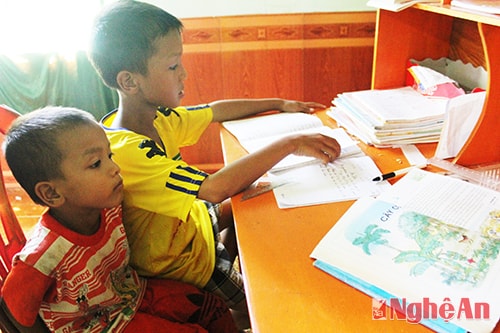 |
| The child of Mr. Nguyen Ham Luc (born in 1971, Hamlet 9, Quang Son Commune) has had to drop out of school for over a year and is studying at home. Photo: DH |
| RELATED NEWS |
|---|
In several dialogues we attended between the authorities, the school, and the villagers and parents, it was evident that the majority of opinions were expressed by older people and those without children attending the remote school. They constantly claimed to represent the people of Van Ha village, but their opinions did not focus on the core issues related to the education of the village's children; instead, they aimed to undermine the credibility of local officials. In fact, this is not the first time some residents of Van Ha village have shown an uncooperative attitude towards the implementation of local economic and social development policies and plans. According to our findings, even fulfilling some annual tax and fund obligations, such as submitting produce or simply the assessment of poor households, has not been met with cooperation from some individuals with the commune and village authorities. These events compel us to question what lies behind the prevention of children from Van Ha village from attending school? Is the motive merely to satisfy the stubbornness, the desire to win, and the desire to defy the authorities—a way for some individuals dissatisfied with certain officials in the commune and village government to vent their anger?
Regardless of the reason, the actions of preventing children from attending school; transporting young children to Vinh City to hang banners in front of government offices to exert pressure by a segment of the population and parents of Van Ha village violate Articles 8 and 9 of the United Nations International Convention on the Rights of the Child; and Section 8, Article 7 of the Vietnamese Law on Protection, Care and Education of Children, which prohibits the act of "hindering children's education." Sections 1 and 2, Article 10 of Decree No. 71/2011/ND-CP, which details and guides the implementation of some articles of the Law on Protection, Care and Education of Children, also clearly state: Abusing prestige, using force, threatening to use force, or using material means or authority to entice, lure, or force children to drop out of school; forcing or enticing children to drop out of school to exert pressure, file complaints, or stage illegal protests are acts of hindering children's education. Furthermore, the act of destroying rice crops and burning straw by some families whose children and grandchildren are attending school shows signs of the crime of "destruction of property" as stipulated in Article 143 of the 1999 Criminal Law (amended and supplemented in 2009).
Everyone knows that the right to education is a fundamental and important right for children, protected by law. Vietnam was the first country in Asia and the second in the world to ratify the Convention on the Rights of the Child on February 20, 1990. Since then, Vietnam has made significant progress in incorporating the spirit and content of the Convention into national laws. Laws enacted or amended have consistently prioritized the rights of children, including the right to education. According to Vietnamese law: All children, regardless of their circumstances, have equal opportunities for education and are provided with opportunities by the State to study. The 2005 Education Law also affirms the goal of Vietnamese education as "Training Vietnamese people to develop comprehensively, possessing morality, knowledge, health, aesthetics, and professional skills… forming and nurturing the personality, qualities, and abilities of citizens, meeting the requirements of national construction and defense." With that goal in mind, children have the right to access a basic, comprehensive, and quality education. The planned merger of schools and classrooms in Quang Son (Do Luong) is also aimed at achieving this goal. And ensuring children's right to education in the best possible environment is a shared responsibility of families, schools, and society. Therefore, parents in Van Ha village have the obligation and responsibility to ensure their children's right to long-term education and development.
The policy of merging smaller schools into the main school in Quang Son commune is absolutely correct. It not only provides opportunities for primary school students but also gives preschool children in Van Ha village the chance to study in a better environment. Therefore, for the long-term future of their children, parents in Van Ha village should support the merger policy of the government and the Education sector. They should not, due to the stubbornness and competitiveness of some adults, put children at risk of dropping out of school. Nor should they, because of conflicts among adults, gamble or bargain with the government for the future of their children. Admittedly, during the implementation of the merger, the work of public awareness campaigns and soliciting opinions from voters by the authorities at various levels was sometimes not entirely smooth; some people disagreed or were dissatisfied with certain individuals in the government's officials at various levels. But this mistake cannot be used as an excuse to lead to a series of other mistakes. And once the authorities at all levels have done everything possible to create conditions for children to go to school, if parents remain stubborn and inflexible, then no one else but them must bear responsibility for the future of their children and for their illegal actions before the law.
For the local authorities of Do Luong district and Quang Son commune, the fact that after two years of propaganda, mobilization, and dialogue, they still haven't received the people's agreement and support shows the limitations in mass mobilization work, stemming from the weaknesses of the political system, especially at the commune and village levels. This is also a lesson that the local Party committee and government need to seriously review and learn from. In the current situation, in addition to continuing to coordinate and do a good job of propaganda and mobilization to gain the people and parents of Van Ha village's consent to the school merger policy and bring their children to school as soon as possible, Do Luong district needs specific solutions to strengthen and improve the grassroots political system, enhance dialogue, listen to, and resolve people's opinions in a fair and reasonable manner, in a constructive and open-minded spirit, thereby building trust among the people. In addition, we will coordinate with relevant authorities to strictly deal with individuals who incite, instigate, threaten, or prevent students from Van Ha village from attending school, in order to ensure the strict enforcement of the law…
Reporters' Team
| The 2013 Constitution (amended in 1992) stipulates:"Learning is both a right and a duty of citizens." Along with the Constitution, this right is further concretized in various documents of the legal system. The Law on Protection, Care, and Education of Children in 2004 affirms in Article 16: "Children have the right to education." Sections 1 and 5 of Article 11 of Decree No. 338-HĐBT dated October 26, 1991, on the implementation of the Law on Universal Primary Education, stipulate that parents and guardians of children have the responsibility to: ensure the conditions for children to complete primary education before the prescribed age, ensure that children attend school at the appropriate age, and ensure that children do not drop out of school; in cases where a child under guardianship fails to complete primary education as prescribed by law, appropriate penalties shall apply. |
Attorney Nguyen Trong Hai - Head of Trong Hai and Associates Law Office: From a legal standpoint, obstructing the schooling of students at all levels of compulsory education violates the 1989 Convention on the Rights of the Child, which Vietnam ratified on February 20, 1990. This act also violates Article 94 of the 2005 Education Law: "Parents or guardians are responsible for nurturing, educating, and caring for their children or wards, creating conditions for them to study, train, and participate in school activities; everyone in the family is responsible for building a cultured family, creating a favorable environment for the comprehensive development of children's morality, intellect, physical health, and aesthetics; older adults are responsible for educating and setting an example for their children, and working with schools to improve the quality and effectiveness of education." For this behavior, violators may be subject to administrative penalties, as stipulated in Article 22 of Decree 138/2013/ND-CP on administrative penalties in the field of education: "1. A warning or a fine of VND 200,000 to VND 500,000 shall be imposed for inciting students not to attend school or to drop out of school at all levels of compulsory education. 2. A warning or a fine of VND 500,000 to VND 1,000,000 shall be imposed for obstructing the schooling of students at all levels of compulsory education." According to Section 2, Article 30, Chapter II of Government Decree No. 144/2013/ND-CP dated October 29, 2013, administrative penalties for acts prohibiting or hindering children's right to education are as follows: "1. A warning or a fine of up to VND 500,000 shall be imposed for one of the following acts: a) Destroying children's books, notebooks, and learning materials; b) Deliberately failing to fulfill the obligation to contribute to children's education as prescribed by law, or failing to ensure adequate learning time and conditions for children. 2. A fine of VND 1,000,000 to VND 3,000,000 shall be imposed for the act of enticing, luring, or forcing children to drop out of school or stop attending school." From a social perspective, hindering children from attending school at all levels of compulsory education is also reprehensible, as it affects their normal development, goes against the policies of the Party and the State, and disrupts social order, safety, and local policies. |


