
Taking decisive action to prevent and control avian influenza outbreaks.
(Baonghean)Currently, there are three outbreaks of avian influenza in our province, located in the districts of Quỳnh Lưu, Nghi Lộc, and Yên Thành. Meanwhile, nationwide, there are 24 outbreaks in 11 provinces, and the risk of H7N9 avian influenza entering from China is very high. The avian influenza situation is becoming increasingly complex, causing not only economic losses but also threatening human safety, requiring decisive and effective prevention and control measures.
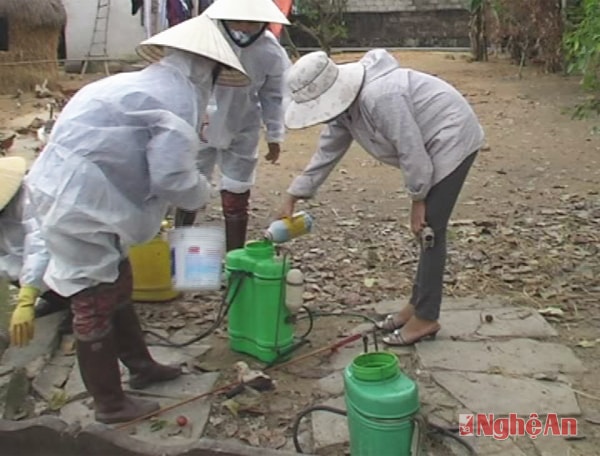 |
| The veterinary team of Dai Thanh commune, Yen Thanh district, is carrying out disinfection and sterilization of livestock barns for households. Photo: Thai Duong |
Nghi Loc is one of the first localities to experience this dangerous disease outbreak in poultry flocks. Mr. Tran Quoc Cuong, Head of the District Veterinary Station, stated: On February 14th, poultry in Hamlet 15, Nghi Van Commune, fell ill and died. After sending samples for testing, it was confirmed that the duck flock was infected with avian influenza H5N1. On February 15th, Nghi Loc organized the destruction of the infected poultry and implemented comprehensive disease control measures such as disinfecting the entire breeding area and village roads in Hamlet 15 and neighboring hamlets, erecting signs prohibiting poultry from entering and leaving the area, and encouraging people to keep poultry confined and not allow them to roam freely. People also restricted access to the outbreak area. Nghi Van Commune used 100 kg of lime to spread around the affected area and access roads. The Veterinary Department also promptly provided 200 liters of disinfectant and 10,000 doses of vaccine for emergency vaccination to contain the outbreak. “Nghi Van has a large number of households raising poultry, more than 14,000 birds of various types, coupled with the cold and rainy weather, so the risk of disease outbreaks is very high. Given this situation, we are currently continuing to focus on monitoring the disease's progression and strengthening disease control measures to prevent its spread,” Mr. Cuong added.
Along with Nghi Loc, two other localities, Yen Thanh and Quynh Luu, are also experiencing outbreaks of avian influenza. Not only in the districts where outbreaks are occurring, but in all other localities throughout the province, disease control efforts are being urgently implemented. Mr. Vo Dinh Khoa, Head of the Veterinary Station of Do Luong district, said: Currently, there are no cases of avian influenza in the district, but given the complex developments of the disease, Do Luong is focusing on propaganda, disinfection of the livestock environment, and especially strengthening disease surveillance. From the beginning of January 2014 until now, at 5 pm every day, veterinary officers in each commune report on the disease surveillance situation in their respective communes, so that timely containment and eradication measures can be taken if an outbreak occurs.
In Dien Chau – a locality considered "sensitive" to disease outbreaks due to its large poultry population and the passage of important transportation routes such as National Highway 1 and National Highway 7 – disease prevention and control efforts are being focused on. Ms. Hoang Thi Huong, Vice Chairman of the District People's Committee, stated: "We are strengthening information dissemination on the disease situation and prevention measures to enable people to proactively prevent outbreaks. We encourage people to properly care for their livestock, not to conceal outbreaks, not to dispose of dead animals indiscriminately, not to buy, sell, slaughter, or consume meat from sick animals, and not to buy poultry of unknown origin for breeding. Regular vaccination of eligible livestock is being implemented; the transportation of poultry and waterfowl is being strictly controlled, and livestock farming must be reported. At the same time, we are mobilizing people to maintain environmental hygiene and regularly use lime powder and chemicals to disinfect and clean the livestock farming environment." For markets and trading centers for livestock and poultry, cleaning and disinfection should be carried out after each market day.
Immediately after the outbreak, the Provincial Veterinary Department promptly supplied 500 liters of Benkocid disinfectant, including 100 liters to Quynh Luu, 200 liters to Yen Thanh, and 200 liters to Nghi Loc, for disinfection of the affected areas. They also provided 40,000 doses of avian influenza vaccine (10,000 doses to Quynh Luu, 20,000 doses to Yen Thanh, and 10,000 doses to Nghi Loc) for districts to organize vaccination campaigns to contain the outbreaks. According to assessments, the outbreaks occurred in small, isolated areas, affecting only one household per hamlet/commune per district. The poultry flocks of these households were contained within separate breeding areas, far from other poultry farms. However, according to Mr. Dang Van Minh, Deputy Head of the Provincial Veterinary Department, while the disease situation is basically under control, the risk of outbreaks in other localities throughout the province remains very high. The cold, rainy weather and high humidity reduce the resistance of poultry, creating favorable conditions for pathogens to develop and spread. Meanwhile, the prevalence rate of the disease in poultry flocks is quite high (8.5%), most poultry in the province have not been vaccinated against avian influenza, and the transportation of poultry and poultry products is small-scale and difficult to control. More worryingly, in addition to causing economic losses, the disease can also endanger humans.
To proactively prevent the entry of avian influenza, including A/H7N9 and H10N8, and to minimize economic losses in the poultry farming sector, while ensuring human lives and food safety, localities need to focus on inspecting and supervising disease prevention and control measures, as well as protecting livestock and poultry from cold and hunger, down to the village level, and concentrating on high-risk areas. Communes, wards, and towns should direct their subordinate units, hamlets, villages, and local veterinary services, as well as local organizations, to strengthen inspection and monitoring to detect outbreaks early and handle them promptly, preventing the spread of the disease. When an outbreak occurs, samples must be taken for testing, and infected poultry flocks must be immediately destroyed (including those testing positive for A/H7N9 and H10N8 influenza viruses). Disinfection and sterilization of the affected area must be carried out, and quarantine checkpoints must be established to prevent the transportation of poultry and poultry products out of the outbreak area. At the same time, strengthen information and communication efforts to raise public awareness about the situation of avian influenza A/H5N1, H7N9, and H10N8 outbreaks worldwide and domestically, the dangers of avian influenza, and the harmful effects of trading, transporting, and consuming poultry and poultry products that have not undergone quarantine and supervision by the Veterinary Department.
In particular, strict control must be implemented over the transportation and trade of poultry and poultry products in the locality, ensuring effective quarantine at the source; and serious penalties must be imposed on violators. Especially for border districts such as Ky Son, Que Phong, Thanh Chuong, etc., close monitoring and enhanced animal quarantine are necessary, including sampling to monitor the circulation of A/H5N1, H7N9, and H10N8 avian influenza viruses in smuggled or imported poultry and poultry products from countries with outbreaks. All forms of cross-border trade and transportation of poultry and poultry products that have not undergone heat treatment, quarantine, or are of unknown origin, including gifts from border residents, are prohibited. Focus on inspection and control to detect and resolutely handle the smuggling of poultry and poultry products in accordance with the law.
Develop plans for human resources, funding, equipment, tools, and chemicals to promptly prevent and control outbreaks when they occur. Encourage people to proactively purchase avian influenza (H5N1 Re-6) vaccine for poultry vaccination. Raise public awareness of the dangers of avian influenza, discourage consumption of raw blood dishes and poultry from sick or dead birds; immediately report sick or dead poultry to local authorities and veterinary services for reporting to higher levels, and simultaneously implement decisive measures to prevent and control outbreaks promptly; all levels of government and relevant agencies must not be complacent or negligent in avian influenza prevention efforts to prevent the risk of avian influenza spreading to humans; strictly prohibit concealing outbreaks and selling sick poultry to spread the disease; and prohibit the trading of smuggled poultry and poultry products of unknown origin or that have not undergone quarantine.
To proactively and effectively prevent and control avian influenza outbreaks, Nghe An province is requesting the central government to provide 2 million doses of H5N1-Re6 avian influenza vaccine (effective against the 2.3.2.1 strain, group C virus currently circulating in Nghe An) for vaccination to contain outbreaks and high-risk areas. |
Phu Huong


