
Quynh Lien: Enhancing the value of agricultural production
(Baonghean)Quynh Lien commune was selected by Hoang Mai town as a pilot area for building new rural areas, and to date, it has achieved 13 out of 19 criteria. Besides actively donating land and contributing labor to build roads and infrastructure, the people here also focus on developing commercial vegetable and crop production models to increase income and improve their lives.
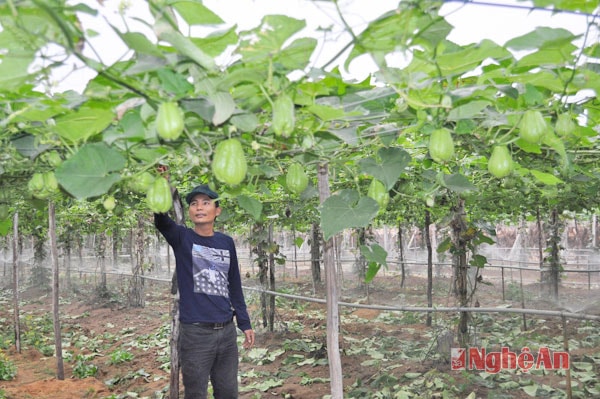 |
| The chayote garden of Mr. Ho Van Duoc in Quynh Lien commune (Quynh Luu district). |
This season, the family of Mr. Ho Van Duoc in Hamlet 6, Quynh Lien Commune, is cultivating 15 sao (approximately 1.5 hectares) of chayote on sandy coastal land. Despite the large area of cultivation, Mr. and Mrs. Duoc always appear relaxed, unlike the busy farmers of the past. Their family cultivates three main crops a year: chayote from August to March (lunar calendar) of the following year, watermelon in April and May, followed by radishes and other vegetables. They have invested nearly 100 million VND in planting the 15 sao of chayote. Mr. Duoc explained: "Chayote is very easy to grow, it's not susceptible to pests or diseases, and doesn't require pesticides. Just fertilizing and watering adequately is enough for the plants to thrive. In cold weather, we water twice a day, and in dry weather, we water all day." Three wells have been dug at the foot of the field, and a semi-automatic irrigation system covers each plant's base; all it takes is plugging in an electric device for the water to spray evenly.
Each harvest yields 60-70 tons of chayote for his family. Even at the average low price of 2,000 VND/kg, they earn over 120 million VND per harvest. In 2013, early-season flooding killed the plants, forcing the family to replant, resulting in lost seeds and delayed harvest, thus reducing income. The advantage of chayote is its readily available market; traders buy all the produce directly from the fields and distribute it to markets in Hanoi, Hue, and even export it to China. Besides chayote, Mr. Duoc's family also grows summer-autumn watermelons and radishes… On average, from producing various fruits and vegetables, Mr. Duoc earns over 300 million VND per year, with a net profit of 200 million VND after deducting expenses. Not content with his current situation, he hopes to acquire more land to expand production by another 20 acres, transforming it into a large-scale vegetable farm.
Next door is the 10-acre chayote garden of Mr. Le Van Nguyet's family in Hamlet 9, yielding over 40 tons of fruit annually. Mr. Nguyet shared: "In this sandy coastal area, almost every household likes to grow chayote because it's easy to cultivate, requires little care, and brings high income. Even in the worst years with the lowest prices, a 10-acre chayote garden yields a net profit of 60 million VND per crop; after harvesting chayote, we continue planting summer-autumn watermelons, yielding 15 tons each crop, selling for 6-7 million VND per ton; then we plant winter vegetables, earning 7-10 million VND per acre, totaling about 200 million VND per year. After deducting expenses, the net profit is about 140 million VND per year. We grow whatever is in season; my family, like all the households in the commune, maintains a closed-loop crop rotation system throughout the year, never letting the land rest." In rural areas where people relied solely on the land for their livelihood, dynamism and creativity in production have led to increasingly prosperous and wealthy lives for the people, thanks to the land.
In 2011, Quynh Lien began building a new rural area while still being on the list of particularly disadvantaged coastal communes in Quynh Luu district. Taking advantage of the local area's potential in commercial vegetable production, Quynh Lien planned over 100 hectares of concentrated, high-income vegetable production areas in all villages within the commune. This is how Quynh Lien escaped its status as a particularly disadvantaged coastal commune. Mr. Nguyen Van Thuyet, a land and agriculture official in Quynh Lien commune, stated: The entire commune has 302 hectares of agricultural land, but the annual crop rotation area reaches 1,060 hectares, with a rotation rate of 3.5 times, and the annual production value from crop cultivation exceeds 48 billion VND. Of this, over 70 hectares are planted with chayote. Most households only have two main laborers, but thanks to the application of a semi-automatic irrigation system at the field level, farmers have reduced labor, less care, and much less hardship than before.
Currently, the locality is implementing land consolidation and field rearrangement, striving to complete it in the first quarter of 2014. Some villages have completed land consolidation, with each household owning only 1-3 plots. This large, concentrated area allows farmers to invest in semi-automatic irrigation systems, intensive farming, and the application of scientific and technical advancements. This has led to a shift in crop structure, increasing production value by 30-35% compared to before, with total income per hectare reaching 159 million VND. More and more households are investing in high-income vegetable production models, promoting a competitive spirit of production and wealth creation in the locality. Economic development, job creation, and stable income for the people are solid foundations for the locality's new rural development.
Quynh Lan


