
Quynh Thang - The power of inner strength
(Baonghean)In the past, Quynh Thang (Quynh Luu) was a desolate, mountainous area with a harsh climate, making it difficult for anyone to settle there for long. Around the beginning of the 18th century, a group of Black Thai people migrated from Thanh Hoa province and from Quy Chau and Nghia Dan districts, establishing villages such as Da Bac, O O, Long Thuyen, Lang Moi, and O Ga. Later, more people from the lowlands came to establish farms and make a living. Between 1930 and 1945, the inhabitants and the land were incorporated into the names of two communes, Vu Duyet and Tam Le. On April 25, 1954, Quynh Thang commune was established by separating from Quynh Mai commune, and the name Quynh Thang has been used ever since.
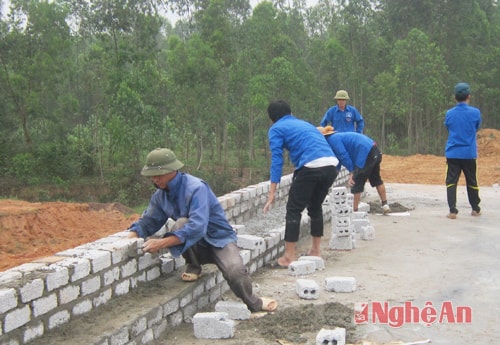 |
| Building new rural areas in Quynh Thang. |
In early 1956, the Party Branch of Quynh Thang commune held its first official congress. From those early years, the Party Committee of Quynh Thang commune set forth the policy of focusing on reclaiming land for food production, breaking the nomadic lifestyle, and coordinating with people from the lowlands to settle and learn about wet rice cultivation… In 1962, the 19/8 Farm in Quynh Thang was established with 103 Party members and volunteer youth union members participating to strengthen the core force for exploiting and developing this new economic zone. Following the success of the 19/8 Farm, the 19/5 Farm was also established shortly after in 1967, and the Ben Nghe Farm was officially established right on the land of Quynh Thang commune. These were the first cooperative economic models, serving as a spiritual support for people from the lowlands to settle here.
Responding to the policy of the Quynh Luu District Party Committee, from 1964 to 1966, people from the lowland communes of the district left their ancestral homes to settle in Quynh Thang, establishing villages and developing a new economy. During the war against the US, with its vast mountainous terrain, Quynh Thang became a refuge for soldiers and civilians from other communes. Many families voluntarily donated their houses and land for vehicles to pass through, creating secret hiding places for soldiers. Throughout the wars, Quynh Thang was home to 70 martyrs, 65 people who lost a part of their bodies on the battlefield, 30 war invalids, and 3 mothers who were awarded the title of Heroic Vietnamese Mother by the State.
During the years of reform, following Government Decree 40/ND-CP dated April 10, 2002, Quynh Thang commune was divided into two: Quynh Thang and Tan Thang. Previously, the commune had 34 hamlets; after the division, Quynh Thang now has 10 hamlets with nearly 3,000 inhabitants. In the early years after the division, despite difficult conditions, Quynh Thang always paid attention to and helped Tan Thang so that the new commune could develop socio-economically. To date, the average per capita income in Tan Thang has reached over 15 million VND, and the poverty rate, which was previously over 50%, has now decreased to only 19.2%. Healthcare and education have also received investment and have made significant progress. These initial results are thanks to the efforts of the Party Committee, government, and people of Tan Thang, including the assistance from Quynh Thang.
Quynh Thang commune has always identified agriculture as its key economic sector, focusing on developing farm and household-based economic models, expanding the area for planting raw materials such as sugarcane, pineapple, cassava, and forests. Currently, the commune has over 600 hectares of forest, with an annual production value of nearly 40 billion VND. The area for sugarcane, cassava, and agarwood cultivation has also been expanded. With 345 hectares of sugarcane, 120 hectares of pineapple, 190 hectares of cassava, and nearly 200 hectares of agarwood, Quynh Thang is truly a strong and highly potential raw material area in Quynh Luu district. The total livestock and poultry population in the commune has also continuously increased over the years. In 2013 alone, the total production value of the livestock sector reached over 62 billion VND.
Implementing the policy of land consolidation and reallocation, Quynh Thang is also one of the pioneering localities in Quynh Luu district. With the concentration of farmland, people have the opportunity to invest in developing models and boldly engage in large-scale business, bringing higher economic efficiency. The service sector is also a focus of the commune; there are two large markets in the area, Ngoc Thang Market and Dong Tam Market, which both ensure the supply of goods for the people and increase the local budget. In 2013, the value of the service sector in Quynh Thang was recorded at 51.6 billion VND.
From a wild, densely forested mountainous area with a sparse population, Quynh Thang has now achieved 100% tiled roofs, with inter-village and inter-hamlet roads widened from 3 to 6 meters, and many roads paved with asphalt and concrete. With the support of the State, the people of Quynh Thang have united and contributed their efforts to build spacious and well-maintained concrete roads – roads reflecting the will of the Party and the aspirations of the people, contributing to beautifying the appearance of their villages. 100% of households have access to the national power grid. Quynh Thang prioritizes investment in educational infrastructure at all three levels to better meet the teaching and learning needs of the area. In the last five years alone, the commune has invested over 14 billion VND in education, a significant effort for a mountainous commune facing many difficulties like Quynh Thang. As a result, the number of outstanding students at all levels and the rate of admission to universities and colleges have continuously increased. In the 2013-2014 school year, Quynh Thang commune will have its Kindergarten and Quynh Thang A Primary School recognized as meeting national standards. The commune's basic healthcare network basically meets the initial medical needs of the people. In addition to the commune's Health Station with 7 medical staff, 100% of villages have village nurses. In 2008, the Quynh Thang Commune Health Station was recognized as meeting healthcare standards for phase 1, and in 2014, Quynh Thang continued to receive the title of meeting standards for phase 2.
Upholding revolutionary traditions, Quynh Thang commune has always paid attention to educating the younger generation about these traditions and effectively carrying out the work of showing gratitude and appreciation. In 2013 alone, from donations and support from the people, the commune invested nearly 60 million VND to repair and upgrade houses for policy beneficiaries and to visit and present gifts to families who contributed to the revolution.
In Quynh Thang today, the days of crossing the Lai River by pontoon bridge, walking, or rowing boats, and teachers having to ride buffaloes across the river to get to class on time, are gone. Instead, the Ben Nghe Bridge has been built, sturdy and modern. Since the bridge was constructed, Quynh Thang in particular and Tan Thang in general have taken on a new appearance; the poverty rate in the commune has decreased to 12%... Looking back on 60 years of history, the Party Committee and people of Quynh Thang are always proud of their achievements. The baggage that the Party Committee and people of Quynh Thang carry into this new journey is the revolutionary tradition and the valuable lessons learned from the pioneering days of establishing settlements, which have resulted in the beautiful and prosperous Quynh Thang of today.
Ho Ngoc Quang


