
Going to the beach feels like coming home!
(Baonghean) - In Ngoc Van fishing village, Dien Ngoc commune, Dien Chau district, on an early autumn day, the sounds of laughter and conversation fill the air as the "children of the sea" prepare for a new trawling trip. On the clear blue waters of Van stream, the reflections of mangrove trees serve as a backdrop for the crew transporting goods from the dock to the boats, creating a truly beautiful scene of labor.
Ngo Tri Nguyen, the "small boss" of the largest twin trawling boats in Nghe An province at the moment (each with a capacity of 600 horsepower), was busy simultaneously instructing workers to unload ice into the harbor, monitoring the inspection of machinery and fishing gear, and discussing work with the sailors about understanding the situation before going out to sea. He was so busy because he was also the platoon leader of the Dien Ngoc commune's militia.
In 2008, after graduating and saying goodbye to his friends and teachers, Ngo Tri Nguyen did not choose to continue his studies at universities or colleges, but instead returned to work on land and at sea with his family and the sailors in Ngoc Van fishing village. Nguyen confided: "My family always needs manpower for fishing, so I convinced them to respect my decision to dedicate myself to the fishing profession."
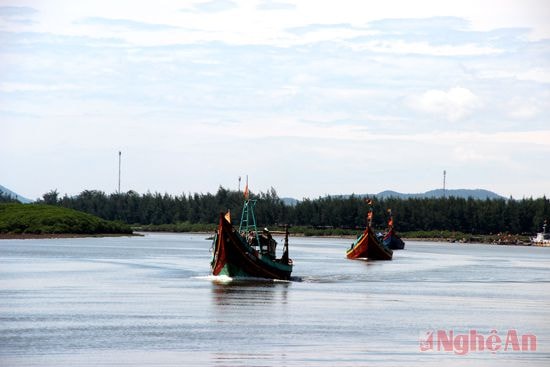 |
| The boat returns to Lach Van. |
At that time, Nguyen's family owned two boats (each with 165 horsepower) purchased from the Dien Ngoc Cooperative. Knowing their son's desire to make a living at sea, the family mobilized 1 billion VND to build two new boats with 600 horsepower each, creating the largest pair of trawling boats in Nghe An province. Nguyen explained that in Ngoc Van fishing village in particular, and Dien Chau in general, the traditional fishing industry is primarily focused on trawling, unlike in Quynh Luu where fishermen have a significant advantage in purse seine fishing.
With a pair of large trawling boats, the family's fishing expeditions are extended, allowing for longer trips at sea, lasting from 7 to 10 days each. Fishing grounds are also expanded; depending on fish schools and weather conditions, the Nguyên family's boats often reach the Quảng Bình fishing grounds when heading south. To the north, they usually fish in the Sầm Sơn area (Thanh Hóa). If venturing eastward, they expand their fishing grounds to the common fishing area at approximately 106.55 degrees East (about 120-130 nautical miles from their starting point on shore). The crew of the two trawling boats is stable at 16 people, earning between 5.5 and 6.5 million VND per month.
Nguyen's family has also expanded their ice-making facility, supplying ice to their own fishing boats and local fishing fleets. Currently, their facility produces approximately 450-500 large ice blocks (about 12-13 tons) daily, providing enough ice for about 30 fishing boats in the area. The facility employs four main workers and three assistants, operating 24/7.
In 2012, with the trust of the local authorities and the confidence of the local fishermen, Ngo Tri Nguyen was introduced and assigned the role of Platoon Leader of the Dien Ngoc Commune Self-Defense Militia. Since then, Ngo Tri Nguyen has not only participated in managing his family's double trawling fleet and logistical support for fishing, but also led a 28-person Self-Defense Militia Platoon, including 5 who were directly sailors and crew members on his family's trawling fleet. The Dien Ngoc Self-Defense Militia Platoon became a connecting point for fishermen's boats at sea, monitoring and reporting all situations and incidents to the mainland. They also participated in rescue operations, assisting fishermen with repairing fishing gear.
Nguyen confided that from mid-2014 to the present, since China illegally deployed the Haiyang 981 oil rig, many fishermen in Dien Ngoc and neighboring communes have been feeling anxious. The 28 members of the Dien Ngoc Self-Defense Militia Platoon have become pioneers in disseminating information and mobilizing fishermen to go out to sea, protect fishing grounds, and participate in defending the sovereignty of the nation's maritime territories. The Self-Defense Militia Platoon is equipped with a communication system that not only helps them stay informed about maritime security but also monitors fishing grounds and fish migration routes, thereby increasing fishing efficiency and stabilizing their income. For sailors, this income ranges from 5.5 to 6.5 million VND per month, and can be higher if they catch many large hauls that month. Therefore, the ability of these maritime self-defense militia members to connect, gather, and support fishermen is increasingly being enhanced.
We said goodbye to Ngoc Van fishing village as the sun was almost setting. The sight of the bobbing fishing boats busily preparing to set sail and the crisp sound of engines echoing across the water created a vibrant atmosphere. Before heading out to sea, Ngo Tri Nguyen and his crew greeted us with firm handshakes. “The sea is like our big home. Returning to the sea is like returning home. Every inch of the sea is precious, so we must preserve our profession and protect the sea!” – Ngo Tri Nguyen’s voice echoed through the waves, mingling with the hearty laughter of the crew on the ship as it began to leave the harbor, majestically departing from Van estuary and heading out to sea.
Kien - Nam


