
The excitement of Tet in the coastal countryside
(Baonghean) - As Tet (Lunar New Year) approaches, the weather is bitterly cold and the sea is rough, but every boat tries to go out to sea to catch as much seafood as possible. They choose the biggest and tastiest fish from their final catch of the trip for the year-end ceremony and New Year's Eve celebration. Even families without members who go to sea still order the biggest fish and shrimp, and even poor families will grill a few large fish to offer as a sacrifice. This has become a custom in coastal villages during the Tet preparations, a way to show respect to their ancestors and to pray for their blessings for a more prosperous new year.
(Baonghean) - As Tet (Lunar New Year) approaches, the weather is bitterly cold and the sea is rough, but every boat tries to go out to sea to catch as much seafood as possible. They choose the biggest and tastiest fish from their final catch of the trip for the year-end ceremony and New Year's Eve celebration. Even families without members who go to sea still order the biggest fish and shrimp, and even poor families will grill a few large fish to offer as a sacrifice. This has become a custom in coastal villages during the Tet preparations, a way to show respect to their ancestors and to pray for their blessings for a more prosperous new year.
Despite being busy all year round, especially during the period leading up to Tet (Lunar New Year), no matter how busy they are, at least on the 28th day of the lunar month, descendants of each family still gather at the family cemetery to perform the ancestral tomb cleaning ceremony and pay respects to their ancestors. This is an indispensable ritual, and everyone does it very conscientiously. Afterwards, they return home to prepare for the year-end ceremony and the New Year's Eve offering. The first task is preparing sticky rice cakes (banh chung) and making Tet jam. Then they clean and redecorate the altar and the house. The preparation of the cakes and jam is handled by the women, while the men take care of decorating the altar and the house. Although many places offer convenient services to make sticky rice cakes for Tet, in this coastal rural area, families still prefer to make their own sticky rice cakes to show their reverence to their ancestors.
I remember one year, because of work commitments and thinking it would ease the burden on my mother and sisters, my younger brother, who worked in the city, bought commercially made sticky rice cakes (bánh chưng), which upset my mother for several days during Tet. My mother gently but profoundly told us: "Sincere reverence for our ancestors cannot be bought, my children!" Besides making sticky rice cakes, people in my hometown also make other types of cakes such as tapioca cakes mixed with molasses, filled with mung beans and spices, ginger, wrapped in banana leaves and boiled like sticky rice cakes, called "honey cakes." There are also many kinds of jams: lotus jam, coconut jam, papaya jam, pumpkin jam, ginger jam… The atmosphere on the day of making sticky rice cakes and jams is truly lively and warm.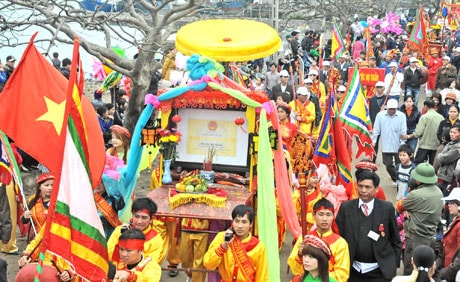
Fishing Festival. (Illustrative image)
In coastal rural areas, Tet (Vietnamese New Year) isn't about material possessions but primarily about exchanging greetings and good wishes. With the belief that "a greeting is more important than a feast," meeting and exchanging good wishes during Tet is highly valued. During Tet, brotherly love and community spirit are most clearly demonstrated. Everyone wants to spend time visiting and exchanging greetings, especially those who frequently go to sea for extended periods or return from distant places. If they can't visit all the villages in their family during Tet, they face reproach and feel guilty for the rest of the year.
From the 4th day of the lunar month, various groups organize spring festivals such as swing games, football, volleyball, wrestling, and card games. During this time, those reaching old age are celebrated by their families and communities in simple, economical, yet dignified ways. These spring festivals are beautiful cultural traditions, creating a warm and vibrant atmosphere of spring in the countryside, eagerly awaited by everyone from the elderly to the young. Unfortunately, in recent years, due to busy work schedules, some spring festivals like human chess, swing games, and card games have gradually disappeared. Many elderly people and children feel regretful, as if something significant is missing from the Tet holiday. My mother recounted that in the past, life was very difficult, but the spring festivals were truly joyful and lasted throughout the entire month of January. Back then, both my parents were chosen to be part of the village's human chess team (called "sitting chess"), and they felt very honored. Although my mother didn't say it explicitly, I understood that it was thanks to those spring festivals and chess games that my parents and many other couples found love and lived faithfully and devotedly for life.
In recent years, several spring festivals have been revived, especially the fishing prayer ceremony. After the New Year's pole is taken down, villages with a fishing tradition organize a fishing prayer ceremony. Previously, the ceremony took place at the shrine of the Whale God, but now that the shrine is dilapidated and many villages no longer have it, they have to hold the ceremony at the docks near the estuaries. The person presiding over the ceremony must be carefully selected, a person of high moral character and prestige, with a harmonious and complete family. The same applies to festivals at the village temples and communal houses at the beginning of the year. The offerings in the fishing prayer ceremony are quite elaborate, including the three sacrificial animals and, importantly, precious seafood. A particularly important item is a large bamboo boat covered with paper, almost the size of a real boat, on which the offerings are placed and then launched into the sea after the ceremony for the gods.
Mai Ho Minh


