
Vietnamese coriander can treat many diseases.
Vietnamese coriander, also known as water willow, has a distinctive aroma, a spicy and warming taste, and contains essential oils. It is a commonly used spice in cooking dishes such as eel porridge, fertilized duck eggs, and chicken salad.
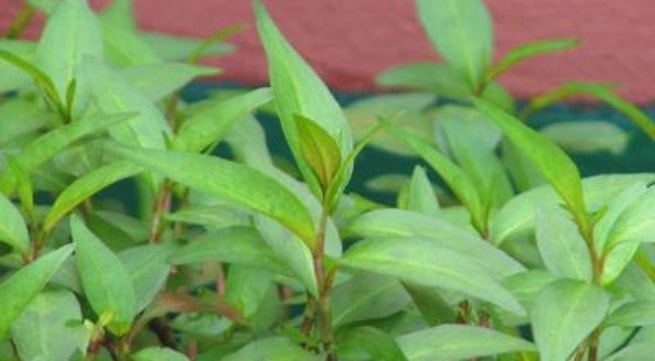 |
Vietnamese coriander, also known as water willow, has a distinctive aroma, a spicy and warming taste, and contains essential oils. It is a commonly used spice in cooking dishes such as eel porridge, fertilized duck eggs, and chicken salad. In Traditional Chinese Medicine, Vietnamese coriander is a medicinal herb with anti-inflammatory and carminative effects, stimulates digestion, dispels cold and dampness, and promotes blood circulation and detoxification.
Vietnamese coriander (Rau răm) is used both its leaves and stems, either alone or in combination with other herbs. It can be used fresh or dried, crushed raw to extract the juice for drinking, and the pulp applied topically. Dried coriander can also be brewed into a decoction for drinking. Vietnamese coriander is non-toxic. In folk medicine, it is used to treat the following ailments:
For bloating and sluggish digestion: take a handful of Vietnamese coriander, wash it thoroughly, crush it, and drink the juice. Use the remaining pulp to rub on the abdomen (focusing on the navel area).
For colds, sneezing, and runny nose: take a handful of Vietnamese coriander and 3 slices of fresh ginger. Crush both and squeeze out the juice to drink. Alternatively, take 20g of Vietnamese coriander, 20g of perilla leaves, 16g of mint, 16g of calamus, 10g of Ligusticum chuanxiong, 10g of Angelica dahurica, and 10g of Ligusticum chuanxiong. Boil these ingredients together and drink the decoction.
Treatment for snake bites: Crush a handful of Vietnamese coriander leaves, squeeze out the juice, and give it to the patient to drink. Apply the remaining pulp to the bite wound and bandage it (early application yields better results), then immediately take the patient to a medical facility.
For abdominal pain and diarrhea caused by cold exposure: 16g dried Vietnamese coriander, 12g Atractylodes macrocephala, 16g Mentha arvensis, 12g Zingiber officinale, 10g cinnamon, 4g roasted ginger. Add 2 bowls of water, decoct until only 1 bowl remains. Divide into 2 doses and drink during the day.
Athlete's foot: Crush Vietnamese coriander leaves and apply to the affected area. Alternatively, crush the leaves and extract the juice, then apply it to the affected area. Do this twice a day (keep the wound dry to prevent secondary infection).
For boils in the inflamed stage: take a handful of Vietnamese coriander (rau răm) and a few grains of salt. Crush both ingredients together and apply to the boil, then bandage. Change the dressing once a day. This method is suitable for all cases of boils and abscesses in the early stages. It has anti-inflammatory, blood-circulating, and detoxifying effects.
Vietnamese coriander has many practical applications in daily life. Therefore, every family should plant a small patch in their garden near a water source. This way, it will be readily available when needed.
According to Health and Life


