
Quynh Luong Green Vegetables
(Baonghean)Visiting Quynh Luong on a winter day, during the peak vegetable season, the fields stretched endlessly in a sea of green...
Making a fortune on sandy land
Vegetables, vast fields of vegetables, a breathtaking expanse of green. That's the first impression anyone gets when they come to Quynh Luong. I remember, about a decade ago, when I first came here, I was amazed by the sight of sprinklers simultaneously irrigating the vast fields of green vegetables. Professional agricultural production was rare back then and remains so even now.
1998 is considered a significant milestone when the government and people of Quynh Luong joined forces to simultaneously convert all areas previously used for growing crops to growing various types of vegetables. However, to determine when Quynh Luong vegetables first appeared, we must go back to the 1970s. At that time, Quynh Luong supplied seeds to all three provinces of Thanh Hoa, Nghe An, and Ha Tinh, offering a wide variety of vegetables, from kohlrabi and cabbage to tomatoes and beans.
Despite the lack of naturally fertile land, the entire coastal area of Quynh Luu district boasts lush green vegetable fields year-round. Explaining this, Mr. Ho Canh Sau, Chairman of the People's Committee of Quynh Luong commune, shared: "The fields here are mostly sandy soil, but thanks to the abundant water source from the ground, even during droughts, you only need to dig 2-4 meters to find clean water. This gives Quynh Luong the initial advantage in developing commercial vegetable production. However, to achieve the results we see today, it must be acknowledged that the human factor is the most important." In 1998, following the commune's thematic resolutions on structural transformation and economic development to increase income, a true "revolution" took place on over 240 hectares of land in Quynh Luong. People used tractors, even ox carts, to buy land from the communes of Quynh Lien, Quynh Bang, etc., replacing chemical fertilizers with organic fertilizers to improve soil quality. The commune also allocated budget to support the construction of an internal drainage system. Recalling those days, the commune chairman couldn't hide his pride: Before electricity, the people worked hard digging wells to irrigate their vegetables; on average, each worker carried about 200 buckets of water per day, equivalent to 7 tons!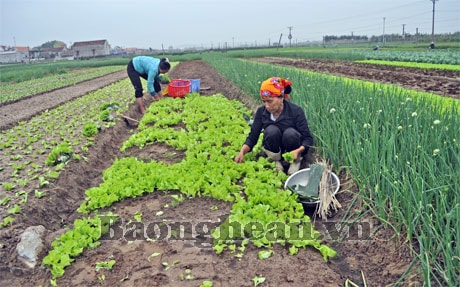
Vegetable crops have brought in hundreds of millions of dong in income each year for farmers in Quynh Luong.
Since 1994, the people of Quynh Luong have extended electricity to their fields, and by 2005-2006, when income from vegetables had become quite high and stable, the movement to build electricity systems for irrigation developed even more strongly. To date, the electricity network is basically complete across the vegetable fields, with approximately 4,000 wells, several thousand pumps, and about 700 generators owned by the people. During power outages, the sound of generators echoes across the fields, irrigating 180 hectares of vegetables. Thanks to this, even during the scorching summer days when the soil is dry and hot, the vegetable fields remain lush and green, and the yield of many varieties is even higher than in the autumn and winter seasons. Although vegetable growers work hard, sometimes having to water 4-5 times a day, and the care is more meticulous, they are compensated by fewer pests and diseases, and don't worry about fungal diseases or frost like in winter. Especially, the selling price is always very high because the vegetables are out of season.
Vegetables... online and in the supermarket
"Just click on the address"www.quynhluong.gov.vn"Customers throughout the country and around the world can rest assured when trading with a supply of clean, high-quality vegetables in large quantities." This is a proud and proven affirmation of the farmers of Quynh Luong commune, demonstrated over many years. Since 2000, implementing the land consolidation movement, the villagers have expanded their vegetable cultivation area to 100 hectares. That same year, Quynh Luong vegetable village proudly won first prize in the Green Productivity (SPE) competition of Nghe An province, and in 2003 continued to win the C Prize at the National Safe Vegetable Product Introduction Competition organized jointly by the Vietnam SPE Organization and the Asia SPE Organization. But what is most impressive is that, as early as 2002, when journalists like us hadn't even touched a computer and articles sent to the editorial office were still... handwritten, the farmers in this coastal commune boldly embraced information technology and promoted their products. And they even buy and sell vegetables they grow themselves... online.
Mr. Ho Canh Sau, Chairman of the People's Committee of Quynh Luong commune, shared: "In October 2003, Quynh Luong vegetables officially went online with its own website. To maximize the effectiveness of the information website, Quynh Luong assigned staff to manage the website to research and disseminate information to farmers about technical advancements in the use of pesticides, standard procedures in vegetable production, and to access customer orders so that people can implement production plans that match the needs of their customers. At the same time, they assigned agents to collect the produce."
Immediately after promoting their vegetables to the wider domestic market, Quỳnh Lương's vegetable sales increased significantly, from 10-15 tons/day to 60-70 tons/day. With online product promotion, more and more customers accessed, transacted, and placed orders, so the market was no longer limited to surrounding areas but quickly expanded from Hanoi, Ninh Binh, Thanh Hoa, to Quang Binh, Quang Tri, Hue, Da Nang, and even received invitations to participate in promoting the export of clean vegetables to the distant United States. Now in Quỳnh Lương, the honest farmers sell their goods via phone and the internet, doing business based on trust, with all payments made via bank transfer or in person without the need for the seller's presence.
In particular, from the very beginning of its focus on commodity production, Quynh Luong has paid great attention to the production of safe vegetables. The people are very aware that consumer trust is the most important factor ensuring their sustainable development. In 2010, after passing the rigorous and strict inspection of Metro - Thang Long supermarket regarding quality, appearance, and compliance with standards on pesticide residues, nitrates, etc., Quynh Luong vegetables officially gained a foothold in the Hanoi market. The commune signed a contract with the Metro supermarket system, allocating 10 hectares in Hamlet 3 for growing safe vegetables to supply the supermarket.
Although Metro supermarket currently only consumes about 200-300 tons of vegetables annually, out of a total production of 15-16 thousand tons per year in Quynh Luong, the local government and people remain determined to continue, both to demonstrate their capabilities and establish a brand, and to create a habit of producing clean products. In July 2010, Phu Luong Cooperative – the first cooperative in Quynh Luong to grow safe vegetables and also the first cooperative in the province to produce safe vegetables according to VietGAP standards – was established. People were guided to produce vegetables according to VietGAP standards, producing according to customer demand at different times. As a result, productivity, quality, food safety, and sales were ensured. By early 2011, the cooperative had signed another contract to supply vegetables to the BigC supermarket chain. Mr. Sau added: "In the near future, we will direct the establishment of two more cooperatives for the production and consumption of safe vegetables according to VietGAP standards, striving to make Quynh Luong a safe vegetable production area, meeting the increasingly high demands of the market."
Phu Huong


