
Vocational schools open wider doors after the national high school graduation exam.
(Baonghean) - At this time, universities are preparing for the first-choice admissions process. Simultaneously, colleges and vocational schools are also entering their enrollment season with many support policies for students before, during, and after graduation...
In this year's national high school graduation exam, Nghe An province has over 12,000 candidates (nearly 34%) in the local exam cluster who only registered to take the exam to obtain a graduation certificate. This rate in Nghe An is higher than the national average, and according to many teachers, this is a positive sign, showing a clear change in the awareness of parents and students in choosing schools and careers. In addition, thousands of other candidates, after receiving their exam results, are also considering vocational training, even though their scores are still sufficient to enter a mid-level university.
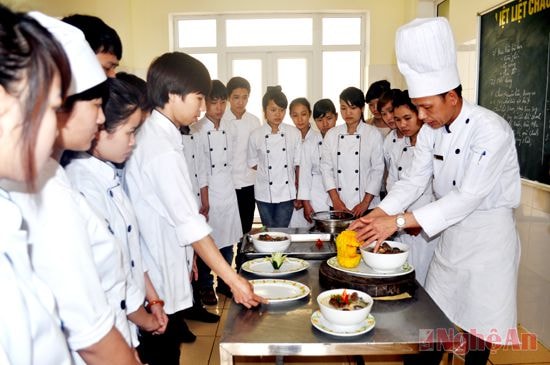 |
| Teaching cooking and food processing techniques to students at Nghe An Tourism and Trade Vocational College. |
In reality, while Nghe An has a large number of university and college graduates, the number of skilled workers is very low, reaching only 46%. Furthermore, Nghe An's labor structure is not aligned with the overall economic restructuring; skills, foreign language proficiency, work discipline, and industrial work ethics are not high enough, limiting competitiveness in both domestic and international labor markets. Currently, over 90% of graduates from vocational colleges and secondary schools find employment after graduation, with the majority being recruited directly by companies and businesses at the schools.
Mr. Duong Xuan Phuc, Deputy Head of the Information and Market Department at the Nghe An Employment Service Center, stated: Currently, many companies are desperately in need of skilled workers and offer numerous incentives for recent graduates. The employment center has many attractive job opportunities with high and stable salaries, but it's difficult to find qualified workers. The center has to compete with universities, and most graduates are hired immediately upon graduation.
With the goal of increasing the percentage of the province's workforce with vocational training to 61% by 2020, the province is prioritizing vocational training and implementing preferential policies for students in vocational schools, such as support for poor households, ethnic minorities, and people with disabilities, and applying policies to waive or reduce tuition fees. In addition, the province is increasing training quotas for vocational schools annually. For the 2015-2016 academic year alone, the province has allocated nearly 12,000 places for 15 colleges, secondary schools, and vocational schools throughout the province (an increase of nearly 2,000 places compared to 2014). At this time, vocational schools are beginning their enrollment season, and most schools are creating favorable conditions for students to register for vocational training.
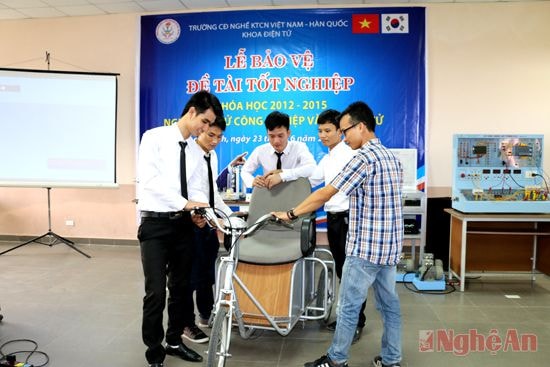 |
| Graduation thesis defense ceremony for students of the Electronics Department, Vietnam-Korea Industrial Technical Vocational College. |
At the Vietnam-Korea Industrial Technical College, this year the school has 850 enrollment slots for 10 vocational programs, of which 5 have received international vocational certification and 2 have received ASEAN certification. The registration process is very simple; students only need to have graduated from high school or equivalent, be in good health, and not have a history of social vices. The school implements many preferential policies for students, such as students with permanent residence in Nghe An province receiving a provincial subsidy of 5.7 million VND/year and a tuition fee of 3 million VND/year. Students from disadvantaged backgrounds: children of martyrs, war invalids, disabled people, poor households, etc., are exempt from tuition fees and receive preferential allowances as stipulated by the State. Students are eligible for scholarships when their academic and training results meet the required standards. Students from outside the province also receive tuition support of 3.5 million VND/year.
At the Vocational School for Small-Scale Handicrafts, to attract students, from the beginning of summer, the school has required all teachers to go to local areas to directly assess the aspirations and send application forms to parents and students. 100% of students graduating from the school are guaranteed job placement and stable income.
At Vinh University of Technology and Education, 40% of its total 1,800 university and college enrollment quotas are reserved for high school graduates or equivalents, based on their high school academic results in three subject combinations: Mathematics, Physics, Chemistry (Group A); or Mathematics, Physics, English (Group A1); or Literature, Mathematics, English (Group D1). In addition, the university has 800 quotas for vocational college programs across 17 fields, most of which offer internationally recognized, ASEAN, and national vocational certificates. The university does not hold entrance exams for these programs; admission is based solely on high school transcripts or the results of the national high school graduation exams. In other localities, vocational schools are currently investing in facilities and expanding their programs to attract a large number of students who are not applying to universities or colleges.
At the Nghe An Ethnic Boarding Vocational School, Principal Nguyen Thanh Binh stated that in the 2015-2016 school year, the school only had 265 enrollment slots, but currently has 397 applications. To attract students this academic year, the school has invested over 5 billion VND in purchasing additional equipment and facilities. We have also expanded our recruitment area, requiring teachers to visit each village to encourage students to pursue vocational training, and have prepared adequate boarding accommodation for students from distant areas free of charge. The vocational training programs are also closely aligned with the labor needs of the mountainous districts, such as animal husbandry and veterinary medicine, brocade weaving, motorcycle repair, and household electrical work.
From July 1st this year, the Vocational Education Law officially came into effect. According to Mr. Hoang Sy Tuyen, Deputy Head of the Vocational Training Department, Department of Labor, Invalids and Social Affairs: The Vocational Education Law has many new features aimed at facilitating students' participation in vocational training, such as allowing students to continue their education through articulation programs; college graduates being recognized as practical engineers or practical bachelors; tuition fee exemption for social policy beneficiaries; and boarding policies for ethnic minorities from poor and near-poor households, and people with disabilities… The Vocational Education Law is also creating new opportunities for vocational schools and vocational trainees, especially when ASEAN becomes a common community at the end of 2015, with ASEAN countries becoming a single labor market. The recognition of training qualifications will serve as a basis for labor mobility between countries in the region as well as with countries around the world and expand the job market for trainees...
To capitalize on this opportunity, Nghe An province has also developed a job creation plan and anticipates investing nearly 600 billion VND over the next five years (a large portion of which will be allocated to vocational training) to create jobs for more than 200,000 workers (1.5 times more than the previous period).
My Ha


